





Filter bags are essential components in modern liquid filtration systems. Whether used in food production, chemical processing, wastewater treatment, paint & coatings, fuel filtration, or industrial manufacturing, filter bags play a critical role in removing unwanted solids from liquids. Their function seems simple-allow liquid to pass through while holding back particles-but behind this simplicity lies a combination of material science, fluid dynamics, pore structure engineering, and precision manufacturing.
This comprehensive guide explains how a filter bag works, covering the filtration mechanism, flow dynamics, material performance, manufacturing techniques, operating conditions, maintenance, and application-specific considerations. By understanding these principles, users and industries can select the right filter bag for improved efficiency, longer service life, and lower operational cost.

What Is a Filter Bag?
A filter bag is a porous, engineered media used inside a filter housing to trap solid particles suspended in a liquid. Most filter bags are cylindrical and designed to fit securely within standard filter vessels. They come in various materials, micron ratings, sizes, and constructions to suit different industrial needs.
Typical components include:
● Filter media (PP, PE, Nylon, PTFE, etc.)
● Support layer (optional)
● Seam construction (sewn or welded)
● Ring top or snap-fit collar for sealing
● Multi-layer depth filtration media for high dirt holding
Filter bags allow high flow rates, large dirt-holding capacity, and quick replacement, making them far more convenient than traditional cartridge filters in many industries.
Common Shapes and Sizes
● Cylindrical, cone, and custom shapes exist for different housings.
● Sizes range from small lab-scale bags to large industrial vessels.
Material Selection Criteria
● Compatibility with fluid chemistry, temperature, and pressure.
● Mechanical strength to withstand flow and pressure variations.
Advantages Over Cartridge Filters
● Faster replacement and maintenance.
● Higher dirt-holding capacity.
● Lower operational downtime.


Common Shapes and Sizes
Filter bags are manufactured in a variety of shapes and sizes to accommodate different filtration housings and industrial requirements. While cylindrical bags are the most common, cone-shaped or oval designs are used in specialized systems where space constraints or flow dynamics demand non-standard geometries. The size of a filter bag can range from small laboratory-scale bags, designed for bench-top experiments or pilot plant testing, to large industrial-scale bags capable of handling thousands of liters per hour. Larger bags often incorporate reinforced collars or support rings to maintain structural integrity under high-pressure conditions. Understanding the dimensional specifications of a filter bag is crucial because improper sizing can lead to bypass, reduced efficiency, or premature failure. For industries such as food processing or chemical production, where precise filtration is critical, selecting the correct bag shape and size ensures that the entire cross-section of the liquid is exposed to the filter media without leakage or dead zones.
Material Selection Criteria
The choice of material for a filter bag is one of the most important factors affecting filtration efficiency, durability, and compatibility with the fluid being filtered. Materials such as polyester, polypropylene, nylon, and PTFE are commonly used, each offering unique chemical resistance, temperature tolerance, and mechanical strength. For instance, polyester is widely used in general industrial applications due to its chemical stability and cost-effectiveness, whereas PTFE is reserved for aggressive chemical environments or high-temperature applications. Material selection also affects the cleaning and reuse capabilities of the bag. Woven nylon or polyester bags can often withstand ultrasonic cleaning or backwashing, while nonwoven polypropylene and PTFE bags are typically single-use due to the risk of structural damage. Beyond chemical compatibility, factors such as mechanical abrasion, hydrostatic pressure, and UV exposure should also be considered, as these can degrade the media over time. Choosing the right material ultimately extends bag life, reduces operational costs, and ensures consistent filtration performance.
Advantages Over Cartridge Filters
Filter bags provide several operational advantages compared to traditional cartridge filters, particularly in large-scale industrial applications. Their higher dirt-holding capacity means that they require fewer replacements over time, which reduces maintenance downtime and labor costs. The simplicity of bag replacement also minimizes the risk of contamination during change-outs, which is critical in food, beverage, and pharmaceutical industries. Additionally, filter bags can handle high flow rates without significantly increasing pressure drop, making them suitable for processes with large volumes of liquid. Unlike rigid cartridges, bags conform more easily to irregular flow paths, ensuring more complete filtration and less bypass. Their flexibility allows customization, including multi-layer depth media for high dirt-holding capacity or pleated designs for increased surface area. In industries where downtime is costly or contamination must be avoided, filter bags provide a cost-effective, high-performance alternative that balances efficiency, longevity, and operational convenience.
How a Filter Bag Works: The Filtration Process
The working mechanism of a filter bag can be broken down into four stages:
● Contaminated liquid enters the filter housing
● Liquid flows from the inside of the bag through the media
● Particles are trapped on or within the filter media
● Clean liquid exits the housing
Filtration occurs through one of two main mechanisms: surface filtration or depth filtration.
Surface Filtration
Surface filtration uses materials with uniform, precise openings-often woven mesh-that trap particles on the surface layer.
Features:
● Precise, consistent pore size
● High flow rate
● Easy to clean and reuse
● Ideal for applications needing strict particle size control
Best for:
● Food oil
● Beer, wine, beverage clarification
● Paint and coatings
● Reusable filtration applications


Depth Filtration
Depth filtration uses thick, nonwoven media that trap particles throughout the internal fiber matrix.
Features:
● High dirt-holding capacity
● Suitable for high-viscosity fluids
● Less frequent replacement
● Handles a wide range of particle sizes
Best for:
● Wastewater treatment
● Chemicals and process fluids
● Oil and lubricants
● Industrial water filtration
Cleaning and Reusability
● Woven surface bags can be backwashed or ultrasonically cleaned.
● Reduces operational costs and environmental waste.
Particle Retention Mechanism
● Particles are captured primarily at the surface.
● Suitable for applications where large debris must be removed quickly.
Depth Filtration
Depth filtration uses thick, nonwoven media that trap particles throughout the internal fiber matrix.
Features:
● High dirt-holding capacity
● Suitable for high-viscosity fluids
● Less frequent replacement
● Handles a wide range of particle sizes
Best for:
● Wastewater treatment
● Chemicals and process fluids
● Oil and lubricants
● Industrial water filtration
Layered Media Design
● Multiple fiber layers increase dirt holding and efficiency.
● Ensures gradual particle capture and prevents clogging.
Application in Complex Fluids
● Effective for slurries, emulsions, and viscous liquids.
● Maintains flow even with high particle loads.
Stages of Filtration Process
The filtration process in a filter bag involves several carefully coordinated stages that ensure the removal of suspended solids while maintaining optimal flow. The first stage begins as contaminated liquid enters the filter housing, which acts as a containment system guiding the flow toward the bag. At this point, the liquid may contain various solid particles, from fine colloidal matter to larger debris, depending on the application. The second stage occurs when the liquid flows from the inside of the bag toward the filter media, initiating contact between the particles and the porous material. During this phase, surface tension, flow velocity, and media porosity interact to determine which particles are trapped immediately and which penetrate deeper. The third stage, particle capture, can occur at the surface or within the depth of the media depending on the bag design. This stage is critical because the retained particles contribute to the gradual buildup of a filtration cake, which can further enhance efficiency by capturing even smaller particles. Finally, the fourth stage involves the exit of clean liquid from the filter housing. Proper outlet design ensures minimal turbulence and prevents re-suspension of captured solids. Each stage must be optimized to balance flow rate, pressure drop, and dirt-holding capacity, ensuring consistent performance across various operating conditions.
Surface Filtration Mechanics
Surface filtration relies on a highly uniform media structure, often a woven mesh, which captures particles on the exterior layer of the bag. The precision of pore size is essential, as it dictates the particle size that can be retained. As liquid passes through, larger particles are immediately intercepted, while smaller particles may either adhere to the surface or be trapped in subsequent layers. The surface filtration method is particularly beneficial in applications where the goal is to remove particles of a specific size with minimal impact on flow rate. Another key advantage is the ease of cleaning, as surface debris can often be removed through backwashing or ultrasonic methods, allowing the bag to be reused multiple times. Applications such as food oils, beverage clarification, and certain paint systems require stringent particle size control, making surface filtration the preferred choice. Additionally, surface filtration provides predictable pressure drop behavior, which simplifies maintenance scheduling and ensures reliable operation in automated systems. Careful selection of material, weave type, and pore uniformity is essential to optimize the balance between filtration efficiency and flow capacity.
Depth Filtration Mechanics
Depth filtration differs fundamentally from surface filtration by utilizing a thick, nonwoven media that traps particles throughout its internal fiber matrix. This design enables the capture of a wide range of particle sizes and significantly increases dirt-holding capacity, which is particularly advantageous for fluids with high contamination levels. As contaminated liquid permeates the media, larger particles are intercepted in the upper layers, while smaller particles penetrate deeper and are gradually trapped within the fibers. This staged capture mechanism reduces the likelihood of sudden pressure spikes and prolongs the operational lifespan of the bag. Depth filtration is particularly suitable for industrial water treatment, chemical processing, oil and lubricant filtration, and wastewater management, where the variability of particle sizes and fluid viscosity presents significant challenges. The internal structure of depth media also allows better flow distribution, minimizing channeling and bypass, which can occur in poorly designed filtration systems. While depth filters are generally disposable, their high dirt-holding capacity reduces the frequency of replacements and maintenance, providing a cost-effective solution in high-volume or continuous operations. Proper engineering of fiber density, layer thickness, and media composition is essential to achieve maximum efficiency and longevity.
Key Factors That Determine Filtration Efficiency
Filtration efficiency depends on multiple interacting factors, including bag material, pore size, fluid properties, and operational parameters.
Filter Media Material
● Common materials include polyester, polypropylene, nylon, and PTFE.
● Polyester: Good chemical resistance, widely used in general filtration.
● Polypropylene: Excellent resistance to acids and bases, suitable for aggressive chemicals.
● Nylon: High mechanical strength, useful for fine particle retention.
● PTFE: Superior chemical and thermal resistance, used in high-temperature or highly corrosive environments.
Pore Size and Retention Rating
● Pore size determines the size of particles retained by the bag.
● Nominal Rating: Captures a defined percentage (usually 85–95%) of particles of a given size.
● Absolute Rating: Captures nearly 100% of particles at a specified size.
● Smaller pores increase filtration efficiency but reduce flow rate and may require more frequent cleaning.
Typical Pore Size vs. Application
| Pore Size (µm) | Typical Application | Retention Type |
|---|---|---|
| 1–5 | Fine chemicals, pharmaceuticals | Absolute |
| 10–25 | Food and beverage, water treatment | Nominal |
| 50–100 | Industrial dust, coarse debris | Nominal |
| 150–200 | Pre-filtration, bulk particulate | Nominal |
Flow Rate and Differential Pressure
● Higher flow rates increase differential pressure across the bag, potentially reducing efficiency and shortening lifespan.
● Monitoring pressure drop helps determine when the bag needs cleaning or replacement.
Filter Media Material
The choice of filter media material is one of the most critical factors influencing the performance, durability, and chemical compatibility of a filter bag. Common materials such as polyester, polypropylene, nylon, and PTFE each offer unique advantages tailored to specific applications. Polyester is widely used in general filtration due to its excellent chemical resistance and moderate cost. It is suitable for water, oil, and mild chemical solutions, and it offers a good balance between mechanical strength and flexibility. Polypropylene, on the other hand, is highly resistant to strong acids and bases, making it ideal for aggressive chemical environments where corrosion can rapidly degrade other materials. Nylon provides superior mechanical strength and abrasion resistance, which makes it highly effective for capturing fine particles and handling fluids with high solid content.
PTFE is the material of choice for high-temperature applications or highly corrosive liquids, offering exceptional thermal stability and chemical inertness, which ensures a long service life in challenging industrial conditions. Selecting the right material requires careful analysis of the fluid's chemical composition, pH, temperature, and flow characteristics. Additionally, material selection affects maintenance practices and reuse potential. Woven polyester and nylon bags can often be cleaned and reused, whereas PTFE and nonwoven polypropylene bags are usually single-use due to their structural fragility under cleaning procedures. Ultimately, understanding the interaction between filter media material and operating conditions is essential to achieve optimal filtration efficiency, reduce operational costs, and prevent contamination.
For a detailed breakdown of each filter bag material-including polyester, polypropylene, nylon, and PTFE-explore our technical guide below:
Filter Bag Materials Explained: How Polyester, Polypropylene, Nylon, and PTFE Affect Filtration Performance
Pore Size and Retention Rating
Pore size and retention rating are fundamental to a filter bag's ability to separate particles effectively from a liquid stream. The pore size determines the maximum particle size that can pass through the media, and it directly affects filtration efficiency and pressure drop. Filtration ratings are typically classified as nominal or absolute. A nominal rating indicates that the filter will capture a defined percentage-usually 85–95%-of particles at a specified size, whereas an absolute rating captures nearly 100% of particles of that size. Smaller pores generally increase filtration efficiency by capturing finer particles but come at the cost of higher pressure drop and potentially shorter bag lifespan due to faster clogging.
Larger pores allow higher flow rates and reduced pressure drop but may permit smaller contaminants to bypass the media. When selecting pore size, it is important to balance the requirements of particle removal with process flow needs. Industries such as pharmaceuticals, fine chemicals, and food and beverage often require absolute ratings to ensure product purity, while applications such as pre-filtration in water treatment may accept nominal ratings to optimize flow. Understanding the distribution of particle sizes in the fluid and the required retention level is crucial for making informed decisions regarding pore size and ensuring the overall efficiency of the filtration system.
To gain a deeper understanding of how micron ratings, flow velocity, and media structure interact to influence real-world performance, refer to our detailed guide:
Understanding Filtration Efficiency: How Micron Ratings and Flow Dynamics Shape Filter Bag Performance.
Types of Filter Bags
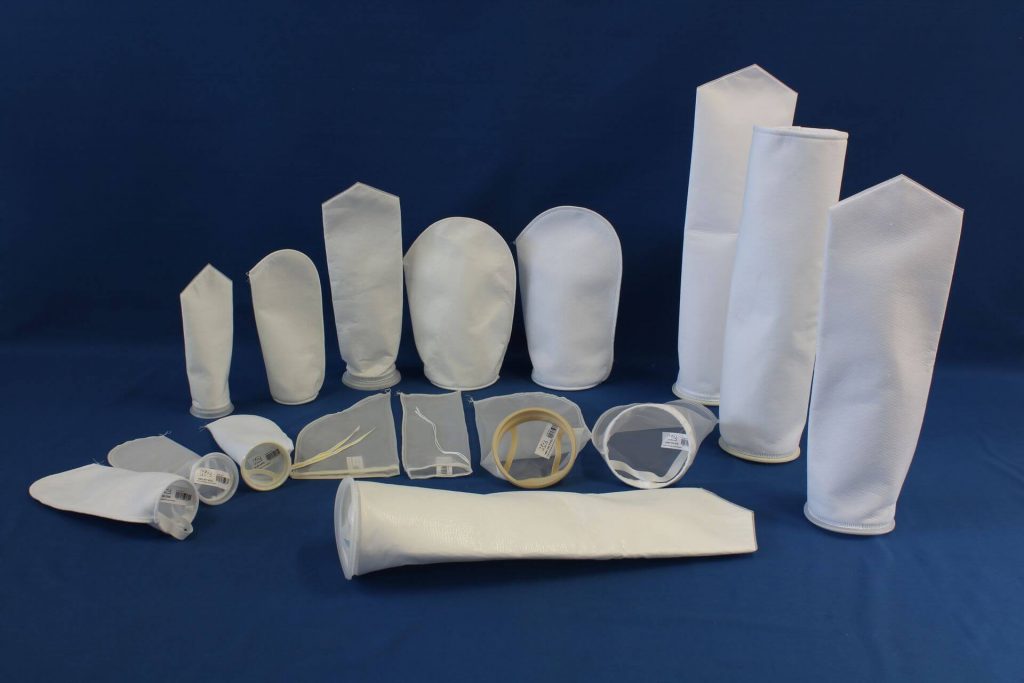
Filter bags are classified by material, structure, and application.
By Material
● Polyester, polypropylene, nylon, PTFE, and blends.
● Selection depends on chemical compatibility, temperature tolerance, and particle characteristics.
By Structure
● Woven: Offers high strength, reusable in some cases, ideal for coarse filtration.
● Non-Woven: Provides higher filtration efficiency for fine particles, commonly disposable.
● Pleated Bags: Increased surface area, lower differential pressure, longer service life.
By Application
● Liquid Filtration: Removes solids from water, chemicals, oils.
● Dust Collection: Traps airborne particulate, protects fans, ducts, and downstream equipment.
● High-Temperature Applications: PTFE or glass fiber bags withstand elevated temperatures.
Table: Bag Type vs. Application
| Bag Type | Typical Fluid/Particle | Advantages |
|---|---|---|
| Woven Polyester | Water, general chemicals | Durable, reusable |
| Non-Woven Nylon | Fine chemicals, food | High retention efficiency |
| PTFE | Hot gases, corrosive liquids | High temp & chemical resistance |
| Pleated | Water, chemicals, air | Large surface area, long service life |
Choosing the Right Bag
● Consider fluid properties, particle size, and replacement frequency.
● Proper selection prevents costly downtime.
H3: Reusable vs Disposable
● Woven bags can be cleaned and reused.
● Nonwoven and PTFE bags often single-use but offer higher efficiency.
Installation and Housing Considerations
Correct installation ensures proper filtration and prevents bypass.
Housing Compatibility
● Filter bags must fit snugly into the filter housing.
● Gasketed collars prevent leakage.
Orientation and Flow Direction
● Correct flow direction is essential; some bags filter outside-in, others inside-out.
● Misorientation reduces efficiency and increases wear.
Sealing and Pressure Ratings
Seams and collars must withstand process pressure.
Overpressure can rupture bags or allow unfiltered fluid to bypass.
Common Installation Mistakes
● Loose fittings, improper orientation, or damaged gaskets.
● Can cause contamination or rapid bag failure.
Pressure Rating Guidelines
● Select bags rated for maximum process pressure.
● Exceeding limits may cause catastrophic failure.
Maintenance Practices for Optimal Performance
Proper maintenance extends the life of filter bags and ensures consistent filtration.
Cleaning and Reuse
● Some woven bags can be backwashed or ultrasonically cleaned.
● Non-woven and PTFE bags are usually disposable.
Replacement Frequency
● Depends on fluid characteristics, particle load, and pressure drop monitoring.
● Premature replacement wastes material; late replacement risks contamination.
Handling and Storage
Store in dry, clean conditions to prevent contamination before use.
Avoid folding or compressing bags, which can damage the media.
Common Issues and Troubleshooting
Bypass or Leakage
● Causes: Improper fit, damaged seams, worn gaskets.
● Solution: Inspect and replace faulty components.
High Differential Pressure
● Causes: Clogged bag, high flow rate.
● Solution: Clean or replace bag; adjust flow.
Reduced Efficiency
● Causes: Incorrect bag material, oversized pore rating.
● Solution: Evaluate particle size and process conditions; select proper bag.
Conclusion
Filter bags remain a cornerstone of modern liquid filtration systems, providing industries with a versatile, cost-effective, and reliable method for removing suspended solids from a wide range of fluids. Their effectiveness stems from a combination of engineered media, carefully controlled pore structures, and precision manufacturing that together ensure consistent particle retention and fluid flow. Understanding the critical factors that influence filtration efficiency-such as media material, pore size, flow rate, differential pressure, and fluid properties-is essential for selecting the most suitable bag for any given application. By tailoring filter bag selection to specific industrial needs, companies can achieve higher operational efficiency, longer service life, and reduced maintenance costs. Furthermore, the ability to choose between surface and depth filtration mechanisms allows operators to optimize performance for both fine and coarse particle removal. Proper installation, regular monitoring, and maintenance further enhance the bag's performance, ensuring that the filtration system operates reliably under varying process conditions. Ultimately, filter bags represent an intersection of material science, fluid dynamics, and practical engineering, offering a balance of efficiency, flexibility, and durability that is difficult to achieve with alternative filtration methods.
Beyond their technical performance, filter bags contribute to overall operational sustainability and process safety. Their high dirt-holding capacity and ease of replacement or cleaning reduce waste and minimize the risk of contamination in critical processes such as food production, pharmaceuticals, and chemical manufacturing. Advances in material technology, including high-temperature polymers and chemically resistant media, have expanded their applicability to increasingly demanding environments. By selecting the right combination of bag type, material, and pore size, industries can not only maintain consistent product quality but also optimize energy usage and reduce environmental impact. The continuous monitoring of differential pressure and adherence to proper maintenance schedules further ensures long-term reliability. In conclusion, understanding and applying the principles of filter bag selection, operation, and maintenance is fundamental for maximizing filtration efficiency, extending bag life, and achieving cost-effective, high-quality outcomes across a diverse range of industrial applications.
You might also be interested in these articles:
Optimizing Filtration Performance with Mesh Density: Engineering Strategies, Materials, and Multi-Layer Design How Micron Rating and Mesh Count Affect Filtration Performance Manufacturing Processes, Design Principles, and Quality Control of Multi-Layer Sintered Stainless Steel Filter Mesh Performance Characteristics and Engineering Advantages of Multi-Layer Sintered Stainless Steel Filter Mesh