





Introduction
Multi-layer sintered stainless steel filter mesh is recognized as one of the most sophisticated and high-performance filtration materials used in modern industrial systems. Its exceptional performance-high mechanical strength, precise and stable filtration accuracy, corrosion resistance, thermal tolerance, and long service life-directly results from advanced manufacturing techniques and stringent quality control procedures.
Behind the finished product lies a highly engineered process involving raw material selection, multi-layer mesh arrangement, high-precision stacking, vacuum sintering, rolling calibration, cutting, welding, and inspection. Every step requires careful control because even minor deviations in pore structure, bonding quality, or material composition can lead to performance failure in critical applications such as petrochemical reactors, aerospace hydraulic lines, pharmaceutical dryers, and high-pressure gas filtration.
This sub-article explores the complete manufacturing workflow, design principles, key technical parameters, inspection standards, and quality control strategies needed to produce stable, reliable, and high-performance multi-layer sintered stainless steel filter mesh.
READ MORE:What Is Multi-Layer Sintered Stainless Steel Filter Mesh?
1. Raw Materials and Design Principles Behind Multi-Layer Sintered Mesh
1.1 Stainless Steel Grades Used for Sintered Mesh
The performance of sintered mesh depends heavily on the stainless steel grade used. Most suppliers offer multiple alloy types to meet industrial-specific requirements.
Common stainless steel grades:
|
Grade |
Characteristics |
Typical Applications |
|
304 |
Standard corrosion resistance; economical |
General filtration, water systems |
|
Superior corrosion resistance, low carbon, excellent chloride resistance |
Chemical processing, pharmaceuticals, marine environments |
|
|
310S |
High-temperature resistance (≤1100°C) |
Thermal oxidizers, hot gas filtration |
|
904L |
Ultra-high corrosion resistance, strong against acids |
Petrochemical reactors, sulfuric acid production |
|
Duplex 2205/2507 |
High strength, high chloride resistance |
Offshore, desalination |
|
Hastelloy, Monel, Inconel |
Extreme corrosion and heat resistance |
Aerospace, nuclear, extreme chemical compatibility |
316L is the most commonly used grade because it provides the best balance between corrosion resistance, weldability, filter cleanliness, and cost.
1.2 Functional Role of Each Layer in Multi-Layer Mesh
Multi-layer sintered mesh is intentionally designed so that each layer contributes a specific engineering function.
Typical 5-Layer Configuration:
|
Layer |
Role |
Design Reason |
|
Protective Layer (1st) |
Protects filter layer from abrasion |
Avoids pore clogging or deformation under flow |
|
Filter Layer (2nd) |
Defines micron rating |
Core functional layer, typically 5–40 μm |
|
Diffusion Layer (3rd) |
Supports filter layer and distributes stress |
Ensures pore uniformity and mechanical stability |
|
Support Layer (4th) |
Provides major structural strength |
Prevents collapse under pressure |
|
Reinforced Layer (5th) |
Adds rigidity for shaping/forming |
Ensures durability for cylinders, discs, tubes |
Each layer is selected based on:
Filtration precision requirements
Strength requirements
Flow rate targets
Expected contamination load
Cleaning method (backwashing, chemical washing, ultrasonic)
Different combinations result in elements optimized for precision filtration, gas diffusion, catalyst retention, or flow equalization.
1.3 Custom Layer Configurations
While the 5-layer mesh is the most common structure, specialized applications require custom configurations:
Examples:
1.3-layer mesh – Lightweight, suitable for general filtration
2.6–7 layer meshes – For high pressure or fine filtration (<2 μm)
3.Metal fiber + mesh composite – For ultra-precise particle retention
4.Perforated metal + multi-layer mesh – For increased mechanical strength
5.Dual filtration layers – For multi-stage contaminant separation
Each custom configuration demands careful engineering to balance permeability, strength, thermal resistance, and precise filtration accuracy.

2. Manufacturing Workflow of Multi-Layer Sintered Stainless Steel Mesh
Producing sintered mesh is a multi-step, precision-controlled process. Below is a full breakdown of all major production stages.
2.1 Step 1 - Raw Mesh Selection and Inspection
Before assembly, raw knitted or woven metal mesh is inspected for:
Wire diameter tolerance
Weave consistency
Surface defects
Cleanliness and oil removal
Material certificate compliance
Defective mesh cannot be used because impurities or wire distortion affect sintering results.
2.2 Step 2 - Precision Layer Stacking
Different mesh layers are placed together in a precise order on a flat assembly table.
Engineering requirements:
Layers must be perfectly aligned
No folding, wave formation, or wrinkles
Zero contamination between layers
Exact superposition at every location
Even small misalignments can reduce pore uniformity or bonding strength.
2.3 Step 3 - Vacuum Sintering (Core Process)
Sintering is performed in a high-temperature vacuum furnace or protective atmosphere furnace.
Typical conditions:
Temperature: 1100–1380°C, depending on alloy
Vacuum: 10⁻³–10⁻⁵ Pa
Heating rate: controlled to prevent thermal shock
Holding time: 60–180 minutes
Controlled cooling cycle
What happens during sintering?
Atomic diffusion occurs at the contact points between wires
Metal surfaces fuse, forming metallurgical bonds
Layers become a unified, solid metal plate
Pores stabilize in size and shape
Mechanical strength increases dramatically
The sintering process is responsible for:
Permanent pore stability
High compressive strength
Backwash capability
Long product lifespan

2.4 Step 4 - Rolling and Calibrating Thickness
After sintering, the mesh may have slight thickness irregularities.
A rolling mill presses the material to:
Achieve uniform thickness
Improve flatness
Enhance pore consistency
Optimize flow distribution
Rolling must be carefully controlled: too much pressure can distort pores.
2.5 Step 5 - Cutting and Shaping
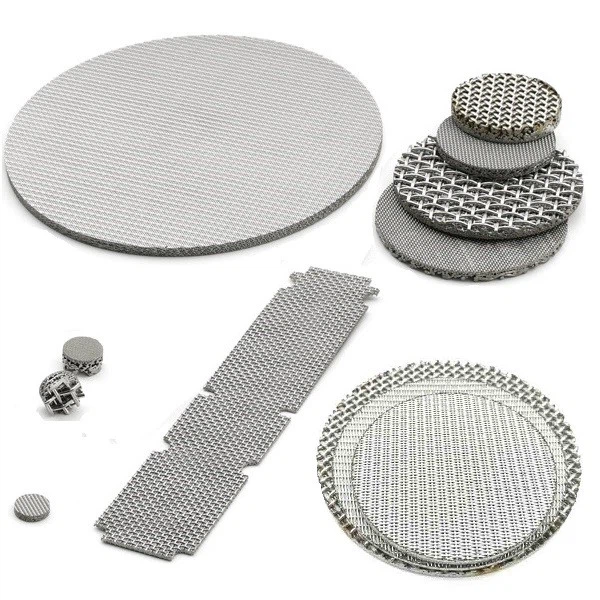
Depending on the final application, sintered mesh may be fabricated into:
Sheets
Discs
Cylinders
Cones
Filter cartridges
Customized geometries
Cutting methods include:
Laser cutting
Waterjet cutting
Wire EDM
Mechanical stamping
Each technique must avoid burr formation or heat damage.
2.6 Step 6 - Welding and Assembly
Sintered mesh components often require welding to form:
Filter tubes
Cartridges
Multi-layer housings
End-cap assemblies
Common welding techniques:
TIG welding (most common)
Laser welding (high precision)
Plasma welding (for thick sections)
Welds must ensure:
Gas-tight or liquid-tight sealing
No contamination
No distortion of pore structure

2.7 Step 7 - Cleaning, Degreasing, and Surface Treatment
Cleaning is essential to remove:
Oil
Sintering residue
Oxides
Dust and metal fines
Common cleaning methods:
Acid pickling
Alkaline washing
Electrolytic cleaning
Ultrasonic cleaning
Passivation (for enhanced corrosion resistance)
3. Quality Control and Inspection Standards
Quality control ensures each batch meets engineering performance requirements.
3.1 Dimensional Accuracy and Thickness Measurement
Key parameters:
Total sheet thickness
Thickness uniformity
Flatness
Tolerances for custom components
Precision instruments used:
Micrometers
Optical thickness sensors
Surface flatness test platforms
3.2 Pore Size and Filtration Accuracy Testing
Filtration accuracy is verified using:
Bubble point testing
Air permeability testing
Mercury porosimetry
Particle retention efficiency tests
These tests ensure:
Correct micron rating
Uniform pore distribution
No blockage or deformation
3.3 Mechanical Strength and Pressure Resistance Testing
Tests include:
Tensile strength
Compressive strength
Burst pressure
Bending resistance
Fatigue resistance
These metrics ensure durability in high-pressure environments.

3.4 Corrosion Resistance and Chemical Stability Testing
Corrosion testing includes:
Salt spray test
Acid/alkali immersion test
Chloride resistance test
High-temperature oxidation test
These confirm suitability for chemical and marine industries.
3.5 Welding Quality Inspection
Inspection methods:
Dye penetrant inspection (DPI)
X-ray or CT weld examination
Visual inspection
Leak testing
Welds must remain strong without compromising pore structure.
4. Engineering-Level Design Considerations
4.1 Choosing the Appropriate Micron Rating
Micron rating selection depends on:
Particle size distribution
Flow rate requirements
Acceptable pressure drop
Dirt-holding capacity expectations
Examples:
|
Application |
Required Micron Range |
|
Gas diffusion |
0.5–10 μm |
|
Hydraulic oil filtration |
10–25 μm |
|
Polymer melt filtration |
10–100 μm |
|
Catalyst retention |
10–40 μm |
|
Chemical purification |
2–20 μm |
4.2 Pressure & Flow Calculations
Key engineering factors:
Darcy permeability
Pressure drop coefficient
Reynolds number for flow through porous media
Engineers must account for:
Fluid viscosity
System pressure limits
Temperature-induced fluid behavior

4.3 Selection Based on Cleaning Method
The design must consider whether the filter will be cleaned by:
Backwash
Reverse flow
Ultrasonic cleaning
Chemical cleaning
Steam sterilization
For systems with frequent cleaning cycles, a reinforced structure is recommended.
4.4 Material Selection Based on Environment
Examples:
Acidic chemicals → 316L / 904L / Hastelloy
Chlorides → Duplex 2507
High temperatures → 310S / Inconel
Strong oxidizers → Monel / Hastelloy
4.5 Choosing Structural Shape
Different shapes serve different purposes:
|
Shape |
Engineering Purpose |
|
Cylindrical |
High dirt-holding capacity, easy backwashing |
|
Conical |
High flow concentration, pre-filtration |
|
Disc shape |
Static filtration, gas dispersion |
|
Multi-layer cartridge |
Deep filtration, high pressure |
5. Common Defects, Failure Modes, and Preventive Measures
Even high-quality sintered mesh can fail if improperly designed or manufactured.
5.1 Common Defects
|
Defect |
Cause |
Prevention |
|
Pore deformation |
Excessive sintering temperature |
Precise furnace control |
|
Layer separation |
Poor stacking/welding |
Improve assembly process |
|
Cracking |
Rapid cooling or mechanical stress |
Controlled furnace cooldown |
|
Contamination |
Dirty raw mesh |
Pre-wash and degreasing |
|
Weak bonding |
Insufficient diffusion |
Adjust sintering time/temperature |

5.2 Failure Modes in Practical Use
Typical failures:
Clogging from incompatible fluids
Corrosion from improper metal selection
Pressure collapse due to inadequate support layer
Weld leakage
Fatigue cracking from vibrations
5.3 Preventive Measures
Select correct alloy
Follow recommended flow limits
Use gradual pressure changes
Clean regularly
Avoid extreme temperature cycling
6. Application Examples Demonstrating the Role of Manufacturing Quality
6.1 Petrochemical Reactors
High-temperature (400–700°C) catalyst filtration requires:
Precise pore size
Pressure resistance
Chemical stability
Long service life
Multi-layer sintered mesh meets these requirements due to diffusion bonding and strong thermal resistance.
6.2 Polymer Melt Filtration
Challenges:
Sticky, high-viscosity fluids
High operating temperatures
Extreme pressure gradients
Sintered mesh provides:
Stable micron rating
Smooth surface for efficient cleaning
Long-term structural integrity
Excellent backwash characteristics
6.3 Aerospace Hydraulic Systems
Hydraulic oil systems demand:
Zero failure tolerance
Accurate micro-filtration
Resistance to vibration and shock
The manufacturing quality of sintered mesh ensures consistent performance under extreme conditions.

Conclusion
The performance of multi-layer sintered stainless steel filter mesh is inseparable from its specialized manufacturing processes, engineering-based design principles, and strict quality control measures. Every step-from alloy selection to layer stacking, vacuum sintering, rolling calibration, welding, and final inspection-must be executed with precision.
Because of these technical strengths, multi-layer sintered mesh has become a cornerstone material for industries that require:
High strength
Accurate and stable filtration
Long service life
Chemical and thermal resistance
Mechanical reliability
Cleanability and reusability
Together, the manufacturing workflow and engineering principles ensure that sintered mesh remains one of the most advanced, reliable, and high-performance filtration media available today.