






In critical B2B process industries-such as precious metal catalyst recovery, fine chemical synthesis, chlor-alkali brine polishing, and pharmaceutical intermediate purification-the primary metric of filtration success is absolute clarity. Plant managers cannot afford "acceptable" averages; a single instance of downstream particle bypass can ruin a multi-million dollar batch, poison a expensive catalyst bed, or cause severe downstream equipment fouling. Achieving consistent, sub-micron clarity requires an unyielding barrier that functions flawlessly under changing pressure cycles and heavy solids loading.
Unfortunately, many industrial plants suffer from mysterious turbidity spikes mid-way through a filtration batch. Even when using high-grade pre-coat materials like diatomaceous earth or cellulose, fine particles manage to bleed through into the clean filtrate tank. While operators frequently assume this is due to incorrect pre-coating or out-of-spec filter aids, the true culprit is typically found at the mechanical level: Micro-deformation of the filter leaf aperture matrix combined with bypass leakage around the frame borders.
When a filter leaf cannot maintain its dimensional integrity under pressure, it transforms from a high-precision clarification tool into an unreliable screen. To understand how overall manufacturing precision impacts this equation-including frame squareness tolerances, structural weld integrity, and raw material mill certifications-review our primary [Stainless Steel Filter Leaf] pillar page.
The Mechanics of Wire Shifting and Pore Distortion Under Pressure
To understand how fine particles bypass a filter, we must examine the microscopic forces acting on a filter leaf mesh during a standard batch run. As a filtration cycle progresses, solids accumulate on the outer skin, creating a dense filter cake. This cake acts as a flow restriction, causing the differential pressure across the leaf to rise steadily. This pressure is not a uniform force; it exerts localized mechanical loads across every square millimeter of the wire cloth.
In standard, budget-grade replacement filter leaves, the outer wire cloth is woven using conventional industrial methods and stretched over the backing grid with minimal tension. Under an operational load of 3.0 to 5.0 Bar, the individual warp and weft wires within the weave experience intense shear and tensile stresses.
If the wires are not mechanically locked into position, they will slide and shift at their intersection points. This micro-shifting causes individual pore apertures to widen and distort. A pore engineered to capture 10-micron particles can stretch into an oblong 18-micron opening under peak load.
As soon as these apertures deform, fine particles, catalyst shards, or carbon dust pass right through the leaf, causing a sudden rise in filtrate turbidity and forcing an early shutdown of the batch.
Technical Parameter Matrix: Precision-Aperture and Structural Stability
To secure zero-bypass performance and long-term clarity in demanding process lines, procurement and engineering teams must evaluate specific structural benchmarks. The following matrix highlights the critical parameters required to maintain tight pore geometries and complete bypass isolation under maximum operating loads:
| Engineering & Clarity Parameter | Standard Replacement Leaves | Our Engineered-Matrix Elements | Test / Verification Method |
| Initial Pass Filtrate Clarity | ~90% to 94% Efficiency | ≧ 99.8% Efficiency First Pass | Digital Turbidimeter (NTU Profiling) |
| Wire Interlock Stability | Low (Wires slide under friction) | High-Tension Mechanical Interlock | Optical Micro-Deformation Analysis |
| Max Allowable Mesh Deflection | ≧2.0mm under 4.5Bar |
≦0.3mm Fixed Sub-Matrix |
High-Precision Laser Profilometry |
| Frame Boundary Joinery | Spot-welded or mechanically crimped | Continuous 360° Robotic Hermetic Weld | Helium Mass Spectrometer Leak Test |
| Cake Release Topography | Rough, high-knuckle wire profile | Precision Calendered Planar Face | Surface Roughness Profilometer (Ra) |
| Slurry Channeling Resistance | Poor (Sagging creates paths) | Excellent (Rigid Flat Face) | Visual Cake Thickness Mapping |
| Traceability Standards | Generic batch tracking | Individual Serialized Leaf Audit | Positive Material Identification (PMI) |
The Dangerous Link Between Mesh Deflection and Cake Cracking
Aperture distortion is not the only risk associated with a flexible filter skin. When the outer wire cloth sags or deflects inward toward the drainage core under pressure, it alters the physical foundation supporting the filter cake.
Industrial filter cakes-especially those formed from dense chemical particulates, activated carbon, or crystalline salts-are highly rigid and brittle. They require an unyielding, perfectly flat surface to maintain their structural integrity.
When a standard filter leaf skin flexes or bows inward by 2 mm or more under load, the brittle filter cake cannot adapt to this changing curvature. As a result, the cake develops deep, microscopic cracks and fissures.
Once a crack forms, the process fluid takes the path of least resistance, rushing through the fracture. This eliminates the filtration benefit of the cake and exposes the raw mesh to high-velocity particle erosion.
This phenomenon, known as preferential channeling, causes immediate particle bypass and leads to uneven cake washing, poor cake dryness, and difficult cake release during discharge cycles.
To see how our warp-resistant, flat-surface matrix configurations eliminate this deflection risk, explore our detailed mechanical breakdowns on our dedicated [Warp-Resistant Flat-Surface Pressure Leaf Filter Elements] performance page.
Engineering the Perimeter: Continuous Hermetic Frame Joinery
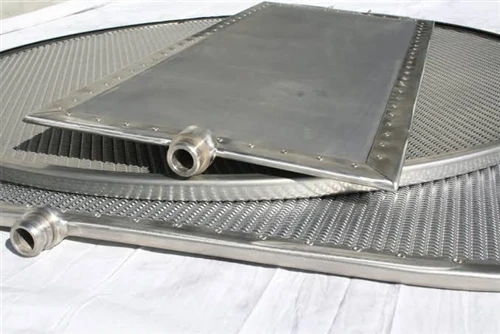
Even if the filtration mesh maintains perfect aperture stability, a filter leaf will still fail if the process liquid can bypass the mesh entirely at the outer frame boundary. In many budget filter leaf designs, the multi-layer mesh pack is simply inserted into a metal U-channel frame and secured using intermittent spot welds or mechanical crimping rivets.
This construction method leaves microscopic gaps between the spot welds or along the crimped edge. Under the influence of differential pressure, fine slurry particles bypass the active filtration face entirely, migrating through these edge gaps and entering the clean drainage core directly. This edge-bypass completely undermines your high-quality mesh selection.
Our precision engineered-matrix elements solve this vulnerability through complete edge isolation. The multi-layer mesh pack is inserted into a heavy-gauge, CNC-formed U-channel frame and secured using an automated, continuous 360-degree robotic weld.
This creates a seamless, hermetic seal around the entire perimeter of the leaf panel. This robotic seam ensures that every drop of process fluid is forced to pass through the precision-aperture filtration skin, providing absolute bypass isolation and guaranteeing consistent filtrate clarity.

Preventing Blind Spots with Calendered Reverse Dutch Weaves
For maximum clarity in fine polishing loops, our elements utilize high-density Reverse Plain Dutch Weave (RPDW) or Twilled Dutch Weave configurations. In these advanced weaves, the warp wires are tightly packed together, creating an intricate, tortuous path that catches fine particulates while maintaining excellent flow permeability.
To optimize this high-density matrix for industrial service, the woven mesh cloth undergoes a controlled calendering process. Precision thermo-mechanical rollers apply immense, uniform pressure to flatten the surface knuckles of the wire cloth.
This flattening creates a smooth, planar surface topography. Calendering locks the wire intersections together, preventing pore distortion under pressure, and eliminates the microscopic crevices where fine particles can wedge themselves.
By eliminating these micro-wedges, we prevent permanent pore blinding, lower your backwash pressure requirements, and ensure the filter cake slides off cleanly during pneumatic vibration or sluicing cycles.
Technical Audit Checklist for Plant Procurement Teams
To ensure your next batch of high-clarity replacement filter leaves delivers reliable, zero-bypass performance in critical filtration loops, verify these three essential manufacturing benchmarks:
● Continuous Boundary Seal: Ensure the procurement specification requires a continuous, full-penetration robotic weld around the frame perimeter, outlawing spot welding or mechanical crimping.
● Zero-Deflection Backing Grid: Confirm the internal drainage core uses a heavy-duty, pre-tensioned crimped wire matrix capable of limiting skin deflection to less than $0.3\text{ mm}$ under maximum pressure.
● Alloy Matrix Certification: Demand individual leaf Positive Material Identification (PMI) testing to ensure no inferior stainless steel grades are used in the active filtration or support layers.
Conclusion
Achieving flawless filtrate clarity is impossible when using standard replacement leaves built with loose meshes, flexible cores, and spot-welded frames. These structural weaknesses introduce internal flow bypassing and pore distortion, resulting in downstream contamination, shorter batch cycles, and expensive product re-filtration. Investing in precision engineered-matrix elements-where locked wire configurations, zero-deflection support layers, and 360-degree hermetically welded frames work together-safeguards your downstream processes, maximizes product purity, and keeps your production line running at peak efficiency.