





In continuous chemical, agricultural, and petrochemical production lines, the solid-liquid separation stage is the ultimate gatekeeper of product quality and throughput. At the heart of this stage sits the vertical or horizontal pressure leaf filter vessel-a robust piece of capital equipment engineered to process thousands of liters of slurry per hour. Yet, despite the massive investment in the vessel itself, the actual success of the entire filtration block relies completely on a series of thin, internal components: the replacement filter leaf elements.
Too often, procurement teams treat replacement filter leaves as simple, low-cost commodities, purchasing standard, off-the-shelf screens based solely on the lowest price per unit. This commodity mindset is an expensive operational trap. A generic filter leaf cannot adapt to the widely divergent physical and chemical environments found across different processing sectors.
Deploying a standard leaf across highly specialized chemical, agricultural, or petrochemical loops leads directly to chronic processing issues: rapid pressure spikes, downstream particulate bleed-through, premature frame warping, and frequent shutdowns for acid washing or manual screen scraping.
To see the baseline engineering tolerances and structural standards that form the foundation of premium manufacturing before customization even begins, reference our primary [Stainless Steel Filter Leaf].

The Pitfalls of Commodity Buying: One Size Fails All
When a generic filter leaf element is placed into a demanding industrial loop, its structural compromises are quickly exposed by the forces of fluid dynamics and chemistry.
For example, a standard leaf engineered for low-pressure water clarification will fail rapidly if dropped into a high-density edible oil winterization loop or a chemical catalyst recovery block. The underlying structural layouts are fundamentally incompatible with these specialized process stresses.
● In Edible Oil Bleaching Loops: The primary challenge is handling heavy solids loading and ensuring rapid, uniform cake discharge during pneumatic vibration cycles. Generic leaves built with thin, loosely crimped frames bend out-of-square under the weight of the heavy clay cake, causing the leaves to stick inside the vessel guides and rip at the nozzle junctions.
● In High-Temperature Chemical Loops: Processing fluids like molten sulfur requires excellent thermal stability. Generic elements feature compressed internal backing meshes that trap heat unevenly, creating localized cold spots where the process fluid freezes and crystallizes inside the core, blinding the element permanently from within.
● In Precision Catalyst Recovery: The absolute priority is preventing micron-level particle bypass. Budget screens feature unstable wire grids that flex and slide under pressure, stretching individual pore apertures and allowing expensive catalyst fines to escape into the clean filtrate line.
Sector-Specific Configuration Matrix: Tailoring the Tool to the Task
Achieving an optimized, low-downtime filtration cycle requires cross-referencing your exact industrial application against specific mechanical, structural, and metallurgical variables. The technical matrix below outlines the custom configuration archetypes designed to solve the distinct failure modes found within major processing sectors:
| Operational Variable | Edible Oil Refinery (Bleaching/Winterization) | High-Temp Chemical (e.g., Molten Sulfur Loops) | Precision Fine Chemical (Catalyst / Brine Polishing) |
| Primary Failure Mode | Frame binding / Slow cake release | Internal crystallization & warping | Fine particle bypass / Mesh blinding |
| Custom Layer Setup | 5-Layer Structurally Rigid Matrix | 3-Layer Heavy-Duty Thermal Core | 5-Layer or 7-Layer Engineered Matrix |
| Active Mesh Selection | 24x110 or 30x150 Plain Dutch Weave | 24x110 Standard Heavy Weave | High-Density Reverse Plain Dutch (RPDW) |
| Surface Topography | Calendered Planar Knuckle Profile | Un-calendered High-Tension Skin | Double-Calendered Micro-Polished Skin |
| Drainage Core Design | 3x3 Crimped Wire Grid (1.6mm) | Ultra-Open High-Conductivity Grid | Precision-Spaced Rigid Sub-Matrix |
| Joinery & Edge Style | Continuous Reinforced U-Frame | Thermally Vented Expansion Frame | 360° Robotic Hermetic Laser Weld |
| Metallurgical Alloy | SS 316L (Food Grade Certified) | 904L / Alloy 20 / Hastelloy C276 | SS 316L / Hastelloy C22 / Titanium |
| Target Micron Purity | 15μm - 25μm (Nominal) | 35μm - 50μm (Absolute) | 1μm - 5μm (Absolute Zero-Bypass) |
Configuring for Edible Oils: Maximizing Vibration Efficiency & Cake Release
In edible oil processing plants-whether refining soybean, palm, sunflower, or corn oils-the filter leaves face a grueling cycle of heavy bleaching earth accumulation followed by sudden, violent pneumatic vibration to dump the cake. If the replacement leaf element is not custom-configured to handle these repetitive mechanical shocks, the frame will deform, the mesh will sag, and the bleaching clay will stick to the knuckles of the wire cloth.
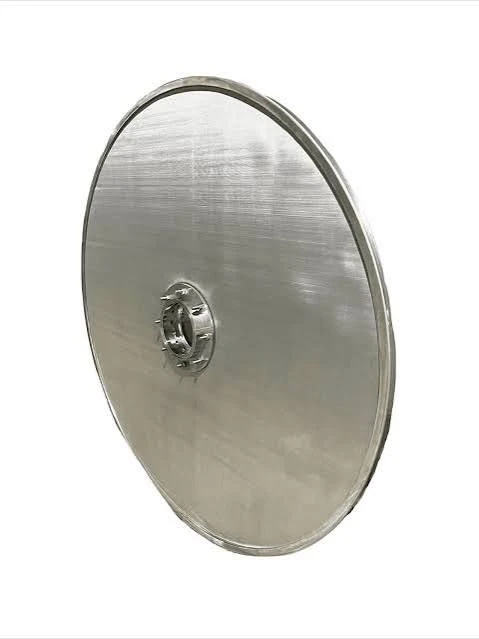
To maximize filtration flux and ensure clean cake release in these loops, our custom edible oil leaves are built with a heavy-duty, hydraulically pre-tensioned 5-Layer Structural Matrix. The outer 24x110 or 30x150 Plain Dutch Weave skin undergoes precision calendering to flatten the wire knuckles, creating a low-friction surface that allows the heavy oil cake to slide off effortlessly during the dry-discharge cycle.
Furthermore, to eliminate the chronic problem of leaves bending and getting stuck inside the tank guides, our frames are held to a strict diagonal squareness tolerance of $\le 2.0\text{ mm}$. This rigidity ensures that 100% of the pneumatic vibrator's energy is transferred directly down the leaf panel, dropping the cake instantly and eliminating the need for operators to open the hot vessel and manually scrape the screens.
To review how this structural stability prevents mesh blinding over long-term operations, explore our dedicated maintenance analysis on [Why Is Your Stainless Steel Filter Leaf Mesh Blinding So Fast?].

Configuring for Molten Sulfur: Defeating Thermal Shock & Internal Freezing
Molten sulfur filtration in sulfuric acid and gas-sweetening plants represents one of the harshest thermal environments in modern process engineering. The sulfur must be kept within a strict temperature window of 135°C to 145°C. If the temperature drops below this threshold, the sulfur's viscosity spikes exponentially before solidifying into a rock-hard crystalline mass.
Customizing for this severe service requires prioritizing thermal conductivity and expansion management. Generic filter leaves utilize thin, unvented U-channel frames that warp severely under thermal shock, tearing the filtration mesh away from the borders.
Our custom molten sulfur elements feature specialized, heavy-gauge stainless U-channels machined with integrated fluid relief slots at the base of the neck, combined with an ultra-open, high-conductivity crimped drainage core.
This design ensures that the high heat from your vessel's steam jacket is distributed evenly across the entire face of the leaf, eliminating localized cold spots. The high-velocity fluid flow path allows the hot filtrate to exit the core rapidly before it can lose heat, completely preventing internal crystallization and eliminating the need for expensive thermal burnout cycles.
To explore the precise fluid dynamic formulas and drainage core behaviors under high-viscosity thermal loads, visit our deep-dive analysis page on [Warp-Resistant Flat-Surface Pressure Leaf Filter Elements].
Configuring for Catalyst Recovery: Achieving Zero-Bypass Sub-Micron Clarity
For plants operating precious metal catalyst loops (such as palladium, platinum, or raney nickel slurry reactors) or fine chlor-alkali brine polishing blocks, the absolute priority is the complete interception of ultra-fine sub-micron particulates. In these applications, the fluid viscosity is typically low, but the mechanical pump pressures are kept high to force maximum liquid volume through tight pore spaces.
Under these high differential pressures , standard wire meshes fail because the individual wires slide and shift, stretching the pore openings and allowing expensive catalyst fines to leak into the clean filtrate line.
Our custom engineered-matrix elements for catalyst recovery feature an advanced Reverse Plain Dutch Weave (RPDW) skin hydraulically bonded to a zero-deflection sub-matrix. This layout restricts screen deflection to 0.3mm even under a maximum pressure load of 6.5 Bar.
The edge frame is completely isolated using a continuous, automated 360-degree robotic hermetic weld, which entirely eliminates the edge-bypass leakage common in budget spot-welded or crimped designs. Every single drop of process fluid is forced through an immutable, locked aperture matrix, ensuring an initial pass filtrate clarity of up to 99.8%.
Conclusion
Procuring replacement filter leaves based purely on a standardized part number and the lowest commodity price is a guaranteed recipe for shortened batch cycles, high maintenance costs, and premature equipment failure. Industrial filtration loops are highly individual environments that demand custom mechanical, thermodynamic, and metallurgical hardware. By moving away from generic screens and partnering with application engineers who custom-configure every layer, mesh weave, frame tolerance, and alloy selection around your specific process parameters, your plant can permanently eliminate hydraulic restrictions, maximize asset lifespans, and secure the lowest possible Total Cost of Ownership (TCO).