





In high-capacity chemical plants, edible oil refineries, hydrometallurgical leaching circuits, and large-scale industrial wastewater facilities, industrial pressure leaf filters are indispensable for liquid-solid separation. While vertical pressure leaf filters excel in compact footprints, Horizontal Pressure Leaf Filters are chosen when processing operations require massive total filtration areas, thick dry cake accumulation, and rapid bundle retraction for inspection.
Operating inside large horizontal pressure vessels, Horizontal Leaf Filter Elements are arranged sequentially along a central outlet manifold or bottom collection shaft. During operation, slurry is pumped into the vessel under pressures up to $5.0 - 6.0\text{ bar}$. As clear filtrate passes through the outer mesh screens and internal drainage cores, heavy filter cakes build up on both faces of each element.
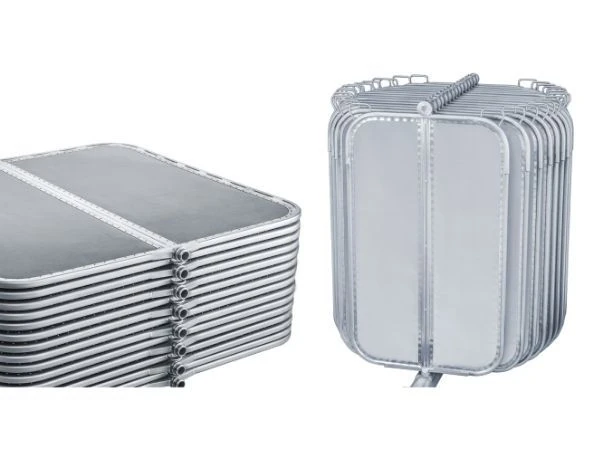
The horizontal vessel configuration presents unique mechanical challenges. Because elements carry exceptionally thick filter cakes-often exceeding $30\text{mm} - 50\text{mm}$ in thickness-the structural frames and central mounting hubs must support immense wet weights without sagging, twisting, or bowing.
This technical article provides an in-depth engineering analysis of horizontal leaf filter elements, examining structural frame mechanics under heavy cake loads, central manifold hub fluidics, pneumatic vibration cake release, and maintenance protocols for horizontal filter bundles.
To explore foundational metallurgy, weave structures, and primary filtration mechanics across our complete product family, visit our core [Stainless Steel Filter Leaf].
Large-Volume Cake Accommodation and Structural Frame Engineering
In horizontal pressure leaf filters, the space between adjacent leaf elements is optimized to accommodate maximum cake volume per cycle. As filtration progresses, the weight of the accumulated cake creates severe gravitational and hydraulic bending forces on each leaf panel.
Preventing Structural Sagging and Panel Bowing
Heavy Cold-Formed C-Channel Rim: The outer frame of each element is fabricated from thick, cold-formed stainless steel C-channels ($1.5\text{mm} - 2.5\text{mm}$ thickness). This heavy profile provides exceptional section modulus ($S_x$), preventing axial bending or frame twisting under multi-ton cake loads.
Internal Structural Stay Bars: Large rectangular or circular panels ($>1500\text{mm}$ span) incorporate internal solid tie rods or heavy wire grid supports that bridge opposing mesh faces. This prevents outer mesh bulging during high differential pressure spikes ($\Delta P > 4.0\text{ bar}$).
Planar Mesh Tensioning: Outer filtration screens are pneumatically tensioned before welding. A tight, perfectly flat screen face prevents mesh sagging, ensuring an even pre-coat layer and uniform cake deposition across the entire surface.
Multi-Layer Drainage Core Architecture and High-Flow Fluidics
Maximizing filtrate throughput in large-capacity horizontal vessels requires an internal drainage path that handles high fluid velocities with minimal internal resistance.
The 5-Layer High-Flow Mesh Stack
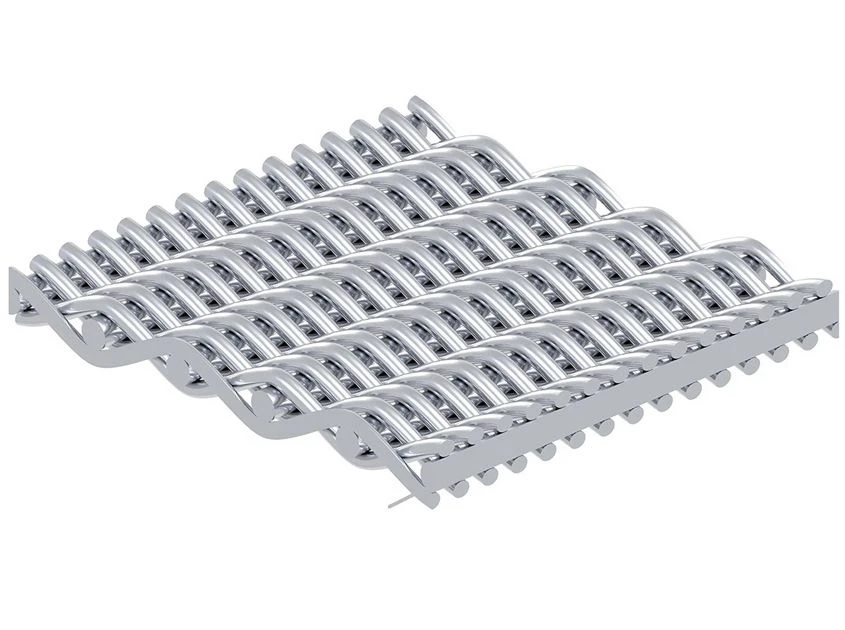
Active Outer Filtration Cloth: Heavy-gauge Plain Dutch Weave (PDW) or Twill Dutch Weave (TDW) wire cloth (15μm - 150μm) acts as the active filtration barrier, providing high mechanical strength and sharp particle retention.
Intermediate Support Mesh: Positioned beneath the outer screens, fine square woven mesh layers prevent the active filter cloth from pressing into the coarse central grid under high differential pressure, preserving open lateral drainage paths.
Central Heavy Support Grid: The innermost core consists of a heavy $4\text{ mesh}$ or $6\text{ mesh}$ square wire matrix ($1.8\text{mm} - 2.5\text{mm}$ wire diameter). This core creates wide, uninhibited internal drainage channels that guide clean liquid directly toward the central manifold hub.
Central Hub Fluidics and Manifold Sealing Integrity
Unlike bottom-spigot vertical leaves, horizontal filter elements frequently connect to a central rotating or stationary discharge shaft using specialized central hubs. Leakage at this connection point allows raw slurry to contaminate clean filtrate lines.
| Component / Feature | Standard Leaf Replacement | Our Engineered Horizontal Element |
| Hub Construction | Light stamped plate / Cast aluminum | CNC Solid Bar Stock Machining (SS316L/Alloy) |
| Sealing Interface | Single flat gasket | Precision Machined O-Ring Recesses / Quad-Rings |
| Manifold Lock Mechanism | Friction fit / Light clamp | Heavy-Duty Tie-Rod / Keyway Alignment Notch |
| Flow Capacity | Narrow internal discharge ports | Expanded High-Velocity Internal Flow Ports |
Vibratory Cake Release and Retractable Bundle Maintenance
Horizontal pressure leaf filters are designed for efficient cake discharge, utilizing either dry pneumatic vibration or wet sluicing.
● Pneumatic Vibratory Cake Discharge: For dry cake recovery, steam or compressed air dries the cake layer. Top-mounted or shaft-mounted pneumatic vibrators apply high-frequency impact force to the element bundle. The rigid chassis transfers vibration energy directly to the flat, tensioned outer screens, causing the dry, brittle cake to drop instantly into the bottom discharge chute.
● Retractable Bundle Accessibility: A key advantage of horizontal vessels is the ability to retract the entire leaf bundle on external rails. Maintenance personnel can easily inspect individual elements, replace worn hub O-rings, or wash down blinded panels without removing the leaves from the vessel manifold shaft.
Operational Best Practices and Maintenance Protocols
To ensure optimal performance and long service life from horizontal leaf filter arrays, plant operators should implement the following maintenance routines:
Pre-Coat Thickness Inspection: Always maintain a uniform $2.0\text{mm} - 3.0\text{mm}$ diatomaceous earth or perlite pre-coat layer. Uneven pre-coating leads to localized cake blinding and asymmetrical hydraulic forces that can bend leaf frames.
Hub Seal Overhauls During Turnarounds: Inspect central hub O-rings and alignment keys during every scheduled maintenance shutdown. Replace heat-hardened or chemical-damaged O-rings to maintain absolute manifold sealing.
Periodic Ultrasonic or Chemical CIP: Scale buildup or sticky organic residues should be removed using targeted chemical Clean-In-Place (CIP) circulation or ultrasonic bath immersion to restore full hydraulic permeability to blinded outer Dutch weave screens.
Conclusion
Horizontal Leaf Filter Elements engineered with heavy-gauge anti-buckling C-channel frames, high-flow 5-layer drainage matrices, and precision CNC-machined central hubs deliver the structural strength, high throughput, and cake accommodation required in demanding horizontal pressure leaf filter systems. Investing in robust replacement elements eliminates panel bowing, prevents slurry bypass, and guarantees rapid, complete cake discharge.
To review general vertical pressure leaf designs and bottom spigot fluidics, read our technical article on [Vertical Leaf Filter Elements: Bottom-Discharge Fluidics, Vessel Manifold Sealing, and Array Alignment Stability], or contact our technical team for custom horizontal leaf replacement CAD drawings and consultations.
Related Articles
1. Full-Stack Retrofit Engineering and Hydraulic Balancing in Pressure Filter Leaf
2. Metallurgical Selection and Corrosion Mechanisms in Chemical Pressure Leaf Filtration
3. Mechanical Stress Mitigation and Frame Architecture in Pressure Filter Leaves
4. High-Precision Wire Mesh Filter Discs for Industrial Extrusion and Liquid Processing
5. The Advanced Guide to Dutch Weave Stainless Steel Mesh Filter Leaf Elements