





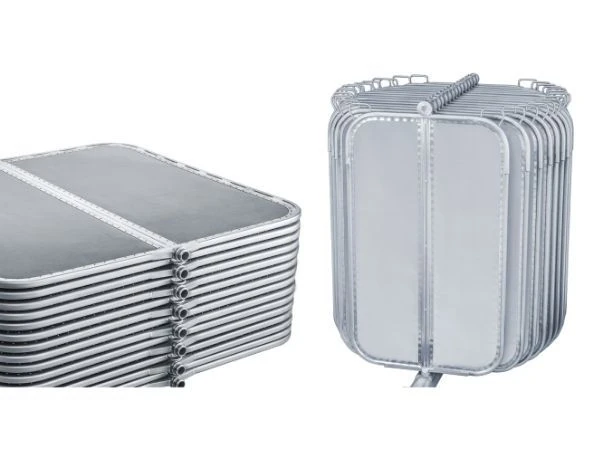
Vertical pressure leaf filters are widely deployed across edible oil refining, sulfur processing, chemical synthesis, and mining hydrometallurgy due to their compact footprint and efficient dry-cake discharge capability. Operating inside a vertical pressure vessel, these systems rely on a bank of parallel Vertical Leaf Filter Elements connected to a bottom filtrate manifold.
Because raw slurry fills the vessel and forms filter cake simultaneously on both sides of each vertical panel, structural stability, non-sagging mesh tension, and leak-free bottom manifold connections are critical to operational success.
This technical article presents an engineering breakdown of vertical leaf filter element performance, focusing on bottom spigot fluidics, double O-ring manifold sealing, vertical array alignment, and vibratory cake release mechanics.
To explore foundational metallurgy, weave structures, and primary filtration mechanics across our complete product family, visit our core [Stainless Steel Filter Leaf] .
Bottom Spigot Fluidics and Manifold Sealing Engineering
In vertical pressure leaf systems, the clean filtrate collected inside the multi-layer core drains downward under gravity and pressure differential toward the bottom discharge nozzle.
Eliminating Slurry Bypass at the Manifold Interface
The interface between the leaf bottom spigot and the vessel manifold represents the single most critical seal point in the entire vessel assembly:
● CNC Solid-Bar Machining: Rather than using thin stamped tubing or cast fittings, spigots are CNC-machined from solid stainless bar stock. This guarantees exact roundness and surface finish tolerances ($Ra < 0.8μm).
● Double O-Ring Redundancy: Machined dual O-ring grooves house resilient elastomeric or fluoroelastomer rings (e.g., Viton, EPDM, Kalrez). This double-seal configuration provides redundant protection against raw slurry ingress into the clean filtrate manifold.
● Low-Pressure-Drop Internal Radius: The internal bore of the spigot features a smooth, radiused inlet transition to minimize fluid turbulence and hydraulic head loss as filtrate enters the manifold.
Vertical Array Alignment and Structural Sway Control
Inside a vertical pressure vessel, multiple leaf elements stand side by side with narrow clearances (typically 75mm to 100mm center-to-center). Maintaining strict vertical alignment across the entire array is essential to prevent adjacent leaves from touching under heavy cake build-up.
Mechanics of Array Stability
● Top Alignment Guide Pins: Integrated top pins engage into the vessel's upper guide rack, preventing lateral swaying during slurry filling and cake blowing.
● High Section Modulus C-Channel Frame: Outer roll-formed C-channels resist bending forces caused by unequal cake buildup on opposing sides of the panel.
● Planar Tautness: Mechanically tensioned outer wire screens prevent "pillow-ing" under pressure, ensuring cake thickness remains uniform across the entire surface area.
Comparative Performance Analysis: Spigot Sealing and Frame Design
Understanding how different spigot and frame construction options impact operational uptime allows plant engineers to optimize their filtration equipment:
| Design Feature | Light-Duty Stamped Spigot | Precision Machined Double-Seal Spigot | Operational Advantage |
| Sealing Reliability | Single-gasket compression (Leak-prone) | CNC Double O-ring seating | Guarantees zero slurry bypass into clean filtrate |
| Spigot Machining Tolerance | Loose ($\pm 0.5\text{mm}$) | Precision ($\pm 0.02\text{mm}$) | Eliminates wobble and improper manifold seating |
| Frame Torsional Rigidity | Spot-welded light strip | Continuous TIG-welded heavy C-channel | Prevents leaf racking and cake bridging between leaves |
| Vibration Energy Transfer | Dampened by frame flex | Direct kinetic energy conduction | Complete, rapid cake release during dry discharge |
Pneumatic Vibration Dynamics and Cake Detachment Mechanics
Dry cake discharge in vertical leaf filters is driven by top-mounted pneumatic vibrators that deliver high-frequency impact cycles down through the leaf frame once the vessel is drained.
Optimizing Kinetic Energy Conduction
For sticky or heavy cakes (such as spent bleaching earth or sulfur residues), efficient energy transfer is required to shear the cake from the wire mesh face:
Monolithic Weld Geometry: Continuous TIG welding between the frame, core, and spigot unifies the panel into a single rigid structure, transmitting vibratory waves directly across the fine filter screen.
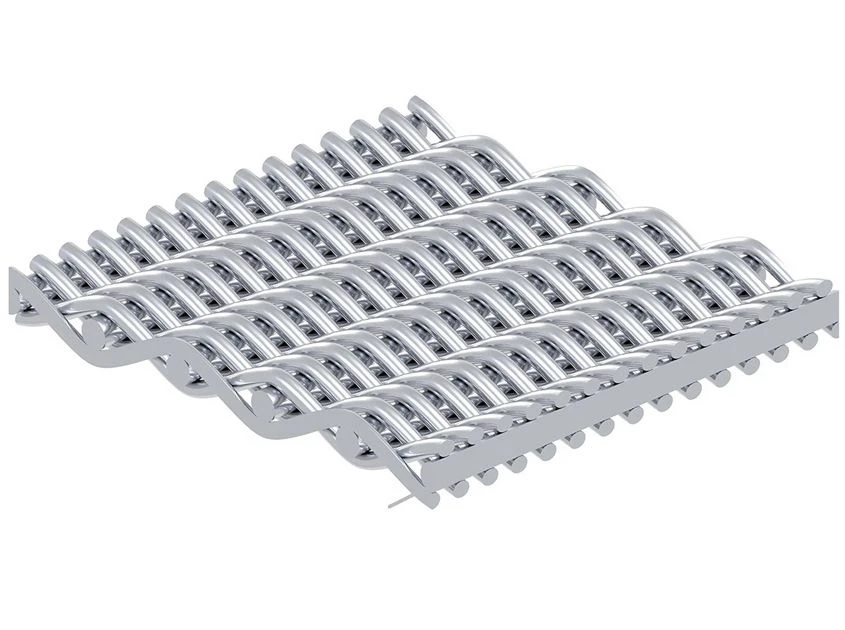
Calendered Mesh Synergy: Coupling rigid frame energy transfer with calendered Dutch weave outer screens lowers the coefficient of friction, allowing thick cake layers to drop cleanly into the vessel bottom cone within seconds.
Inspection Protocols and Manifold Maintenance Strategies
To maintain long-term reliability and prevent unexpected filtrate contamination during batch production, routine maintenance protocols should be established:
Spigot Seal Surface Inspection: During routine turnaround, spigot sealing surfaces should be cleaned and inspected for scratching or pitting that could compromise O-ring seating.
Manifold Alignment Checks: Using dummy alignment leaves to verify bottom manifold socket positioning ensures that replacement leaves seat vertically without force-induced stress on the bottom spigots.
Hydrostatic Bypass Testing: Re-meshed vertical leaves should undergo low-pressure air/water submerged testing to confirm complete perimeter seal integrity prior to vessel installation.
Conclusion
Vertical leaf filter elements engineered with CNC-machined double-seal spigots, heavy C-channel frames, and precision alignment guides ensure complete clarity, prevent slurry bypass, and accelerate dry cake discharge in demanding vertical vessel operations. Upgrading to high-integrity element architecture optimizes process cycles and extends component service life.
To explore wire mesh screen replacements and surface calendering options, review our technical article on [Leaf Filter Screens: Weave Mechanics, Surface Calendering, and Particle Retention Optimization], or consult our application engineers for custom vessel retrofitting.
Related Articles
2. The Advanced Guide to Dutch Weave Stainless Steel Mesh Filter Leaf Elements
3. How to Specify, Size, and Order Stainless Steel Pressure Leaf Elements
4. The Engineering Behind Precision-Aperture Stability and Zero-Bypass Filter Leaf Construction