






Edible oil filtration and palm oil filtration are typical applications of pressure leaf filtration in oil refining. Filter leaves need to retain bleaching clay, wax crystals, catalysts, gums, and solid impurities while maintaining flow rate, pressure differential, and clear liquid quality. The right solution should start with the oil type, process stage, particles, viscosity, temperature, pre-coating method, and cleaning conditions - not with picking a generic mesh count first.
How Pressure Leaf Filtration Works in Edible Oil Refining
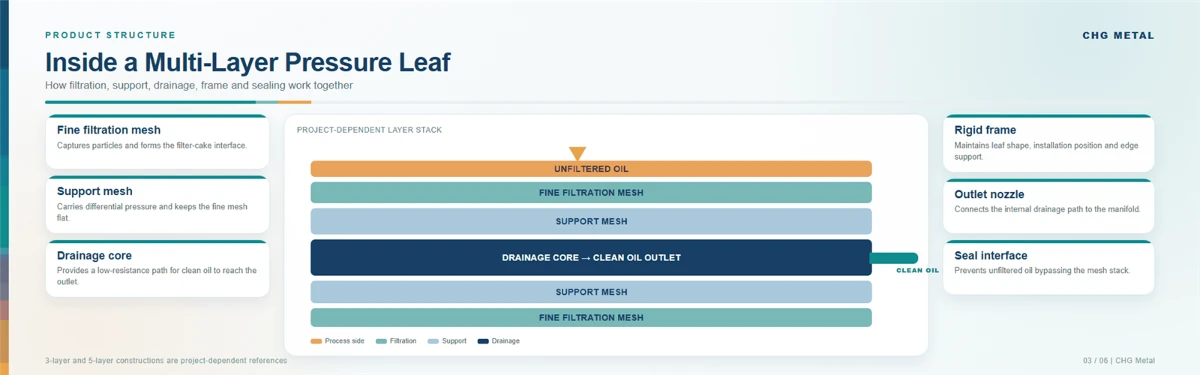
Edible oil refining typically includes degumming, neutralization, bleaching, deodorization, and dewaxing/winterization. Pressure leaf filtration is mostly used for bleaching clay separation after bleaching, catalyst removal after hydrogenation, wax crystal filtration, and finished oil polishing. After the solids-laden oil enters the pressure vessel, the clear liquid passes through the filter leaf mesh and drainage core, while solids form a filter cake on the mesh surface. Once the cake reaches a certain thickness, it is discharged through vibration, sluice, or re-slurrying.
Precoat filtration is commonly used to improve clear liquid clarity, protect the fine mesh, and help with cake release. The precoat medium, dosage, and circulation method should be determined through testing or plant experience - not just from a generic formula.
For industry background on oil refining and processing scope, you can refer to AOCS Edible Oil Processing.
Palm Oil Filtration: Bleaching, Dewaxing, and Catalyst Removal
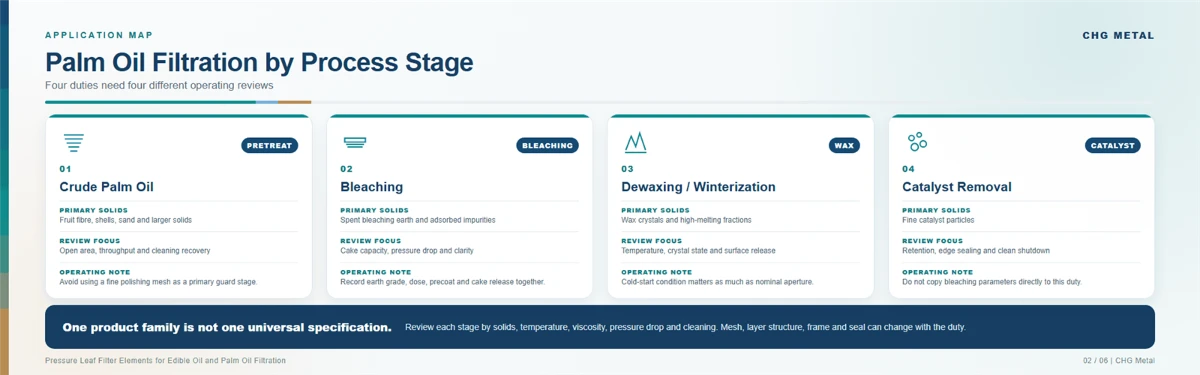
Crude palm oil filtration may involve raw oil impurity removal, bleaching clay removal, winterization/dewaxing, and hydrogenation catalyst filtration. Since the solids properties, viscosity, and temperature differ at each process stage, the filter leaf's mesh count, layer count, frame, and sealing need to be confirmed separately.
Palm oil bleaching filtration commonly uses clay to adsorb pigments and impurities. During filtration, attention needs to be paid to clay loading, cake thickness, and clear liquid turbidity. Wax crystals and catalyst particles may be finer, so the filtration medium should be selected based on particle distribution, target clarity, and allowable pressure differential.
For the effects of palm oil degumming and bleaching on pigments, metals, and oxidation products, you can refer to MPOB JOPR's research on palm oil degumming and bleaching.
How to Select Filter Leaf Mesh and Materials for Oil Filtration
In an oil filtration system, filter leaf mesh should be selected based on the target particles, allowable pressure differential, oil viscosity, temperature, pre-coating method, and cleaning method. A finer mesh isn't always better: if flow is insufficient or pressure differential rises too quickly, the mesh type, layer count, support layers, and drainage core need to be re-evaluated. Plain Dutch Weave or Twill Dutch Weave can be considered for the filtration surface, while support layers and the drainage core ensure structural stability and flow.
Material selection covers the frame, mesh, drainage core, nozzle, fasteners, and seals. SS304/304L, SS316/316L, 904L, and special alloys can be evaluated based on the oil, temperature, cleaning chemicals, and equipment requirements. Material selection can't just look at the mesh - it must cover all contact parts of the entire filter leaf.
For food contact and hygienic design, you can refer to 3-A Sanitary Standards and the EHEDG Guideline Catalogue.
Cleaning, Pre-Coating, and Maintenance of Filter Leaves in Vegetable Oil Plants
The maintenance focus of vegetable oil filtration is on stable pre-coating, pressure differential control, maintaining cake release, and inspecting filter leaf boundaries. The precoat medium, dosage, and circulation method should be determined based on the oil, particles, equipment, and plant experience; without test-based evidence, don't specify a fixed formula or fixed filtration cycle.
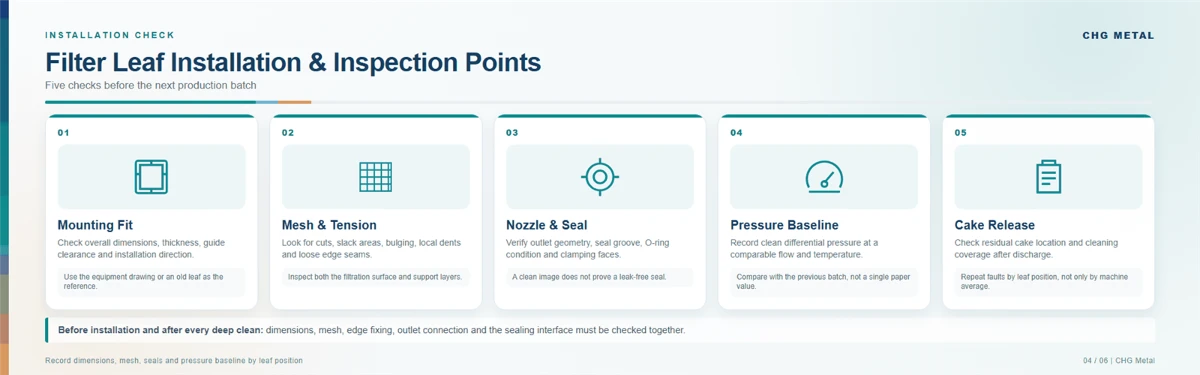
At each shutdown, inspect the mesh, edges, frame, nozzle, O-rings, and pressure differential records. If cake adhesion, cloudy clear liquid, rising pressure differential, or installation difficulties occur, first check the seal, mesh, pre-coating, and drainage core - rather than directly replacing the entire filter leaf.
FAQ
Q: Which edible oil process stages is pressure leaf filtration suitable for?
A: It's commonly used for bleaching clay filtration, hydrogenation catalyst removal, dewaxing/winterization, crude oil impurity removal, and finished oil polishing. The specific stage should be confirmed based on the oil, particles, and process conditions.
Q: Is pre-coating always required for edible oil filtration?
A: Not necessarily. Whether to pre-coat depends on the clarity target, particle characteristics, mesh count, and the need to protect the fine mesh - and should be determined through testing or plant experience.
Q: How do I choose a filter leaf for edible oil?
A: Select the mesh type, layer count, material, and frame based on the oil, viscosity, temperature, particles, flow rate, pressure differential, pre-coating, and cleaning method.
Q: What's the difference between palm oil filtration and regular vegetable oil filtration?
A: Palm oil stages may involve higher clay loading, wax crystals, or catalyst particles, and the temperature and viscosity may also differ - these need to be confirmed separately.
Q: Can filter leaves still be used after cleaning?
A: The mesh, edges, frame, nozzle, and seals need to be inspected. Only when the structure and dimensions still meet requirements is it suitable for re-meshing or continued use.
Q: What information is needed for a quotation?
A: Please provide the oil type, process stage, flow rate, temperature, viscosity, particles, clay/catalyst loading, pressure, pressure differential, pre-coating method, equipment connections, and quantity.
Q: Request a Selection Review for Edible Oil / Palm Oil Filter Leaves
A: Send CHG Metal the oil type, refining stage, flow rate, temperature, viscosity, particles, clay or catalyst loading, equipment drawings, and existing filter leaf information. Our team can help determine the mesh, layer count, material, and mounting solution for a filter leaf for edible oil or filter leaf for palm oil, and provide a quotation.