





Table of Contents
1.Introduction
2.Definition and Principle
3.Materials and Construction
4.Manufacturing Process
5.Key Properties and Performance Characteristics
6.Comparison with Other Filter Media
7.Applications Across Industries
8.Design Considerations for Multi-Layer Mesh
9.Advantages and Trade-offs
10.Failure Modes and Maintenance
11.Selection Guidelines
12.Case Studies and Examples
13.Future Trends and Innovations
14.Conclusion
1. Introduction
In modern industrial filtration, the demand for highly reliable, durable, and precise filter media has grown rapidly. One advanced solution is multi-layer sintered stainless steel filter mesh - a material that combines the mechanical robustness of metal with the fine pore control of engineered mesh. According to Hengko, multi-layer sintered stainless steel mesh overcomes many weaknesses of conventional metal mesh, such as low rigidity, unstable shape, and limited strength.
This article delves deeply into what multi-layer sintered stainless steel mesh is, how it's made, why it's advantageous, and where it's used - giving you a holistic understanding of this advanced filter material.
2. Definition and Principle
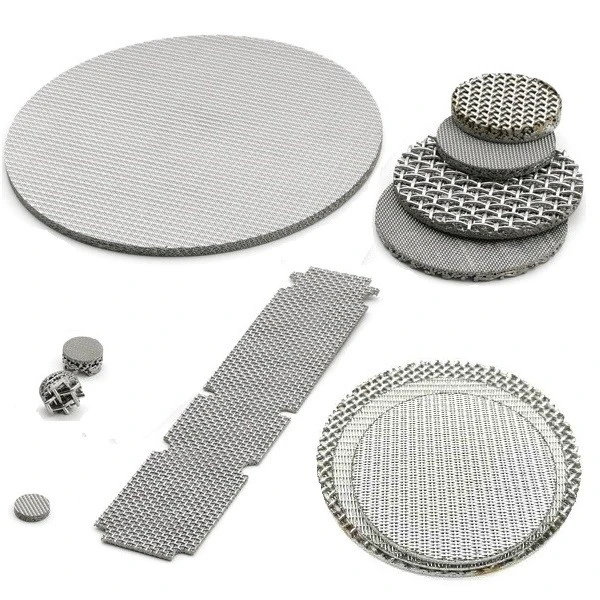
Multi-layer sintered stainless steel filter mesh is defined as a filter medium composed of several layers of woven stainless steel wire mesh, which are laminated and then sintered under vacuum or inert atmosphere. Through sintering, the mesh layers are diffusion-bonded to form a monolithic, rigid, porous structure with highly controlled pores, excellent mechanical strength, and high stability.
The multilayer lamination allows combining different mesh layers (for example, coarse, support, precision) to achieve a filtration gradient: large particles are caught by outer layers, while inner, earlier layers trap finer particles. The sintering step fuses the mesh so it acts as one integral piece, making it far more robust than loosely stacked mesh layers.
3. Materials and Construction
3.1 Stainless Steel Alloy Choice
Typical stainless alloys used in production include:
304 / 304L – standard stainless steel, cost-effective
316 / 316L – better corrosion resistance, especially to chlorides; Hengko uses 316L which can withstand high-temperature oxidation and restore environments.
Other advanced alloys (depending on application) may also be used, though Hengko primarily mentions 316L for their sintered mesh.
3.2 Layer Configuration
A typical multi-layer sintered mesh may contain:
A protection (outer) layer - coarser mesh, protects finer layers
One or more support layers - provide structural strength
A precision (core) layer - fine mesh for filtration
This stacked design helps balance flow rate, strength, and filtration precision.
3.3 Geometric Forms
Multi-layer sintered stainless steel mesh can be formed into:
Flat discs
Circular or cylindrical tubes/candles
Custom shapes (plates, rings, complex geometry)
Example Products:
1 Micron 4 Layer Sintered Stainless Mesh Disc - a precision 4-layer filter disc.
10 Micron 5 Layer Sintered Stainless Mesh Plate - larger area, more layers, suitable for high-precision filtration.

4. Manufacturing Process
The production of multi-layer sintered stainless steel mesh involves several critical steps:
4.1 Mesh Stacking / Lamination
Select woven stainless wire meshes with required mesh counts (thread densities) for each layer (outer, support, precision).
Stack the mesh layers in a designed sequence. Proper layer alignment is crucial.
Compress the stack under mechanical pressure (lamination) to ensure good layer contact.
4.2 Sintering
The laminated mesh stack is placed into a vacuum furnace (or controlled atmosphere) to avoid oxidation during heating.
Temperature is raised to a point where diffusion bonding will occur - typically below the melting point of the metal, but high enough to allow atomic diffusion across wire boundaries.
Under these conditions, adjacent wires from different layers bond at their contact points, forming a unified structure.
4.3 Cooling and Stabilization
After sintering, the mesh must be cooled in a controlled way to avoid distortion or internal stress. Once cooled, the mesh layers remain firmly bonded, resulting in a rigid, monolithic filter medium.
4.4 Post-Processing (Optional)
Depending on the application:
The sintered mesh may be cut or stamped into precise shapes (discs, rings, custom geometry).
Surface finishing (deburring, polishing) may be conducted.
Cleaning (ultrasonic, solvent, backwash) to remove residues or sintering by-products.

5. Key Properties and Performance Characteristics
Multi-layer sintered stainless steel mesh offers a combination of mechanical, thermal, chemical, and filtration properties that make it unique:
5.1 Mechanical Strength and Rigidity
Because of diffusion bonding, the mesh exhibits very high mechanical strength and compressive rigidity.
The multi-layer structure resists deformation, and unlike loose mesh, the layers do not slip.
5.2 Precise and Uniform Pore Structure
The sintered mesh supports uniform pore distribution across its surface.
Filtration accuracy can range from 1 µm to 300 µm, according to Hengko.
Because of the layered design, different pore sizes can be engineered for gradient filtration.
5.3 Thermal Performance
Multi-layer sintered stainless mesh from Hengko can operate in a wide temperature range: –200 °C to 500 °C.
Excellent heat resistance relative to many polymer-type filter media.
5.4 Chemical & Corrosion Resistance
Utilizing stainless steel (especially 316L) provides strong corrosion resistance.
Stable in many corrosive environments depending on the alloy and usage conditions.
5.5 Cleanability and Durability
Because of its rigid, metal structure, the mesh can be backwashed, ultrasonically cleaned, or chemically cleaned.
Long service life due to mechanical robustness and resistance to clogging.
5.6 Pressure Drop and Flow Characteristics
The multi-layer design allows balancing low impedance (for flow) with filtration precision.
Compared to powder sintered or ceramic filters, multi-layer mesh often exhibits lower pressure drop for similar filtration performance.
6. Comparison with Other Filter Media
Here's a comparison of multi-layer sintered stainless steel mesh vs other common filter materials:
|
Filter Media |
Strengths |
Limitations |
How Multi-Layer Mesh Compares |
|
Powder Sintered Metal |
Fine pores, rigid |
Higher cost, brittle, high pressure drop |
Mesh offers better flow & mechanical toughness |
|
Ceramic Filters |
Excellent chemical resistance & pore control |
Fragile, brittle, heavy |
Metal mesh is more impact resistant & easier to clean |
|
Fiber / Felt-Metal Filters |
High porosity, flexible |
Lower strength, limited temperature |
Mesh is more rigid, less compressible |
|
Polymer Filters (e.g., PTFE, PES) |
Low cost, high chemical compatibility |
Temperature limits, mechanical wear |
Mesh withstands much higher temps & mechanical stress |
|
Woven Wire Mesh (single layer) |
Simplicity, low cost |
Weak rigidity, unstable shape |
Multi-layer mesh is unified, dimensionally stable |

7. Applications Across Industries
Multi-layer sintered stainless steel filter mesh is employed in a wide range of industries, thanks to its robustness and versatility. Below are several typical applications:
7.1 Pharmaceutical and Biotechnology
Filtration of gases (sterile vents, sparging)
Liquid filtration in bioreactors
Purification of process fluids where precise micron-level control is required
Use in "2-in-1" or "3-in-1" pharmaceutical equipment - as mentioned by Hengko.
7.2 Food & Beverage
Filtration of particulates in liquid food processing
Clarification of beverages
Steam filtration
High-temperature resistance makes it suitable for sterilization systems
7.3 Petrochemical and Chemical
Catalyst recovery (slurry filtration)
Filtration of particles in process gases
High-temperature, high-pressure filtration loops
7.4 Energy & Power
Filtration in high-temperature steam systems
Gas filtration in power generation plants
Impurity removal in fuel systems
7.5 Environmental & Water Treatment
Sediment filtration in water treatment plants
Filtration of particulate in industrial wastewater
Backwash-capable filters for longevity
7.6 Electronics & Semiconductor
Filtration of ultrapure water or chemical solutions
Precision filtration for microelectronics manufacturing
7.7 Aerospace & Automotive
Filtration in hydraulic systems
Fuel filtration
High-temperature gas systems

8. Design Considerations for Multi-Layer Mesh
When designing a filter using multi-layer sintered mesh, several key factors must be considered:
8.1 Pore Size and Mesh Count
Choose mesh counts for each layer such that outer layers protect without overly restricting flow, inner layers provide required precision.
Hengko offers customization from 0.2 µm up to 120 µm depending on design.
8.2 Number of Layers
More layers → better strength and more gradual filtration, but also more pressure drop and cost.
Typical layer structures: 3-layer, 5-layer, or more.
8.3 Thickness and Porosity
Thicker mesh (more layers) increases mechanical strength but may reduce permeability.
Porosity must be optimized: too tight leads to clogging, too loose reduces filtration efficiency.
8.4 Material Selection
316L is often preferred for corrosion resistance and thermal stability.
For very aggressive chemical environments, specialized alloys may be required.
8.5 Geometry & Shape
Discs, tubes, custom shapes all possible - design must consider flow, cleaning, and installation constraints.
Integration with housing, welding, sealing, or mounting must be considered.
8.6 Cleaning and Maintenance Strategy
Plan for backwash, ultrasonic cleaning, or chemical cleaning during maintenance design.
Avoid dead zones in flow paths that prevent effective cleaning.
8.7 Thermal and Pressure Loads
Design must account for maximum operating temperature and pressure.
Safety margins for thermal expansion and mechanical loads are essential.

9. Advantages and Trade-offs
9.1 Major Advantages
1.High Mechanical Strength – Because of the sintered, diffusion-bonded structure.
2.Wide Temperature Range – Operable from very low to very high temperatures.
3.Excellent Durability – Resistant to fatigue, abrasion, and repeated cleaning.
4.Precision Filtration – Gradient control via layered design.
5.Long Service Life – Metal structure resists wear better than polymer or paper.
6.Cleanability – Suitable for backwashing and aggressive cleaning.
7.Design Flexibility – Custom shapes and pore sizes.
9.2 Trade-offs and Limitations
Cost: Higher than simple wire mesh or polymer media.
Manufacturing Complexity: Requires precise lamination and sintering.
Weight: Heavier than polymer filters.
Pressure Drop: Depending on layers, can be higher than very coarse filter media.
Corrosion Limits: Though resistant, stainless steel can corrode under extremely aggressive chemical environments if not properly selected.
10. Failure Modes and Maintenance
Even with multi-layer sintered mesh, certain failure modes can occur without proper design or maintenance.
10.1 Clogging / Fouling
Fine particles build up in the precision layer.
Prevention: backwash, periodic chemical or ultrasonic cleaning.
10.2 Mechanical Deformation
Overpressure can deform mesh.
Prevention: design for max pressure, use safety margin.
10.3 Corrosion
In aggressive chemical environments, stainless may corrode if not alloyed correctly or passivated.
Prevention: use proper alloy (e.g., 316L), apply passivation, monitor.
10.4 Sinter Bonding Degradation
Poor sintering (incomplete bonding) can lead to layer delamination or loss of integrity.
Prevention: quality control in manufacturing, proper sintering cycle.
10.5 Thermal Fatigue
Repeated thermal cycling can stress the sintered bonds.
Prevention: design for thermal expansion, control operating temperature swings.

11. Selection Guidelines
To choose the right multi-layer sintered stainless steel mesh filter for your application, follow a structured approach:
1.Define Filtration Requirements
Particle size, concentration, nature (solid, slurry, gas)
2.Assess Operating Conditions
Temperature, pressure, chemical exposure
3.Choose Material
Alloy (e.g., 316L), number of layers, layer mesh counts
4.Design Geometry
Shape (disc, tube), size, thickness
5.Plan Cleaning Strategy
Frequency, method (backwash, ultrasonic, chemical)
6.Evaluate Lifecycle Costs
Initial cost vs. maintenance vs. downtime
7.Specify Quality / Manufacturing Requirements
Sintering quality, porosity control, testing
12. Case Studies and Examples
Example 1: Precision Filtration in Pharmaceutical Bioreactor
A biopharmaceutical company needed a filter to remove micro-contaminants from gas sparging lines in their bioreactor. They selected a multi-layer sintered disc with:
Outer layer: coarse mesh for strength
Core layer: fine mesh (1–5 µm) for precision
Alloy: 316L
Result: Reliable filtration, low pressure drop, excellent cleanability via ultrasonic and backwash. The filter survived hundreds of cycles without degradation.
Example 2: High-Temperature Steam Filtration
An industrial steam plant required a filter that could operate at 400°C continuously. They used a multi-layer sintered mesh tube made of 316L stainless steel.
Result: The sintered tube maintained its structure, resisted thermal cycling, and removed particulates reliably. Downtime dropped significantly.
Example 3: Catalyst Recovery in Petrochemical Process
In a petrochemical reactor, catalyst fines needed to be recovered while minimizing pressure loss. Engineers selected a 5-layer sintered mesh plate offering gradient filtration:
First layer protects from large particles
Inner layers filter progressively finer particulates
Result: High recovery efficiency, long service life, and lower maintenance cost than ceramic filters.

13. Future Trends and Innovations
13.1 Additive Manufacturing & 3D Structures
3D printing of metal components could integrate sintered mesh into complex geometries, enabling:
Optimized flow paths
Reduced size and weight
Embedded filter regions
13.2 Hybrid Materials
Combining sintered stainless mesh with other materials, such as:
Ceramic coatings
Functionalized surfaces for catalysis
Composite structures for targeted filtration
13.3 Nanostructured Mesh
Advances in wire manufacturing might enable ultra-fine wire (nanowires), allowing sub-micron sintered mesh for extreme precision filtering.
13.4 Smart Filters
Embedding sensors (pressure, temperature, particle load) into sintered mesh structures can transform filters into smart, self-monitoring systems.
13.5 Sustainable Manufacturing
Recycling of sintered mesh
Energy-efficient sintering processes
Eco-friendly pre- and post-treatment
RAED MORE:
14. Conclusion
Multi-layer sintered stainless steel filter mesh represents a powerful and flexible filtration solution that bridges the gap between rigid mechanical strength and fine particle control. Thanks to its laminated and sintered structure, it delivers:
High structural strength
Precise and stable pore distribution
Excellent thermal and chemical durability
Long service life and strong cleanability
As advanced industrial processes demand higher reliability and performance, multi-layer sintered mesh continues to extend its footprint in sectors such as pharmaceuticals, petrochemicals, power generation, and environmental technology.
By understanding its structure, manufacturing, properties, and real-world application, engineers and decision-makers can design filtration systems that leverage its full potential - achieving both efficiency and robustness.