





The industrial world operates on the precision of separation. From the massive vibrating screens that sort raw ore in mining operations to the sub-micron filters used in the synthesis of life-saving pharmaceuticals, the stainless steel mesh is an indispensable tool. However, "stainless steel mesh" is not a singular commodity. It is a sophisticated category of engineering materials defined by complex metallurgical compositions, varied manufacturing methods, and specialized weave geometries. Choosing the correct type of mesh requires a professional understanding of how these variables interact with fluid dynamics, mechanical stress, and chemical aggression. This 3,000-word guide serves as the definitive manual for navigating the diverse landscape of stainless steel mesh, providing the technical clarity required for high-stakes procurement and process engineering.

Classification by Weave Pattern: The Geometry of Filtration
Plain Weave: The Foundation of Mesh Design
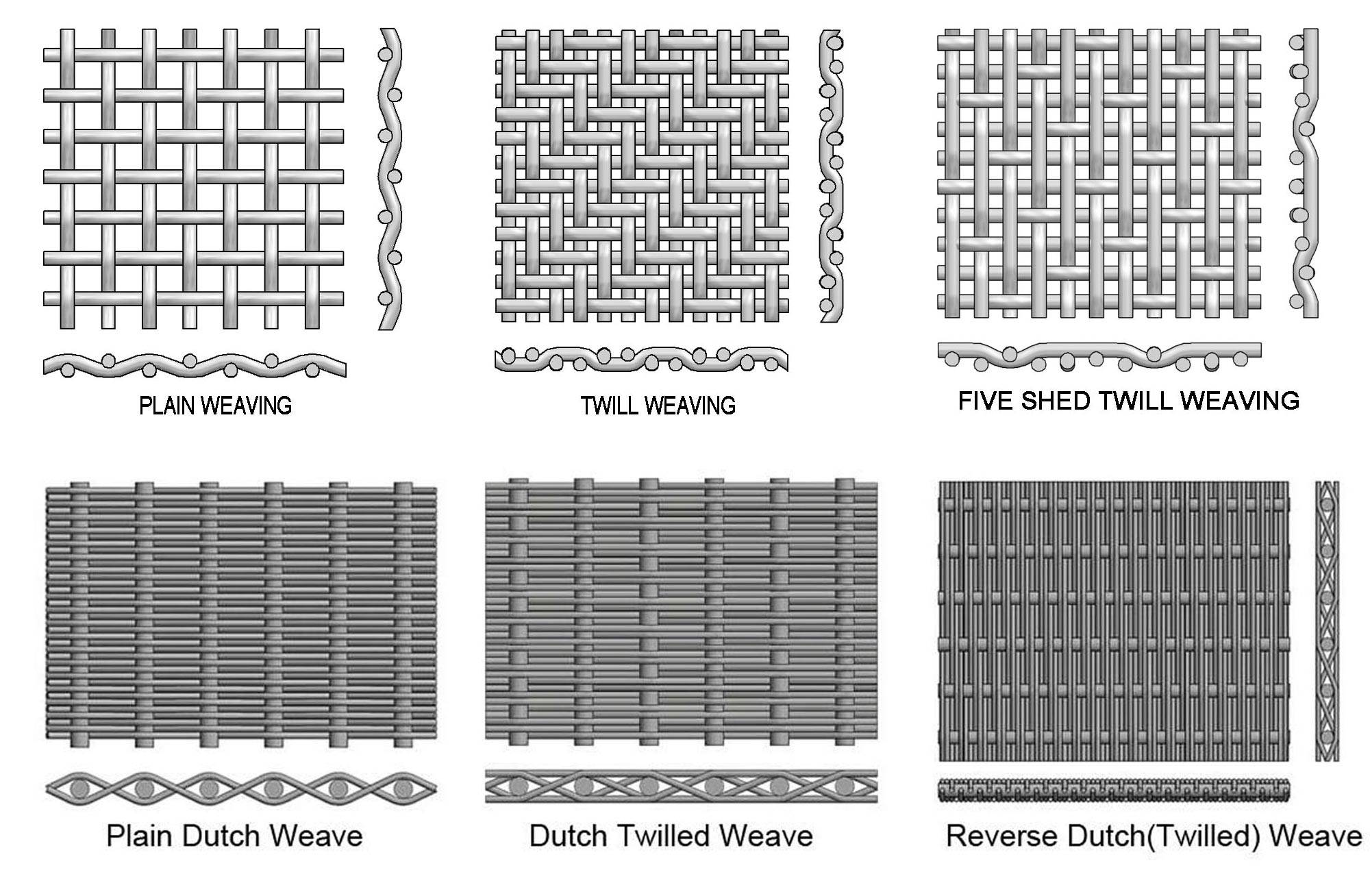
The Plain Weave is the most widely utilized and recognizable type of stainless steel wire cloth. Its construction follows a simple "over-one, under-one" pattern, where each warp (vertical) wire interlaced at 90 degrees with each shute (horizontal) wire. This symmetry creates a series of perfectly square apertures, making it the ideal choice for applications where high transparency and a predictable, uniform flow rate are the primary requirements. Because every intersection is a point of friction, the plain weave is remarkably stable and resists wire migration.
In industrial settings, plain weave mesh is the "gold standard" for general-purpose sifting and protective screening. Its simplicity allows for high-speed, cost-effective manufacturing, yet it maintains a high degree of accuracy in aperture size. However, the plain weave does have a physical limitation: as the mesh count increases (meaning the holes get smaller), the wires must become thinner. If the wires are too thick for the desired aperture, the mechanical stress of the 1:1 bending can lead to "crevice corrosion" or fatigue. Therefore, plain weave is typically reserved for counts between 2 mesh and 100 mesh.
Twill Weave: Overcoming Wire Stiffness
When a process demands a very fine mesh count-such as 200, 325, or even 635 mesh-the physical limitations of the plain weave become apparent. The wires required for these fine apertures are often too stiff to be bent in a 1:1 ratio without breaking. To solve this, engineers utilize the Twill Weave. In this pattern, each shute wire passes over and under two warp wires in a staggered, diagonal sequence. This reduces the "crimp" or bending angle of each individual wire, allowing for a much more compact packing of the metal.
Twill weave is "good" because it allows for the use of relatively thicker wires in very fine counts, resulting in a mesh that is significantly stronger and more durable than a plain weave of equivalent micron rating. The diagonal structure also creates a slightly more "tortuous path" for the fluid, which can enhance the capture of irregularly shaped particles. This weave is the preferred choice for heavy-duty chemical filtration and laboratory testing where both precision and mechanical resilience are mandatory.
Plain Dutch Weave: Maximum Density for Liquids
Unlike the square apertures found in plain and twill weaves, the Dutch Weave is engineered for "surface-depth" hybrid filtration. In a Plain Dutch Weave, the warp wires are relatively thick and spaced widely apart, while the shute wires are much thinner and driven tightly together during the weaving process. This results in a mesh where you cannot see through the openings; instead, the fluid must travel through triangular, wedge-shaped channels formed by the overlapping wires.
This type of mesh is specifically designed for high-pressure liquid filtration. Because the shute wires are packed so densely, the mesh possesses an incredibly high tensile strength and resists deformation under hydraulic shock. It is the primary type used in fuel filters, hydraulic systems, and plastic extrusion "breaker plates." The "goodness" of a Dutch weave lies in its ability to provide a high flow rate while maintaining an absolute particle cutoff, making it a critical component in the oil and gas industry.
Twill Dutch Weave: The Apex of Fine Filtration
The Twill Dutch Weave represents the most complex and precise category of woven wire cloth. It combines the staggered pattern of a twill weave with the high-density logic of the Dutch weave. By passing shute wires over and under two warp wires in a dense packing arrangement, manufacturers can achieve absolute micron ratings down to 1 or 2 microns. This is a level of precision that is invisible to the human eye, yet it is vital for protecting sensitive aerospace components and pharmaceutical reactors.
Twill Dutch mesh is often utilized in "sintered" form to create the world's most robust filters. It provides a curved, multi-dimensional path for the fluid, ensuring that even needle-like particles are trapped. While the flow resistance is higher than a square mesh, the structural integrity of the Twill Dutch allows it to be cleaned via high-pressure back-pulsing without the risk of wire displacement.
While we have covered the basics of geometry here, the fluid dynamics of these patterns are complex. For an engineering analysis of how these weaves affect flow resistance, see our technical guide on:
[The Physics of Weave Patterns]
Classification by Manufacturing Method: Beyond Woven Cloth
Welded Wire Mesh: Rigid Structural Integrity
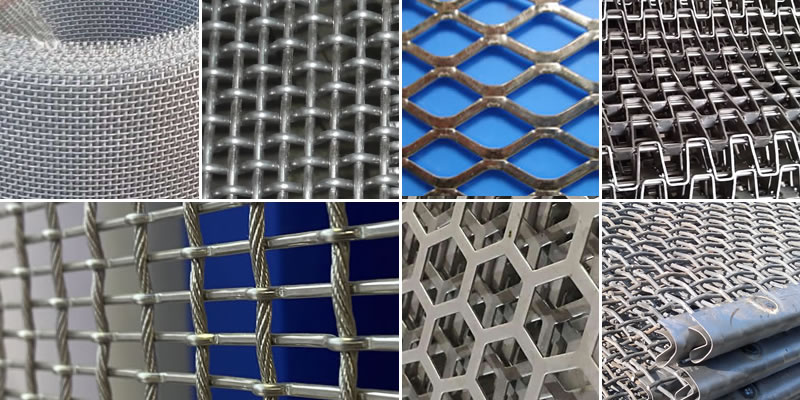
While woven mesh relies on friction and tension to hold its shape, Welded Wire Mesh is a rigid, monolithic structure. It is manufactured by placing warp and shute wires in a grid and fusing them at every intersection using electrical resistance welding. This creates a non-deformable grid that will not unravel even if individual wires are cut. This "good" rigidity makes welded mesh the premier choice for structural applications where safety and stability are the primary concerns.
In the industrial sector, welded stainless steel mesh is frequently used as a "support layer" for finer woven meshes. Because it can withstand massive hydraulic loads without bowing, it acts as the skeleton for large filter drums. It is also the standard for security screens, machine guards, and animal enclosures. While it lacks the extreme precision of fine woven mesh (it is usually restricted to apertures of 1/4 inch and larger), its durability in harsh environments is unparalleled.
Expanded Metal Mesh: Sustainable Efficiency
Expanded Metal Mesh is a "non-woven" type that offers a unique combination of strength and material efficiency. It is manufactured by taking a solid sheet of stainless steel and simultaneously slitting and stretching it. This process creates a series of diamond-shaped openings without losing a single gram of material. Because it is made from a single piece of metal, there are no welds or joints to fail, making it incredibly strong relative to its weight.
Expanded mesh is "good" for applications requiring high transparency and air flow, such as architectural facades, walkways, and ventilation grilles. In filtration, it is often used as a coarse "pre-filter" to catch large debris before it can damage more expensive downstream components. The "3D" nature of the expanded strands also provides an excellent surface for "impingement" filtration, where droplets of liquid are pulled out of gas streams.
Perforated Metal: The Heavy-Duty Alternative
Perforated Metal is produced by punching a series of holes into a solid stainless steel plate using a high-speed CNC press. This type is fundamentally different from woven or welded mesh because it starts as a solid structural member. This gives it the highest impact resistance of any "mesh" category. Perforated plates are used in hammer mills, centrifuges, and heavy-duty vibrating screens where the material being processed would shred a standard wire screen.
The primary advantage of perforated metal is the ability to customize hole shapes-round, square, slotted, or hexagonal-to match the specific geometry of the material. While it has a lower "open area" percentage than woven mesh, its structural longevity is significantly higher. It is often used in the food industry for drying trays and in the mining industry for primary sorting.
Knitted Wire Mesh: Flexibility and Resilience
Knitted Wire Mesh is a highly specialized type characterized by an interlocking loop structure, similar to a traditional wool sweater. This creates a "stretchy" and highly resilient material that can be compressed into various shapes. Knitted mesh is rarely used for traditional particle sifting; instead, it is the primary material for mist eliminators, vibration dampeners, and high-temperature gaskets.
Because the knitted loops can move relative to one another, the mesh is exceptionally "good" at absorbing mechanical energy. In the automotive industry, knitted stainless steel mesh is used in exhaust systems to manage thermal expansion. In chemical processing, stacks of knitted mesh are used to "coalesce" fine mists into larger droplets, allowing them to be removed from gas streams. Its high surface area and porosity make it a versatile tool for phase separation.
Metallurgical Variations: Choosing the Correct Alloy
The 300 Series: Austenitic Excellence
The vast majority of stainless steel mesh is produced from the 300 series alloys, primarily Grade 304 and Grade 316L. These are austenitic steels, meaning they possess a specific crystal structure that makes them non-magnetic and highly ductile. Grade 304 is the general-purpose workhorse, offering excellent strength for indoor and freshwater environments. However, for almost all professional industrial applications, Grade 316L is the mandatory standard.
The "L" in 316L stands for low carbon, which is crucial for mesh that will be welded or sintered. Higher carbon levels can lead to "sensitization" during the heating process, which causes the chromium to precipitate out, leaving the mesh vulnerable to rust at the joints. 316L also contains Molybdenum, which provides the critical defense against chloride-induced pitting. This section explores why the 300 series is considered the "gold standard" for the pharmaceutical and food industries due to its ease of cleaning and chemical passivity.
Ferritic and Martensitic Grades: Magnetic Solutions
While austenitic steels are the most common, the 400 series (Ferritic and Martensitic) alloys serve specialized niches. Ferritic grades, like 430, are magnetic. This is a vital "good" property for the food processing industry. If a piece of 430 mesh were to break off and fall into a food batch, it could be easily detected and removed by a magnetic separator.
Martensitic grades, like 410, can be heat-treated to achieve extreme hardness. These are used in abrasive screening environments where the mesh must act as a cutting or grinding surface. However, these 400-series alloys generally have lower corrosion resistance than the 300-series. Choosing these grades requires a careful trade-off between mechanical hardness (or magnetic detectability) and the long-term chemical lifespan of the filter.
Duplex and Super-Duplex Alloys: Extreme Strength
Duplex stainless steels are a "hybrid" of austenitic and ferritic structures. This results in a material that is nearly twice as strong as Grade 316L. In the world of wire mesh, this high strength allows for the use of thinner wires to achieve the same pressure rating, which significantly increases the "open area" and flow capacity of the filter.
Furthermore, Duplex alloys like 2205 are highly resistant to Stress Corrosion Cracking (SCC), a common failure mode in hot, chloride-rich environments like offshore oil rigs and desalination plants. While more expensive to manufacture, the "lifecycle value" of a Duplex mesh screen in a high-pressure, corrosive environment often makes it the most economical choice over a five-year period, as it outlasts standard 316L by a factor of three or four.
Exotic Super-Alloys: Heat and Acid Resistance
When the operating environment exceeds the limits of iron-based steels, engineers turn to exotic super-alloys like Inconel, Monel, and Hastelloy. Inconel is a nickel-chromium alloy designed to maintain its tensile strength at glowing temperatures (above $800^{\circ} \mathrm{C}$), making it essential for aerospace flame arrestors. Monel (nickel-copper) is virtually immune to stagnant seawater, making it the premier choice for subsea mesh screens.
Hastelloy is the ultimate defense against aggressive acids like hydrochloric and sulfuric acid. These alloys are difficult to weave because they are extremely tough and work-harden rapidly. However, in a chemical reactor where standard stainless steel would dissolve in days, these exotic meshes provide the only viable solution. This section emphasizes that alloy selection is the most critical "risk management" step in the procurement process.
Standard alloys serve most needs, but extreme environments require exotic solutions. Explore the chemical limits of high-nickel alloys in our deep dive:
[Metallurgical Selection: Beyond the 300 Series]
Advanced Sintered Structures: The Structural Filter
Single-Layer Sintered Mesh: Permanent Stability
Sintering is a thermal process that bonds metal particles or wires together without melting the base material. In a Single-Layer Sintered Mesh, a standard woven cloth is placed in a vacuum furnace and heated until the wires fuse at every contact point. This transforms a "flexible" cloth into a "rigid" plate.
The primary "good" property of single-layer sintering is the elimination of "media migration." In high-vibration environments, the wires of a traditional woven mesh can eventually rub against each other and break off, contaminating the downstream fluid. Sintering prevents this by making the weave permanent. It also stabilizes the aperture size, ensuring that the filter's micron rating remains constant even under intense hydraulic surges.
Multi-Layer Sintered Laminates: The 5-Layer Standard
Multi-layer sintering is the pinnacle of filtration technology. By bonding multiple layers of different mesh counts together-typically a fine filtration layer protected by several drainage and support layers-engineers create a "structural filter." The standard 5-layer laminate is designed to be puncture-proof and capable of withstanding back-pulsing pressures that would shred a single-layer screen.
This type of mesh is "good" because it combines the precision of sub-visible filtration with the ruggedness of a solid steel plate. It is the go-to choice for polymer extrusion, where it must catch microscopic "gels" while being pushed by thousands of pounds of pressure. The multi-layer structure also provides a degree of "depth filtration," trapping particles within the laminate itself, which significantly increases its dirt-holding capacity compared to a single-layer surface filter.
Sintered Metal Fiber Felt: Depth Filtration Logic
Sintered Metal Fiber Felt is a non-woven type of mesh. It is made by taking random stainless steel fibers and compressing them into a mat before sintering them in a furnace. Unlike woven mesh, which has a two-dimensional "surface" logic, fiber felt is a "depth" media. It possesses a high porosity (up to 80%) and a tortuous path that traps contaminants throughout the entire thickness of the material.
This type is exceptionally "good" for fluids with a high concentration of deformable particles (like waxes or organic matter) that would quickly "blind" a woven screen. Metal fiber felt provides a much higher dirt-holding capacity and a lower pressure drop over its lifespan. It is widely used in the chemical and pharmaceutical industries for "polishing" fluids to a high degree of clarity.
Sintered Powder Metal: Micronic Precision
The most dense type of sintered mesh is made from metal powders. Fine stainless steel powders are compacted into a mold and then sintered to create a rigid, porous plate. While it looks like a solid piece of metal to the naked eye, it contains millions of microscopic interconnected pores.
Sintered powder metal is used for the most delicate filtration tasks, such as gas sparging (injecting fine bubbles of gas into a liquid) and ultra-high-purity gas filtration in the semiconductor industry. It offers the highest degree of "absolute" filtration, often down to 0.1 microns. Because it is a monolithic block of metal, it is incredibly resistant to thermal shock and aggressive chemical cleaning, making it a "permanent" solution for high-value process lines.
Manufacturing Method and Best Use Case
| Manufacturing Type | Characteristic | Primary Advantage | Best Application |
| Woven | Flexible, precise | Huge range of micron sizes | Filtration, Sifting |
| Welded | Rigid, non-fraying | High structural stability | Support Grids, Security |
| Sintered | Fused multi-layers | Puncture-proof, high pressure | Polymer Extrusion |
| Expanded | One-piece diamond | Cost-effective, no waste | Walkways, Architectural |
| Perforated | Solid plate with holes | High impact resistance | Hammer Mill Screens |
Sintering transforms a delicate cloth into a structural component. To understand the thermal bonding process and multi-layer design, read:
[Sintering Technology: The Future of Metal Filtration]

Physical Properties and Engineering Metrics
Open Area and Flow Velocity Relationships
The "Open Area Percentage" is the most critical metric for determining the energy efficiency of a filtration system. It represents the ratio of the hole area to the total surface area. A mesh with a high open area is "good" because it allows for a high flow velocity with a low pressure drop, which reduces the energy required by pumps and fans.
However, there is always a trade-off: a higher open area usually means thinner wires, which decreases the mechanical strength of the mesh. Engineers must calculate the "Permeability" of the mesh to ensure it can handle the required flow volume without creating a bottleneck. This section details how the weave pattern affects this calculation and why "calendaring" the mesh can sometimes stabilize flow even if it slightly reduces the open area.
Tensile Strength and Burst Pressure Dynamics
In high-pressure systems, the mesh must act as a pressure vessel. The "Tensile Strength" of the wire and the "Burst Pressure" of the finished mesh determine if the filter will survive a hydraulic surge. Stainless steel is chosen for these applications because it has a high "Yield Strength," meaning it can bend and return to its original shape without permanent deformation.
We analyze the impact of "Pulsating Loads" on mesh integrity. In systems with reciprocating pumps, the mesh is constantly "flexing." This can lead to metal fatigue. Using a "Twill Weave" or a "Sintered" structure can mitigate this risk by distributing the mechanical stress more evenly across the metal. Understanding these dynamics is essential for designing filters that won't fail catastrophically during a system spike.
Surface Roughness and Cleanability Factors
In the food and pharmaceutical industries, the surface roughness of the wire is a regulatory concern. If a wire is too rough, it contains microscopic crevices where bacteria and proteins can hide, making the system impossible to sterilize. Smooth, high-quality wire is "good" because it facilitates "filter cake release"-the ability for the accumulated dirt to slide off the mesh during a back-wash cycle.
This section explores how different manufacturing processes affect roughness. Woven mesh is naturally smoother than expanded or perforated metal. However, for the most demanding sanitary applications, the mesh must undergo "Electropolishing." This process removes the microscopic "peaks" of the metal, leaving a mirror-like finish that prevents organic matter from clinging to the screen, ensuring a truly sterile operation.
Micron Ratings: Absolute vs. Nominal Definitions
The most common source of confusion in the mesh industry is the difference between "Absolute" and "Nominal" micron ratings. A Nominal rating is an "average" capture rate; a 10-micron nominal filter might stop 60% or 80% of 10-micron particles. An Absolute rating, however, is a mathematical certainty, usually defined as the size of the largest spherical glass bead that can pass through the mesh.
For mission-critical applications like aerospace or medicine, only an Absolute rating is acceptable. This section details how the "Bubble Point Test" (ISO 4003) is used to verify these ratings. By immersing the mesh in a liquid and increasing air pressure until the first bubble appears, engineers can calculate the exact maximum pore size, ensuring that the "type" of mesh purchased actually performs to the required safety standard.
Weave Type Comparison Matrix
| Weave Type | Aperture Shape | Strength | Cleanability | Best Application |
| Plain | Square | Moderate | Excellent | General Sifting |
| Twill | Square | High | Good | Heavy Duty Sieving |
| Plain Dutch | Triangular | Very High | Fair | High-Pressure Liquid |
| Twill Dutch | Curved Path | Exceptional | Difficult | Absolute Fine Filter |
Conclusion
In summary, navigating the diverse world of stainless steel mesh requires a deep understanding of weave geometry, metallurgical properties, and manufacturing precision. By correctly aligning these technical variables with your specific industrial requirements, you can optimize flow rates, ensure product purity, and maximize the operational lifespan of your filtration equipment.
Ultimately, the choice of mesh is a critical engineering decision that impacts both system safety and economic efficiency. Whether you require the high dirt-holding capacity of a sintered fiber felt or the structural rigidity of a welded grid, selecting certified, high-quality stainless steel mesh remains the foundation of professional fluid management and industrial separation.