





In the heavy chemical synthesis, food refining, and mineral processing sectors, production supervisors and plant engineers chase a dual mandate that constantly conflicts: maximize the hourly volumetric throughput of clarified liquid while keeping downstream solid particulate contamination at absolute zero. When managing large-scale enclosed pressure leaf filters, achieving this balance is an ongoing operational challenge.
When the time comes to re-mesh, repair, or replace the worn, blinded, or structurally fatigued wire screens on your filter leaf panels, you are immediately forced to confront a classic fluid dynamics bottleneck: the trade-off between Flow Rate and Micron Precision.
If your technical procurement team selects a replacement wire mesh cloth that is woven too tightly, your filtrate clarity will be flawless, but the high initial flow resistance will cause your differential pressure to surge rapidly toward the system's maximum safe operating threshold (typically 4.0 bar). This shortens your batch cycles, forces premature backwashing, and drops your overall daily plant capacity.
Conversely, if you opt for an excessively open weave to reduce hydraulic flow restriction, fine particulates like bleaching clays, activated carbon fines, or microscopic catalyst dust will slip straight through the openings. This creates a hazy final product and triggers incredibly expensive re-filtration cycles.
To resolve this conflict, plant engineers must look past generic screen catalogs and dive into the advanced structural mechanics of Dutch weave stainless steel wire cloth. This article analyzes how wire sizing, interlocking weave configurations, and calendering processes break this fluid dynamics bottleneck, allowing plants to maximize flow velocity without sacrificing micron precision.

The Underlying Physics of Leaf Filtration: Managing Total Flow Resistance
To truly grasp why selecting the correct wire mesh architecture is so critical to your plant's bottom line, we must look at the physical principles governing fluid flow through a porous medium. In any pressure leaf filtration setup, the system's operational efficiency-specifically, how much clean liquid your machine can pump out per hour-is dictated by a constant battle between driving pump pressure and total hydraulic resistance.
The total resistance blocking the path of your fluid is actually split into two distinct parts:
● The Intrinsic Resistance of the Clean Wire Mesh Cloth: The baseline restriction caused by the steel wires themselves before any filtration begins.
● The Resistance of the Accumulating Filter Cake: The restriction that builds up as trapped solid particulates layer on top of the screen.
In a healthy, highly efficient filtration cycle, the mesh's own baseline resistance should be an absolute fraction of the total restriction. This allows the fluid to pass through the metal screen effortlessly, giving the real filtration work over to the growing filter cake.
However, if the replacement wire cloth is poorly engineered, loosely woven, or prone to internal pore blinding, the mesh's baseline resistance skyrockets. When the metal screen itself becomes the primary bottleneck, your feed pump's driving pressure is entirely wasted just trying to force the liquid through the naked metal wire matrix, rather than building a productive, permeable filter cake.
The immediate result is a steep, early drop-off in production velocity. Your cycle times stretch out, and plant throughput stalls-all because the fluid dynamics of the mesh fabric were fundamentally misaligned with the process requirements.
Why Standard Square Weaves Fail under Industrial Pressures
When sourcing replacement metal fabrics, procurement departments are often tempted to utilize standard square plain weave screens (where warp and weft wires are equal in diameter and cross over in a simple one-on-one layout) due to their low cost. However, under the harsh conditions of pressurized industrial filtration, square meshes are highly prone to rapid structural failure.
Square weaves feature completely open, straight-through geometric apertures. When irregular, angular particulates like diatomaceous earth are pumped against a square screen under pressure, the particles are pushed directly into these open squares. If a particle matches the hole size, it wedges itself permanently in place. This triggers immediate mesh blinding, rapidly sealing off the open area of the leaf panel and causing an early spike in △P.
Furthermore, square weaves lack the tensile strength to resist multi-directional hydraulic forces. Because the wires are thin, they have a low resistance to mechanical deflection. Under standard operating pressures of 4.0 bar, the forward hydraulic drag forces the square openings to stretch and distort. An aperture intended to capture 70-micron solids can easily stretch into a loose 110-micron opening under a sudden pump surge, causing massive solid bypass leaks.
The Mechanics of the Plain Dutch Weave: Breaking the Bottleneck
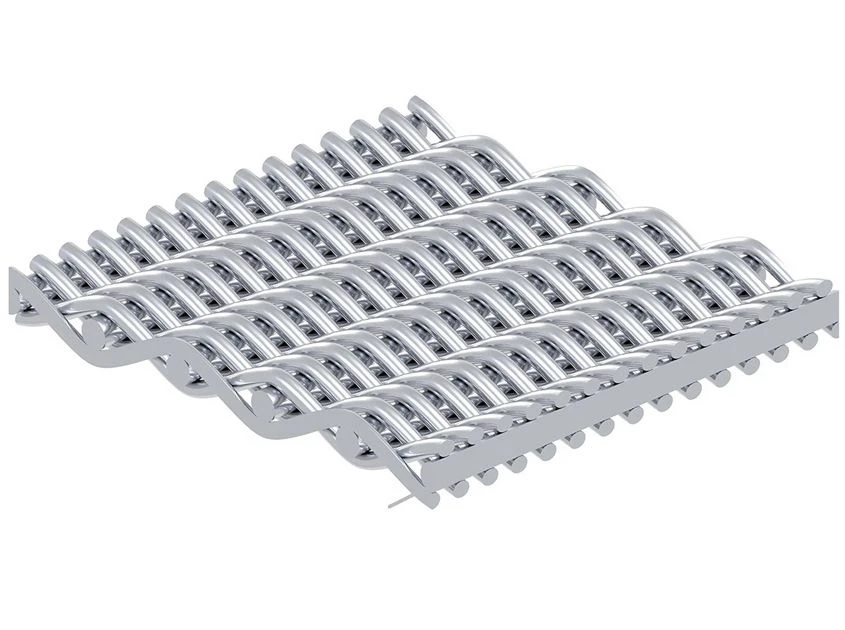
To solve these pressure and blinding limitations, heavy-duty industrial filter leaves rely almost entirely on Plain Dutch Weave (PDW) wire cloth, most commonly specified as 24 x 110 mesh.
The mechanical architecture of a Plain Dutch Weave breaks the flow-vs-precision bottleneck by dividing structural support and fine filtration between two entirely different wire profiles:
● The High-Tensile Warp Backbone: The warp wires running lengthwise along the cloth are thick, heavy-gauge steel structures. Spaced relatively far apart, these heavy wires do not perform the micro-filtration. Instead, they act as a rigid, high-tensile structural skeleton designed to absorb the immense forward hydraulic pressure of the slurry pump without stretching or bending.
● The Interlocking Weft Filter Barrier: The weft wires driven crosswise are micro-fine and are packed tightly against one another using heavy mechanical beating looms. These fine wires completely blanket the heavy warp threads.
Because the fine weft wires curve over and under the thick warp wires, they form a winding, three-dimensional pore matrix instead of straight-through holes. The gaps are overlapping micro-wedges. When raw slurry meets this surface, the liquid can easily detour through the curving paths at high velocity, while the solid particulates are trapped on the outer surface.
This surface retention is vital because it facilitates the formation of a uniform, permeable "filter cake." The cake itself becomes the primary filtration medium, while our Dutch weave mesh functions as the perfect, low-resistance structural retaining wall.
Rheological Impact: Managing High Viscosity and Shear Spikes
The interaction between the wire mesh pores and the fluid changes dramatically when processing non-Newtonian or high-viscosity liquids, such as winterized edible oils containing dense waxes, concentrated glucose syrups, or polymer resins.
When a high-viscosity fluid encounters a filtration screen, a stationary boundary layer forms along the surface of the wires. This layer restricts the effective opening size of the pore, reducing flow capacity. If the wire cloth is woven with improper tolerances, this boundary layer thickens, causing localized flow stagnation.
Furthermore, during pump restarts or batch switches, localized pressure spikes generate intense fluid shear rates along the wire intersections. In a low-grade mesh panel, these shear forces trigger weft wire slippage (mesh creep). Because the fine weft wires are held together only by friction, high-shear fluid forces can push them sideways, creating localized gaps that allow solids to bypass.
To prevent this creep, high-performance leaf mesh utilizes high-precision automated looming. This process applies massive mechanical crimping force to lock the weft wires tightly into the warp wire curves, ensuring the pore geometry remains stable even under severe fluid shear stress.
Overcoming Boundary Layer Friction via Precision Calendering
Even when utilizing a 24x110 Dutch weave, fluid dynamics dictate that liquid passing through microscopic gaps experiences intense surface friction. To counter this friction drop, premium filter leaf mesh undergoes a secondary manufacturing process called calendering.
Calendering passes the woven steel cloth through high-pressure precision rolling mills. This applies massive compressive force to the metal fabric, flattening the raised knuckles of the wire intersections.
This mechanical alteration delivers two critical process benefits:
1. Reduction of Fluid Friction Drag
Calendering alters the entry geometry of the micro-wedge pores, smoothing out the fluid flow path. This reduction in boundary-layer friction drop allows your pressure leaf systems to operate at higher hourly flow velocities, often increasing filtration capacity by 10% to 15% compared to uncalendered wire cloth.
2. Lowering Interface Shear Stress for Cake Release
During the automated pneumatic discharge phase, the filter cake must detach cleanly from the leaf face. If the wire mesh surface is rough, the cake locks into the wire knuckles, requiring high interface shear stress to break free. This leads to incomplete cake release, leaving patches of old cake that blind the screen on the next cycle.
Calendering creates an ultra-smooth surface topography (Ra≦ 0.8mm). This mirror-flat finish minimizes the cake's mechanical grip, allowing the brittle filter cake to slide off cleanly in a single sheet during vibration.
Metallurgical Integrity: Preventing Pore Drift under Thermal Load
The final piece of the flow-vs-precision puzzle is maintaining the stability of the mesh openings across long production runs. In applications like edible oil winterization or chemical catalyst recovery, the wire cloth is subjected to continuous thermal cycling between room temperature and 140°C.
Under these high thermal loads, low-grade stainless steel alloys experience a phenomenon called thermal relaxation or micro-creep. The internal stress within the wires relieves itself, causing the tightly packed weft threads to drift apart.
A drift of just 5μm across a 24x110 mesh panel opens up micro-gaps that allow fine clays to bypass into the clean manifold stream.
Sourcing mill-certified, vacuum-annealed SS316L or 904L ensures that the metal maintains its structural modulus and yield strength at elevated temperatures. The interlocking weft wires stay permanently locked in position, guaranteeing consistent micron precision and uniform flow distributions over years of continuous operation.
Summary Technical Checklist for Plant Engineers
Before ordering your next inventory batch of replacement wire mesh screens, ensure your technical specifications match these optimal operational benchmarks:
● Weave Pattern: Plain Dutch Weave, precision-calendered for low surface friction.
● Alloy Specification: Mill-certified SS316L (Low Carbon) or 904L for acid/pitting resistance.
● Wire Sizing Standard: For 24x110 mesh, verify Warp is $0.35\text{ mm}$ and Weft is $0.25\text{ mm}$ to preserve original hydraulic parameters.
● Surface Finish: Calendered flat face to guarantee zero-residual cake discharge.
Conclusion
Sourcing the right wire cloth for your filter leaf maintenance inventory is a balancing act of structural engineering. Settling for generic, uncalendered square meshes or poorly tensioned low-grade alloys is a guaranteed recipe for premature blinding, flow restrictions, and costly solid bypass leaks. By shifting away from standard screen profiles and selecting optimized, precision-calendered Plain Dutch Weave mesh matrices, your production facility can eliminate flow bottlenecks, secure long batch run times, and maximize daily production capacity.
Explore our full inventory of premium wire cloth specs, alloy certification details, and custom panel dimensions on our main [Stainless Steel Filter Leaf] pillar page. If your technical team is currently evaluating an upgrade to a higher flow capacity or tighter micron precision, review our hard data on our dedicated [High-Flow Dutch Weave Wire Mesh for Filter Leaf Replacement] page, or contact our engineering team to request factory-direct screen samples and expert technical consultations.