






In modern process engineering, circular wire mesh filter leaf discs are indispensable components for critical solid-liquid and solid-gas separation. Found in plastic recycling screen changers, synthetic fiber extrusion lines, hydraulic circuit manifolds, pharmaceutical nutsche filters, and chemical resin filtration loops, these compact filter elements ensure process fluid purity and protect downstream equipment from particle contamination.
Despite their simple circular appearance, specifying the correct industrial filter leaf disc involves sophisticated engineering decisions. Plant engineers and procurement specialists must carefully evaluate wire weave geometry, multi-layer matrix sequencing, rim encapsulation methods, and metallurgical compatibility. Choosing an improper disc configuration often leads to catastrophic failure modes: wire shedding into high-value product streams, rapid pore blinding, disc cupping under pressure, and perimeter leakage.
This complete engineering guide breaks down the essential design parameters for industrial filter leaf discs. By understanding layer synergy, border framing technologies, and application-tuned mesh selection, maintenance and procurement teams can maximize filtration efficiency and reduce total operational costs.
To benchmark the manufacturing tolerances, alloy grades, and perimeter construction standards available for high-reliability filter elements, explore our foundational [Stainless Steel Filter Leaf] pillar page.


Single-Layer vs. Multi-Layer Discs: Structural Dynamics
Understanding the structural behavior of wire mesh under differential pressure ($\Delta P$) is fundamental to choosing between single-layer and multi-layer disc configurations:
A. Single-Layer Filter Leaf Discs
● Construction: Stamped from a single sheet of woven wire cloth (Plain, Twill, or Dutch weave).
● Best Suited For: Low-pressure systems, coarse straining applications, or cost-sensitive batch processing where filter discs are replaced frequently.
● Limitations: Single-layer fine mesh lacks structural rigidity. Under pressure differentials exceeding 1.5Bar, fine wires deform, expanding mesh openings and allowing oversized contaminants to pass through.
B. Multi-Layer Spot-Welded Discs
● Construction: Multiple mesh sheets stacked together in a specific sequence and spot-welded along the perimeter or center point.
● Best Suited For: Moderate-pressure extrusion and fluid purification requiring multi-stage particle interception.
● Advantages: Combines fine filtration mesh with heavy protective coarse backing wire cloth. The coarse layers absorb mechanical stress and prevent the fine mesh from ballooning under pressure.
C. Multi-Layer Framed Discs (Sandwich Packs)
● Construction: Multi-layer mesh matrices permanently bound within a continuous crimped metal rim (Aluminum, Copper, or Stainless Steel).
● Best Suited For: High-pressure polymer melt filtration, continuous hydraulic circuits, and critical pharmaceutical processing.
● Advantages: Delivers maximum structural integrity, zero wire shedding, and enhanced perimeter sealing capability.
Border Framing Options and Edge Integrity
The perimeter treatment of a filter leaf disc dictates its sealing performance and mechanical safety during operation. Exposed wire edges are a frequent source of downstream contamination and seal bypass:
A. Unframed (Cut-Edge) Discs
Unframed discs are economical but leave individual wire ends exposed around the rim. In high-velocity fluid flows or high-viscosity extrusion, loose wires can snap off due to fatigue, contaminating the final product. Unframed discs should only be used where the disc housing fully clamps the outer perimeter inside a recessed groove.
B. Aluminum Rim Framing
Aluminum is the most popular rim material for plastic extrusion and general industrial filtration. Soft aluminum crimps tightly around multi-layer mesh packs, providing a continuous smooth edge. When installed, the aluminum rim compresses slightly under clamping torque, acting as an effective gasket to prevent bypass leakage.
C. Stainless Steel (SS 304/316L) Rim Framing
For high-temperature, corrosive chemical loops, or food and pharmaceutical processing where aluminum is prohibited, stainless steel rims are mandatory. Precision-stamped SS rims are crimped or laser-welded around the mesh pack, providing extreme corrosion resistance, high tensile strength, and full clean-in-place (CIP) compatibility.
D. Ultrasonic Edge Fusion
For synthetic mesh discs (Nylon, Polyester, Polypropylene) or specific metal mesh combinations, ultrasonic welding fuses the perimeter wires into a solid, smooth plastic or metallic bead without adding a separate metal frame.
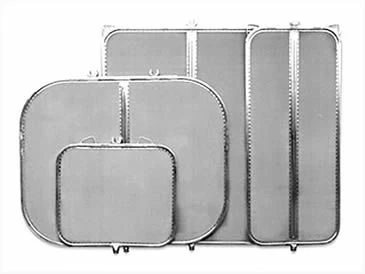

Selecting the Right Mesh Sequence for Your Application
Optimizing a multi-layer filter leaf disc requires arranging mesh layers in a balanced, functional hierarchy. A typical high-performance 5-layer disc layout includes:
1. Upstream Protective Layer (Coarse Mesh): Traps large, aggressive debris and breaks up agglomerates before they impact fine pores.
2. Upstream Support Layer (Medium Mesh): Distributes fluid flow evenly across the active face and prevents fine mesh migration.
3. Active Filtration Layer (Fine Dutch or Square Mesh): Dictates the target micron rating and captures specific particle sizes.
4. Downstream Support Layer (Medium Mesh): Supports the active layer against back-pressure and prevents pore deformation.
5. Downstream Drainage Layer (Heavy Coarse Mesh): Provides rigid mechanical backing and facilitates unobstructed fluid evacuation into downstream housing channels.
Application Matrix: Matching Discs to Industrial Processes
Different industrial processes demand distinct disc configurations to handle specific temperatures, pressures, and chemical environments:
Polymer Melt & Plastic Extrusion Screen Changers
● Recommended Config: 3-layer to 5-layer aluminum framed discs with Plain Dutch Weave active mesh.
● Key Requirement: High pressure resistance (up to $200\text{ Bar}$ system pressure) and zero wire fraying to protect extrusion nozzles.
Hydraulic & Lubrication Oil Filtration
● Recommended Config: Multi-layer spot-welded or stainless-framed discs utilizing Twill Dutch or Square mesh.
● Key Requirement: Low initial pressure drop and high fatigue strength under fluctuating pump pulses.
Pharmaceutical & Fine Chemical Filtration
● Recommended Config: Single-layer or multi-layer SS 316L framed discs with precision Reverse Plain Dutch Weave (RPDW).
● Key Requirement: Full metallurgical certification (PMI), smooth surface calendering for easy cake release, and zero chemical reactivity.
Procurement Checklist for Filter Leaf Disc Buyers
Before placing a high-volume OEM order for industrial filter leaf discs, ensure your technical vendor satisfies these key quality benchmarks:
● Diameter Precision: Can the supplier guarantee outer diameter tolerances within ≦0.1mm for smooth automated loading?
● Frame Seam Rigidity: Is the crimped metal border tight and uniform without loose corners or buckling?
● Mesh Layer Integrity: Are multi-layer packs arranged in a true symmetrical sequence to prevent disc cupping under heat and pressure?
● Material Verification: Does the vendor provide Mill Test Certificates (MTC) and PMI testing for SS 316L or exotic alloy meshes?
Conclusion
Industrial filter leaf discs play a vital role in safeguarding product purity and protecting expensive downstream machinery across global manufacturing lines. By moving away from generic unframed discs and selecting application-tuned, metal-framed multi-layer matrix packs, plant engineering teams can permanently eliminate wire shedding, prevent perimeter fluid bypass, and extend equipment operating cycles.
Whether you need high-volume aluminum-framed discs for polymer extrusion screen changers, high-purity SS 316L discs for chemical refining, or custom stamped geometries for specialized filtration equipment, review our structural specifications on [Hermetically-Sealed Multi-Layer Stainless Steel Filter Leaves] or contact our application engineering team today for custom prototyping and technical guidance.