






Stainless steel filters are essential components in modern industrial filtration systems, offering durability, temperature resistance, and reliable performance across a wide variety of applications. Compared with disposable filter media such as polypropylene or polyester, stainless steel filters deliver superior mechanical strength, maintain consistent pore size, and provide excellent reusability-making them a preferred choice in demanding processing environments. This comprehensive guide explores the different types of stainless steel filters, their industrial applications, performance benefits, and key considerations for selecting the right configuration.

Types of Stainless Steel Filters
Stainless Steel Woven Wire Mesh Filters
Stainless steel woven wire mesh is one of the most widely used filter media due to its uniform pore size, high mechanical stability, and compatibility with aggressive chemicals. The mesh is produced by interweaving metal wires in precise patterns such as plain weave, twill weave, and Dutch weave. This allows high filtration accuracy ranging from coarse filtration down to fine micron levels. Woven mesh is ideal for situations requiring predictable flow rates and precise particle retention. Its rigid, non-shedding structure ensures long-term consistency without media migration, making it suitable for high-purity applications and repeated cleaning cycles.
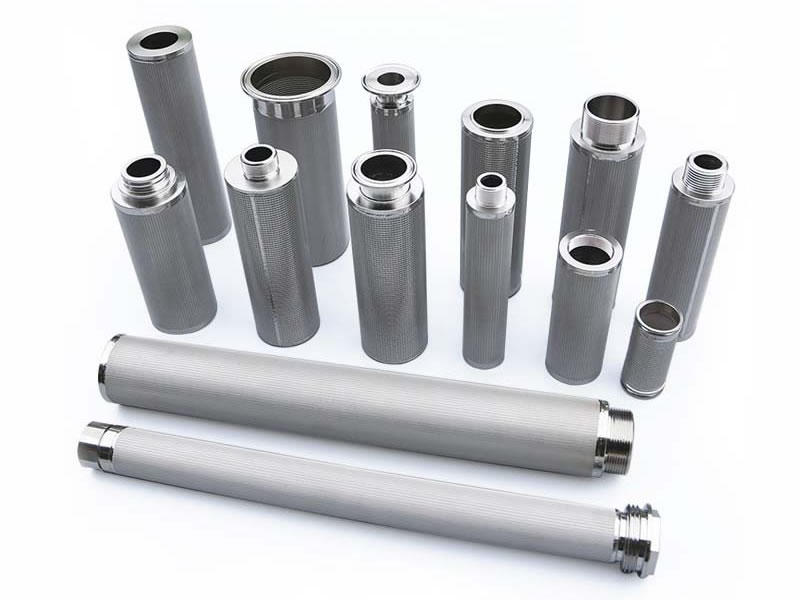
Stainless Steel Sintered Mesh Filters
Sintered mesh is produced by bonding multiple layers of woven wire mesh through a controlled sintering process, resulting in a robust, multi-layer porous structure. This technique enhances mechanical strength, backwash capability, and filtration depth, making sintered filters suitable for high-pressure and high-temperature operations. The uniform pore structure prevents collapse or deformation, even when exposed to pressure fluctuations. These filters are commonly used in petrochemical refining, hydraulic systems, natural gas processing, and chemical reactors where consistent filtration under harsh conditions is required.

Stainless Steel Perforated Metal Filters
Perforated metal filters are designed using stainless steel plates punched with evenly distributed holes. They offer excellent structural rigidity and are often used as support layers for finer filter elements. Perforated filters handle large particle loads and withstand mechanical impact, making them ideal as pre-filters or strainers in pipelines. They are frequently applied in industries handling viscous fluids, slurries, and abrasive materials. Their open area can be customized to meet specific flow and particle requirements, ensuring efficient filtration while maintaining strong durability.
Key Benefits of Stainless Steel Filters
Excellent Temperature and Pressure Resistance
Stainless steel maintains structural integrity at extreme temperatures-often exceeding 500°C depending on the alloy grade. This makes it suitable for hot oils, steam, petrochemicals, and thermal adhesives. Stainless steel filters also tolerate high differential pressures without collapsing or deforming. In systems experiencing pressure cycling, stainless steel ensures consistent performance, minimizing downtime and product contamination.
Outstanding Chemical Compatibility
Unlike polymer-based media, stainless steel resists degradation by acids, solvents, aromatic hydrocarbons, alcohols, caustics, and oxidizers. This chemical stability ensures longer service life and reduced maintenance in aggressive processing environments. Grades such as 304, 316, and 316L offer corrosion resistance suitable for food, pharmaceutical, and marine applications, while 904L and duplex steels are preferred for highly corrosive environments such as chloride-rich solutions.
Reusability and Cost Efficiency Over Time
Although stainless steel filters have a higher initial cost, their long-term value is significantly greater due to their reusability. They can be cleaned, backwashed, or regenerated multiple times without losing structural consistency. This reduces replacement frequency, disposal costs, and system downtime. Industries with continuous processing-such as petrochemicals, beverages, or coatings-benefit from improved operational efficiency and lower total cost of ownership.
Common Industrial Applications of Stainless Steel Filters

Chemical Processing
Chemical plants use stainless steel filters to handle corrosive solvents, polymers, catalysts, and high-temperature fluids. Their robust design ensures consistent filtration without degradation, even in processes involving aggressive chemical reactions. Sintered mesh filters are common in catalytic filtration, reaction purification, and process gas treatment. Stainless steel is also preferred in reactor and distillation systems where fine solids must be removed reliably.

Food & Beverage Industry
Stainless steel filters are essential for hygienic filtration of edible oils, syrups, beer, dairy liquids, and process water. Their non-reactive and non-leaching properties meet stringent food safety requirements. The smooth surface prevents microbial adhesion and simplifies cleaning, making them ideal for CIP and SIP systems. Woven or sintered stainless steel filters provide stable micron retention for clarification, polishing, and particle removal across beverage and liquid food production lines.

Oil, Gas, and Petrochemical Sectors
In high-pressure, high-temperature, and abrasive environments, stainless steel filters offer unmatched reliability. They are used in fuel lines, hydraulic systems, refinery units, compressor protection, and downstream processing. Their resistance to thermal stress and mechanical fatigue ensures stable performance during fluctuating operating conditions. Perforated metal and sintered mesh elements are often used to remove solid impurities from crude oil, natural gas, lubricants, and petrochemical intermediates.
How Stainless Steel Filters Improve System Efficiency
Reduced Downtime Through Longer Service Life
Because stainless steel filters maintain structural stability under harsh operating conditions, they last significantly longer than disposable alternatives. This reduces the frequency of shutdowns for filter changes, improving productivity and minimizing maintenance costs. Their predictable wear characteristics allow operators to establish accurate maintenance intervals and avoid sudden failures.
Improved Filtration Accuracy and Flow Consistency
Stainless steel filters provide consistent pore structure that does not change under temperature or pressure variations. This improves particle retention accuracy and maintains stable flow rates throughout the filter's life cycle. In systems where fluid clarity is critical-such as hydraulic circuits or high-purity chemical lines-stainless steel ensures predictable system performance.
Enhanced Cleanability and Hygiene Control
Stainless steel surfaces resist fouling and microbial buildup, making cleaning easier and more effective. Filters can be cleaned using steam, ultrasonic cleaning, chemical solutions, or high-pressure water. This reduces contamination risk and supports industries with high sanitation standards. Reusability also reduces waste generation, supporting environmentally responsible operations.
Stainless Steel Filter Construction Methods and Their Performance Impact
Woven Construction and Its Performance Characteristics
Woven stainless steel filters are manufactured through precise interlacing of metal wires, forming uniform pore structures that deliver predictable filtration accuracy. The stability of these pores ensures consistent flow rates and reliable particle retention over long periods of operation. Because woven mesh can be produced in a wide range of weave styles-plain, twill, and Dutch-weaving allows engineers to tailor filtration performance to various industries. Plain weave offers balanced strength and open area, while twill weave increases mechanical stability. Dutch weaves are ideal for fine filtration where micron accuracy is essential. This manufacturing method also provides excellent flexibility, enabling filters to be formed into discs, tubes, pleated elements, or panels depending on system requirements.
Sintered Laminate Construction for High-Demand Applications
Sintered laminate filters are engineered by bonding multiple layers of woven mesh under high temperature and vacuum pressure. This process fuses the layers together, creating a rigid, multi-layer porous structure with enhanced mechanical strength and excellent backwash capability. Because the pore geometry remains stable even under high differential pressure, sintered filters are preferred in hydraulic systems, petrochemical plants, and high-temperature processing lines. The depth structure provides better dirt-holding capacity than single-layer media, ensuring improved filtration efficiency and longer service intervals. Sintered laminates also resist thermal expansion and vibration, reducing the risk of deformation during demanding operations.
Perforated Plate Support and Hybrid Designs
Many stainless steel filter cartridges use perforated plates as internal or external support structures. Perforated stainless steel offers exceptional rigidity, making it suitable for filters exposed to heavy loads, pulsating pressure, or viscous fluids that require structural reinforcement. When combined with woven or sintered mesh, perforated plates prevent collapse while maintaining high flow efficiency. Hybrid designs are increasingly used in industries that require both strength and precision-such as chemical reactors, paint production, and pipeline protection systems. These combinations ensure that even under harsh industrial conditions, the filter element maintains optimal pore shape, mechanical integrity, and long-term performance.

Factors That Influence the Performance of Stainless Steel Filters
Fluid Characteristics and Contaminant Profiles
The performance of stainless steel filters is closely linked to the nature of the fluid being processed. Parameters such as viscosity, temperature, solid concentration, and chemical composition all influence filtration efficiency. High-viscosity fluids require filters with larger open areas to maintain adequate flow, whereas abrasive particles necessitate higher-strength alloys or sintered structures. Understanding contaminant size distribution is equally important: applications with a broad range of particle sizes often need multi-stage filtration, while processes involving fine solids require tighter mesh or Dutch weave constructions. Correctly matching filter media to the fluid characteristics prevents premature clogging and ensures stable system output.
Operating Pressure, Temperature, and Flow Conditions
Stainless steel filters must withstand operational pressures and temperatures that vary significantly between industries. High-pressure hydraulic systems require rigid, sintered multi-layer filters to prevent deformation, whereas high-temperature food oil or petrochemical lines may need heat-resistant grades like 316L or 310S. Flow consistency is also critical-rapid fluctuations can stress the filter structure and reduce service life. Selecting a filter element with appropriate strength, alloy grade, and porosity ensures that filtration remains stable across fluctuating operating conditions. Understanding the dynamic behavior of the system allows engineers to specify filters with optimal performance and longevity.
Maintenance Practices and Cleaning Methods
The lifespan of stainless steel filters largely depends on maintenance frequency and cleaning method selection. Because stainless steel is reusable, operators can take advantage of techniques such as ultrasonic cleaning, steam sterilization, chemical soaking, and backwashing. However, selecting the wrong cleaning method may damage the pore structure or reduce mechanical strength. For instance, aggressive acids may degrade lower-grade stainless steels, while excessive pressure during backwashing can deform woven mesh. Establishing maintenance intervals based on particle loading and system pressure also helps extend service life. Proper care ensures consistent filtration efficiency and reduces total operating costs.
Comparing Stainless Steel Filter Grades and Material Options
Common Stainless Steel Grades Used in Filtration
Different stainless steel grades offer varying corrosion resistance, mechanical strength, and temperature tolerance. Grade 304 is widely used due to balanced cost and performance, while 316 and 316L provide increased resistance to chlorides, making them suitable for marine, chemical, or food applications. Higher nickel-content alloys such as 904L and duplex stainless steels excel in aggressive environments where pitting and crevice corrosion are concerns. The grade selection depends on the fluid's chemical properties, temperature range, and the required durability of the filtration system. A suitable grade ensures long-term stability and prevents premature failure.
How Alloy Selection Affects Operational Lifespan
Selecting the correct alloy directly impacts the filter's resistance to corrosion, erosion, and thermal stress. In environments containing acids, chlorides, or solvents, lower-grade stainless steel may degrade quickly, leading to pore enlargement or structural weakening. Using 316L or duplex materials increases lifespan by providing superior corrosion and fatigue resistance. In high-temperature operations, alloys such as 310S maintain mechanical strength and pore stability better than standard grades. Understanding the environmental stressors allows engineers to choose the alloy that maximizes filtration accuracy and reduces long-term maintenance costs.
Cost Considerations for Different Stainless Steel Materials
Although higher-grade stainless steels have greater initial costs, they often provide better long-term economic value in systems exposed to corrosion, fluctuating temperatures, or abrasive particles. The total cost of ownership includes not only purchase price but also maintenance frequency, downtime, and replacement cycles. For industries with aggressive chemicals, selecting a more corrosion-resistant alloy may reduce costs by preventing frequent failures. In contrast, applications involving clean water or mild fluids may benefit from cost-effective grades such as 304. Matching the alloy to system requirements ensures the best balance of performance and budget.
Comparison of Stainless Steel Grades for Filtration
| Stainless Steel Grade | Corrosion Resistance | Temperature Resistance | Ideal Applications |
|---|---|---|---|
| 304 | Moderate | Up to ~870°C | Water, general filtration |
| 316 / 316L | High (chlorides) | Up to ~900°C | Food, chemicals, marine |
| 904L | Very high | Up to ~450°C | Acidic, corrosive fluids |
| Duplex SS | Very high | Up to ~300°C | High stress & corrosive systems |
To explore filter grade selection in greater detail-especially how to match each stainless steel grade to your process conditions-you may also find our extended guide helpful:
Selecting the Right Stainless Steel Filter Grade for Your Application.
Installation, Configuration, and System Integration Best Practices
Proper Housing and Seal Design for Optimal Performance
The effectiveness of stainless steel filters depends heavily on correct installation. Filter housings must be compatible with the filter format-such as cartridges, baskets, or discs-and must provide secure sealing to prevent bypass. O-ring selection also plays a critical role. Incompatible elastomers may swell or degrade, creating gaps where contaminants can escape. Ensuring proper alignment, compression, and seal compatibility maintains system integrity and ensures that filtration efficiency meets design expectations. Regular inspections of housing surfaces and sealing components help prevent leaks and operational failures.
Correct Piping Layout and Flow Direction
System configuration greatly influences filtration performance. Incorrect flow direction may push contaminants deeper into the filter media, making cleaning more difficult. Proper piping layout ensures smooth flow and reduces turbulence, preventing pressure surges that stress the filter element. Installing pressure gauges before and after the filter housing allows operators to monitor differential pressure and determine optimal cleaning intervals. A well-engineered piping configuration minimizes energy consumption, stabilizes flow, and enhances the overall reliability of filtration operations.
Integration With Multi-Stage Filtration Systems
Many industrial processes integrate stainless steel filters into multi-stage filtration systems. Stainless steel filters often serve as pre-filters or polishing filters depending on fluid characteristics and particle sizes. When configured properly, multi-stage systems improve efficiency by distributing the filtration load across different filter types. For instance, coarse strainers remove large solids, followed by stainless steel mesh for mid-size particles, and fine cartridge filters for final polishing. Proper integration reduces stress on each filter stage and maximizes service life, resulting in improved system reliability and lower operational costs.
Recommended Installation Parameters
| Parameter | Recommendation | Impact |
|---|---|---|
| Flow Direction | Follow manufacturer marking | Prevents media damage |
| Differential Pressure Gauge | Required | Maintenance scheduling |
| Seal/O-ring Selection | Match chemical compatibility | Avoids leaks and bypass |
| Housing Alignment | Must be precise | Ensures full filtration efficiency |
Maintenance Practices for Long-Lasting Stainless Steel Filters
Routine Cleaning Methods to Maintain Peak Performance(约150词)
Regular cleaning is the cornerstone of extending the service life of stainless steel filters. Depending on the contamination type-oil, dust, sediment, or chemical residues-cleaning procedures may vary, but the goals remain consistent: restore flow rate, prevent clogging, and maintain uniform filtration accuracy. For coarse filtration systems, simple backwashing or ultrasonic cleaning is often sufficient. In more demanding environments such as chemical and pharmaceutical plants, alkaline soaking or acid-neutralizing cleaning cycles are used to dissolve stubborn residues without damaging the metal structure. It is recommended to establish cleaning intervals based on the differential pressure trend rather than arbitrary schedules. When cleaning stainless steel mesh, operators should avoid using steel brushes or abrasive tools, as these may scratch or deform the mesh, reducing filtration accuracy. Proper drying after cleaning is equally important to prevent corrosion in chloride-rich environments.
Inspection Techniques to Detect Early Wear or Deformation
Routine inspection ensures the filter is functioning within design parameters and prevents unexpected shutdowns. Visual inspection is the most common technique and should focus on identifying mesh deformation, broken wires, pitting corrosion, or discoloration caused by chemical attack. For fine micron-rated filters, shining a strong light behind the mesh helps reveal pinholes or irregular openings that compromise filtration efficiency. In high-pressure systems, frame warping and gasket wear are critical issues that require immediate attention, as they may lead to bypassing. Advanced industries also use dimensional measurement tools or micro-cameras to examine mesh uniformity. It is advisable to record inspection results in a maintenance log so that gradual degradation trends can be recognized. By comparing performance data-such as flow rate or cycle time-operators can determine whether filtration decline is caused by clogging or structural damage.
When to Repair vs. Replace Stainless Steel Filters
Deciding whether to repair or replace a stainless steel filter depends on several technical factors, including structural integrity, mesh precision, and the cost of downtime. Minor damage-such as slight clogging or small deformations-can often be resolved by re-cleaning, gentle reshaping, or replacing gaskets. However, if the filter shows repeated clogging even after proper cleaning, it may indicate permanent mesh distortion or micro-cracks that are no longer visible to the naked eye. In such cases, replacement is the most reliable option. High-risk industries like pharmaceuticals, food processing, and petrochemicals should replace filters immediately if contamination is detected downstream, as product purity and equipment safety are at stake. Evaluating total operational cost is also important: sometimes the cost of frequent cleaning outweighs the investment in a new filter. A planned replacement schedule helps avoid emergency downtime and enhances long-term system reliability.
Conclusion
Stainless steel filters remain one of the most reliable and versatile filtration solutions across industrial sectors due to their durability, heat resistance, and exceptional mechanical strength. However, achieving optimal performance requires more than selecting the right mesh size or alloy-it depends on implementing proper maintenance practices, understanding the operational environment, and monitoring system performance. When industries incorporate structured cleaning cycles, periodic inspections, and data-driven replacement decisions, the filtration system maintains consistent flow rates, stable pressure, and precise filtration quality. Additionally, stainless steel filters offer advantages over disposable media, including long service life and reduced waste, making them a cost-effective choice for long-term operations.
By applying the techniques discussed in this guide, manufacturers and plant operators can significantly reduce downtime, prevent contamination risks, and extend the service life of their filtration equipment. Stainless steel filters play a crucial role in protecting pumps, valves, and downstream systems, ultimately improving overall production efficiency. Proper maintenance not only preserves the structural integrity of the mesh but also ensures filtration accuracy remains within required specifications. Whether used in chemicals, water treatment, food processing, oil refining, or hydraulic systems, the combination of correct filter selection and proactive maintenance strategies provides reliable protection and sustained operational performance.