






While the selection of a stainless steel alloy determines the chemical resilience of a filter, it is the weave pattern that dictates its functional physics. The way wires are interlaced-the angles of the crimp, the density of the packing, and the resulting geometry of the aperture-creates the fundamental "logic" of the separation process. In industrial engineering, the weave pattern is not an aesthetic choice; it is a calculation of flow resistance, mechanical stability, and particle capture efficiency. A miscalculation in weave selection can lead to premature blinding, media migration, or structural failure under pressure.
We will examine the mechanical stresses inherent in each design, the fluid dynamics of their respective pore structures, and the mathematical relationships between wire diameter and aperture stability. By understanding the physics behind these patterns, engineers can move beyond "nominal" specifications to design filtration systems that offer predictable performance across thousands of operational hours.

Square Mesh Geometries: Plain vs. Twill Mechanics
Plain Weave: Symmetry and Interfacial Friction
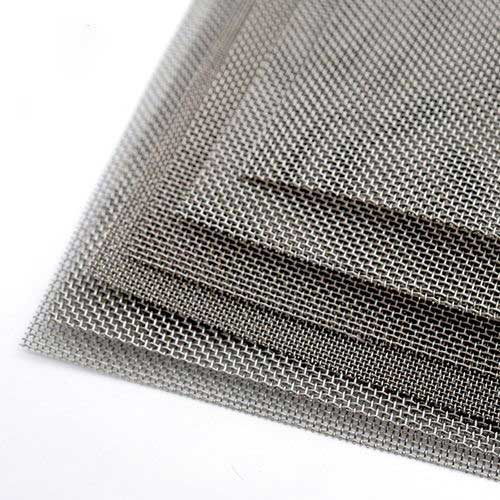
The Plain Weave is the most stable of all weave patterns due to the maximum number of wire-to-wire contact points. In this 1:1 interlacing style, every warp wire passes over and under every shute wire. This creates a high level of "interfacial friction" that locks the wires into a fixed position. From a physics perspective, the plain weave offers the most predictable "Open Area" calculation because the apertures are perfectly square and uniform. This symmetry ensures that fluid velocity remains constant across the entire surface of the mesh, which is critical for sifting applications where even a small deviation in hole size could compromise product quality.
However, the stability of the plain weave comes at a mechanical cost. Each wire must undergo a sharp bend (crimp) at every intersection. As the wire diameter increases relative to the aperture size, the internal stresses in the metal rise significantly. If the "weaveability limit" is exceeded, the wires can develop micro-cracks during the manufacturing process, leading to a "good" filter that fails prematurely due to stress corrosion. For this reason, plain weaves are typically restricted to lower mesh counts where the wire is flexible enough to accommodate the frequent 90-degree transitions required by the over-under pattern.
Twill Weave: Stress Distribution and Packing Density
Twill weaving was developed to overcome the physical limitations of the plain weave. By passing each shute wire over and under two warp wires, the "crimp" angle is significantly reduced. In terms of physics, this means the individual wires undergo less mechanical deformation during the weaving process, allowing for the use of thicker, stronger wires in much finer mesh counts. The staggered, diagonal pattern of the twill weave distributes mechanical loads more evenly across the metal cloth, making it highly resistant to the "fatigue" caused by pulsating hydraulic loads or high-frequency vibration.
The diagonal alignment of a twill weave also creates a unique pore structure. While a plain weave has a direct, straight-through aperture, the twill weave presents a slightly more angled path for the fluid. This "tortuous path" can be an advantage in certain filtration scenarios, as it increases the likelihood of a particle striking a wire rather than passing through the center of a hole. This section explores why twill weaves are the standard for high-durability applications between 100 and 635 mesh, where the combination of high wire density and reduced internal stress is required for long-term survival in aggressive industrial environments.
Square Mesh Mechanical Comparison
| Feature | Plain Weave (Standard) | Twill Weave (Heavy Duty) | Engineering Impact |
| Interlace Ratio | 1:1 (Over 1, Under 1) | 2:2 (Over 2, Under 2) | Twill allows for thicker wire use |
| Crimp Angle | High / Sharp | Low / Gradual | Twill reduces internal metal stress |
| Wire Stability | Highest (Max friction) | Moderate (Needs tension) | Plain resists wire shifting better |
| Aperture Shape | Exact Square | Slightly Tapered Square | Plain is better for lab-grade sifting |
| Flexibility | Rigid | Pliable | Twill is easier to form into shapes |
Dutch Weave Dynamics: The Surface-Depth Hybrid
Plain Dutch Weave: The Physics of "Zero" Open Area
Dutch weaves introduce a non-symmetrical geometry where the warp and shute wires have different diameters and counts. In a Plain Dutch weave, the shute wires are driven so closely together that they touch, effectively creating a "zero" visible open area when viewed from above. The physics of this weave is fascinating because the fluid does not move in a straight line; it must navigate a series of triangular, wedge-shaped openings. This makes the Dutch weave a "surface-depth" hybrid, where large particles are caught on the surface while finer particles are trapped within the wedge-shaped "tunnels" of the mesh.
The primary mechanical advantage of the Dutch weave is its incredible tensile strength. Because the shute wires are packed to their physical limit, they support each other against hydraulic pressure. This makes the Dutch weave "good" for high-pressure systems where a standard square mesh would simply "blow out" or tear. We analyze the "flow coefficient" of these triangular pores, which, despite their dense appearance, can maintain surprisingly high flow rates due to the sheer number of microscopic channels available per square inch of the filter media.
Twill Dutch Weave: Achieving Sub-Visible Precision
Twill Dutch weaves are the most sophisticated products of the loom, combining the staggered twill pattern with the dense packing of the Dutch weave. This allows for the use of incredibly fine shute wires-sometimes thinner than a human hair-packed in multiple layers. The result is a filter media capable of absolute particle cutoff down to 1 or 2 microns. In this sub-visible realm, the physics of "Brownian motion" and "Interception" become more relevant than simple mechanical sifting. Particles do not just "hit" the mesh; they are pulled toward the wires by microscopic fluid eddies within the curved pore structure.
This weave pattern is essential for high-stakes industries like aerospace and medical device manufacturing. However, the complexity of the Twill Dutch pore makes it notoriously difficult to clean. Unlike the square hole of a plain weave, which can be easily cleared with a back-wash, the curved paths of a Twill Dutch weave can permanently trap certain types of contaminants. This section discusses the trade-off between the "absolute" filtration accuracy of the Twill Dutch and the "operational cost" of maintaining such a dense and intricate metal structure in a continuous process line.

Engineering Selection: Matching Weave to Flow
The Impact of Weave Pattern on Pressure Drop ($\Delta P$)
The "Pressure Drop" ($\Delta P$) across a filter is the most direct measure of its impact on system efficiency. From a fluid dynamics perspective, every wire intersection in a mesh is a source of turbulence and energy loss. Because a plain weave has a high open-area-to-metal ratio, it typically offers the lowest initial pressure drop. In contrast, the dense packing of a Dutch weave creates a much higher resistance to flow. However, the initial $\Delta P$ is only half the story.
We must also consider the "loading curve"-how the pressure increases as the filter gets dirty. Because Dutch weaves have a 3D-like pore structure, they can sometimes hold more dirt before reaching a critical pressure spike compared to a simple 2D square mesh. This section explains how to balance the "clean $\Delta P$" against the "total dirt capacity" when choosing a weave pattern. A "good" weave choice optimizes the total energy consumption of the pump over the entire duration of the filter's service life, rather than just focusing on the first hour of operation.
Wire Migration and Structural Integrity
In high-vibration environments, such as those found in food processing shakers or aerospace fuel lines, the physical stability of the weave is a major safety concern. "Media migration" occurs when wires shift out of place, enlarging some holes while closing others, or in the worst case, breaking off and contaminating the downstream product. Plain weaves are "good" because their 1:1 locking mechanism provides the highest resistance to shifting. Twill and Dutch weaves, while stronger in tension, can be more susceptible to wire movement if they are not properly "calendared" (pressed) during the finishing process.
This section highlights the importance of choosing a weave that matches the "vibration profile" of the machinery. We examine how "Sintering"-the thermal bonding of the wire intersections-can take a complex weave like a Twill Dutch and make it as structurally rigid as a solid plate. For engineers, the ultimate goal is to ensure that the "geometric integrity" of the aperture remains constant from the first minute of service to the last, regardless of the mechanical shocks the system endures.
Conclusion
The choice between Plain, Twill, and Dutch weaves is a decision that affects every metric of a filtration system, from its energy consumption to its safety profile. By understanding the physics of interfacial friction, crimp stress, and tortuous path dynamics, engineers can select a weave that is perfectly tuned to the specific demands of their fluid and their environment. Whether you require the high transparency of a Plain weave, the mechanical endurance of a Twill weave, or the absolute precision of a Dutch weave, the geometry of the wire is the foundation upon which industrial purity is built.
To return to the broader overview of all mesh varieties, visit our master manual:
[What are the different types of stainless steel mesh?]