






Wire mesh is a highly engineered material used in countless industrial, architectural, and technological applications. From the precision filtration of microscopic particles in pharmaceutical laboratories to the robust security fencing of high-risk infrastructure, its versatility is unmatched in the metalworking world. The material's performance is governed by its geometric precision, material composition, and the specific method of construction, which together determine its strength, transparency, and longevity.
Choosing the correct wire mesh requires a technical understanding of the relationship between wire diameter, opening size, and the physical properties of the chosen alloy. This guide provides a comprehensive breakdown of the specifications that define high-quality wire mesh. By exploring the nuances of mesh count, weave patterns, and structural joining methods, engineers and project managers can ensure they select a material that not only meets immediate functional requirements but also provides long-term operational value in diverse environments.


Technical Metrics and Geometry
Understanding Mesh Count and Micron Ratings
The fundamental language of wire mesh begins with the "Mesh Count," a term that defines the density of the grid. In technical terms, the mesh count refers to the number of openings per linear inch, measured from the center of one wire to a point one inch away. For example, a 4x4 mesh has four openings in every inch of length and width. However, as applications move into high-precision filtration, the industry shifts its terminology toward "Microns." A micron is one-millionth of a meter, and in the world of wire cloth, it represents the diameter of the largest spherical particle that can pass through the mesh.
Understanding the inverse relationship between mesh count and micron rating is critical for engineers: a higher mesh count typically results in a smaller micron rating, but this is also heavily influenced by the "Wire Diameter." If a thicker wire is used, the opening size decreases even if the mesh count remains the same. This leads to a higher pressure drop across the screen, which can be detrimental in hydraulic or pneumatic systems. Precise calibration of these three variables-count, diameter, and micron-is the hallmark of high-end manufacturing.
The Significance of Open Area Percentage
The "Open Area Percentage" is perhaps the most vital calculation for any engineer dealing with fluid dynamics, ventilation, or screening. It represents the ratio of the total area of the openings to the total area of the mesh sheet. The calculation formula is: $(Opening / (Opening + Wire Diameter))^2 \times 100$. A mesh with a high open area allows for high flow rates with minimal pressure drop, but it may sacrifice the structural strength required to resist mechanical stress or high-velocity impacts.
Conversely, a mesh with a low open area is more robust and rigid but may lead to "blinding" or clogging in filtration cycles where particles become trapped in the narrow passages. When specifying mesh for architectural sunshades or ventilation panels, the open area also dictates the level of light transmission and airflow. Designers must find the "Sweet Spot" where the mesh provides enough transparency for its intended use while maintaining the tensile strength needed to span large frames without sagging or warping.
Standard Wire Mesh Technical Specifications
| Mesh Count (per inch) | Wire Diameter (inches) | Opening Size (inches) | Opening Size (microns) | Open Area (%) |
| 2 x 2 | 0.063 | 0.437 | 11100 | 76.4% |
| 10 x 10 | 0.025 | 0.075 | 1905 | 56.3% |
| 40 x 40 | 0.010 | 0.015 | 381 | 36.0% |
| 100 x 100 | 0.0045 | 0.0055 | 140 | 30.3% |
| 200 x 200 | 0.0021 | 0.0029 | 74 | 33.6% |
| 400 x 400 | 0.0010 | 0.0015 | 38 | 36.0% |
Weave Patterns and Performance
Plain Weave vs. Twill Weave Characteristics
The method by which wires are interlaced determines the mesh's performance in specialized environments. The most common and straightforward is the Plain Weave, where each shute wire passes alternately over and under each warp wire. This pattern is ideal for general screening and decorative applications because it offers the most consistent opening sizes and is the easiest to clean. Because the openings are square and uniform, it is the standard for sieve analysis and basic particle separation.
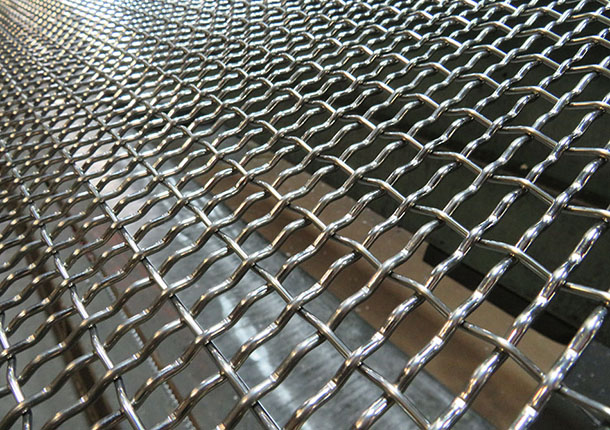
However, as the required mesh count increases for finer filtration, the wires must become thinner to maintain the same open area, which can compromise the mesh's stability. To address this, manufacturers utilize the Twill Weave, where each shute wire passes alternately over and under two warp wires. This allows for the use of heavier wires in a fine mesh, providing greater strength and resistance to "sagging" or "diagonal distortion" without reducing the filtration capability. Twill weaves are often used in high-pressure oil filters and specialized laboratory screens where durability is as important as precision.
High-Precision Dutch Weave Variations
For high-pressure industrial filtration, such as in the oil, gas, or polymer industries, Dutch Weaves are the gold standard. Unlike plain or twill weaves, Dutch weaves use different diameters for the warp and shute wires. The Plain Dutch Weave features a coarse warp mesh combined with a very fine shute mesh, resulting in a "wedge-shaped" opening that provides superior filtration at the surface. This design allows the mesh to handle high flow rates while maintaining an incredibly fine filter rating.

For even greater precision, the Twill Dutch Weave combines the twilling process with the varying wire diameters of a Dutch weave, creating a multi-layered filtration path within a single thickness of mesh. This pattern can achieve incredibly fine filtration-down to 5 microns-while maintaining enough structural integrity to be used in high-pressure hydraulic systems. Each of these patterns affects the "tortuosity" of the path that a particle must take, which in turn influences the "cake-building" characteristics of the filter, allowing for longer intervals between cleanings.
Structural Joining and Testing
Welded Wire Mesh: Rigidity and Strength
Beyond the weave, the method of joining the wires distinguishes "Woven Wire Cloth" from "Welded Wire Mesh." Welded Wire Mesh is created by laying wires in a grid pattern and fusing them at every intersection using electrical resistance welding. This creates a rigid, permanent bond that prevents the wires from shifting. Welded mesh is the preferred choice for safety guards, security fencing, and concrete reinforcement because it maintains its geometric integrity even if a portion of the mesh is cut.

In testing these welds, manufacturers perform "Shear Tests" to ensure that the bond can withstand a specific amount of force before failing. A high-quality welded mesh will typically see the wire fail before the weld itself breaks, indicating a perfect fusion of the metals. This rigidity makes welded mesh easier to fabricate into baskets or partitions, as it does not require a complex tensioning frame to maintain its shape, unlike its woven counterparts.
Quality Control and Bubble Point Testing
Testing woven mesh involves "Aperture Accuracy" checks using optical comparators to ensure that every opening is within the allowed tolerance. For aerospace and medical applications, where lives may depend on filtration accuracy, "Bubble Point Testing" is often required. The mesh is submerged in a liquid, and air pressure is applied until bubbles appear at the surface. This allows technicians to calculate the "absolute" micron rating of the mesh based on the surface tension of the liquid and the pressure required to break it.
Furthermore, "Intercrimp" and "Lock Crimp" styles are tested for mechanical stability. These crimping methods ensure that even in coarse woven mesh, the wires do not "vibrate loose" or shift under mechanical stress. By adhering to these rigorous testing protocols, manufacturers guarantee that whether the mesh is used in a backyard garden fence or a nuclear reactor's cooling system, it meets the exact structural and safety requirements of the application, providing peace of mind and operational reliability.
Welded vs. Woven Performance Comparison
| Performance Metric | Welded Wire Mesh | Woven Wire Cloth |
| Stability | Fixed (wires cannot move) | Flexible (wires may shift) |
| Material Loss | Low (wires are fused) | High (wires can unravel) |
| Opening Precision | High (fixed grid) | Extremely High (calibrated) |
| Flexibility | Rigid (hard to curve) | High (can follow contours) |
| Common Materials | Carbon Steel, Galvanized | Stainless Steel, Brass, Copper |
| Typical Use Case | Safety Barriers, Cages | Filtration, Sieving, Design |
Material Longevity and Corrosion
Stainless Steel and Specialty Alloys
The longevity of a wire mesh system is almost entirely dependent on the material's chemical compatibility with its environment. Stainless Steel is the most widely specified material, with Grade 304 being the standard for general use and Grade 316 reserved for marine or highly corrosive chemical environments. The addition of Molybdenum in 316 stainless steel significantly increases its resistance to "pitting" caused by chlorides.
In specialized chemical processing, even higher grades like 904L or nickel-based alloys like Inconel and Monel are used to withstand extreme temperatures and acidic conditions. These materials are selected not just for their resistance to rust, but for their ability to maintain tensile strength at temperatures exceeding 1000°F. Understanding the metallurgical properties of these alloys is essential for projects in the petrochemical and aerospace sectors, where material failure is not an option.
Environmental Protection and Surface Finishing
Beyond the base alloy, "Surface Treatments" can be applied to enhance longevity and aesthetics. Passivation is a chemical process for stainless steel that removes free iron from the surface, enhancing the protective chromium-oxide layer. Electro-polishing goes a step further by removing a thin layer of the metal itself, resulting in a mirror-like finish that is extremely easy to sanitize-essential for the food and pharmaceutical industries.
For outdoor architectural mesh, PVDF coatings or powder coating can provide UV resistance and color stability, preventing the metal from dulling over time. It is also vital to consider "Galvanic Corrosion," which occurs when dissimilar metals contact each other in a moist environment. By specifying compatible fasteners and support structures, engineers can ensure the mesh assembly remains structurally sound for decades, even in the most unforgiving industrial landscapes.
To see how the precision and flexibility of wire mesh stacks up against the rigidity of expanded and sheet metal, revisit the:
[Choosing the Right Material: Expanded metal, Wire Mesh, or Sheet Metal].