






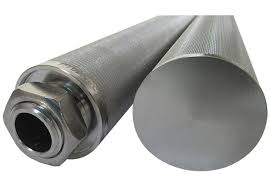
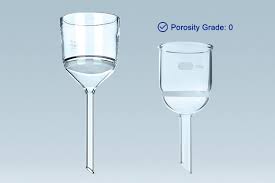
Sintered filtration media are essential for advanced industrial separation, fluid purification, catalyst recovery, analytical preparation, and high-purity gas handling. Among these materials, sintered stainless steel (SS) and sintered glass rank as two of the most widely used porous filter types. Both undergo high-temperature consolidation of particles to form rigid, stable, and uniformly porous structures. However, their mechanical strength, thermal behavior, and chemical stability differ significantly, making each material advantageous for specific environments and limitations.
This sub-article provides a deep technical comparison between sintered stainless steel and sintered glass filters across multiple performance dimensions. The goal is to help engineers, procurement specialists, and system designers determine which material best suits demanding applications in chemical processing, water treatment, pharmaceuticals, food & beverage, semiconductors, environmental sampling, and laboratory systems.
1. Mechanical Performance Comparison
Mechanical behavior determines how well a filter withstands operating stresses such as pressure, vibration, impact, and flow fluctuations. Stainless steel and glass differ greatly in this category.
1.1 Structural Strength and Pressure Resistance
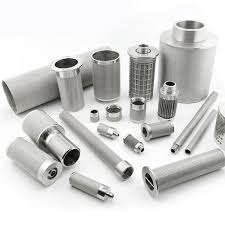
Sintered Stainless Steel
Exhibits exceptional mechanical strength, especially in compression and tension.
Can withstand very high differential pressure-often up to 3–10 MPa depending on grade and thickness.
Resilient against:
Pulsating flow
Hydraulic pressure shocks
Mechanical load-bearing applications
Suitable for:
High-pressure gas filtration
Hydraulic oil filtration
Steam filtration
Reactor and catalyst bed support
The material's ductility also allows it to deform rather than crack, ensuring safer, fail-tolerant operation.
Sintered Glass
Exhibits good rigidity but brittle behavior under mechanical load.
Maximum pressure resistance is significantly lower-usually 0.5–1 MPa, depending on pore size and thickness.
Vulnerable to:
Impact
Sudden pressure spikes
Vibrations
Mechanical shock
Because glass lacks ductility, cracks or fractures can occur suddenly and propagate quickly.
Conclusion
Sintered stainless steel is far superior in mechanical load-bearing applications. Sintered glass is suitable only for low-pressure, stable laboratory or low-stress process environments.
1.2 Porosity and Particle Retention Stability Under Mechanical Stress
Sintered Stainless Steel
Maintains pore structure integrity under compression and vibration.
Pores do not collapse easily, even under high differential pressure.
Ideal for:
Backwashing cycles
Ultrasonic cleaning
High-velocity gas streams
Sintered Glass
Porosity remains stable at low pressure, but pore distortion occurs when mechanical forces exceed threshold levels.
Higher likelihood of:
Micro-cracking
Shear-induced porosity changes
Particle shedding from fractured surfaces
Conclusion
Stainless steel offers dramatically better mechanical porosity stability in dynamic or high-energy environments.
1.3 Fatigue Resistance and Durability
Sintered Stainless Steel
Excellent fatigue resistance over long-term cyclic operation.
Suitable for continuous industrial duty, including:
Repeated pressure cycling
Pulsating compressor systems
Continuous 24/7 operation
Sintered Glass
Fatigue resistance is low because glass cannot absorb cyclic stress.
Long-term vibration or pressure cycling increases risk of fracture.
Conclusion
Stainless steel is the clear choice for longevity and fatigue-heavy environments.
2. Thermal Performance Comparison
Temperature tolerance is a critical factor in selecting filtration material. Both stainless steel and glass have unique strengths in this domain, but their practical performance differs by operating conditions, thermal shock resistance, and heat cycling behavior.
2.1 Maximum Operating Temperature
Sintered Stainless Steel
Can tolerate up to 600–1000°C depending on steel grade (316L, 310S, Inconel sintered variants).
Does not lose mechanical strength rapidly at elevated temperatures.
Suitable for:
Hot gas filtration
Steam systems
Furnace exhaust treatment
High-temperature catalyst support
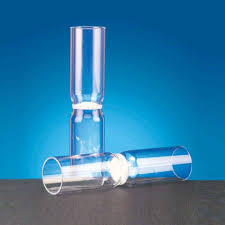
Sintered Glass
Typical operating temperature tolerance: 400–500°C for borosilicate-based sintered glass.
High thermal tolerance, but less robust under load compared to stainless steel.
Conclusion
Both materials have high temperature resistance, but stainless steel is superior for extremely high temperatures and load-bearing conditions.
READ MORE:Understanding Sintered Stainless Steel Filters: Structure, Properties, and Industrial Applications
2.2 Thermal Shock Resistance
Sintered Stainless Steel
Outstanding thermal shock resistance.
Can be rapidly heated or cooled without cracking.
Withstands:
Steam sterilization
Thermal cycling in reactors
Sudden changes in fluid temperature
Rapid switching between hot gas and ambient air
Sintered Glass
Very poor thermal shock resistance.
Rapid temperature changes cause:
Cracking
Micro-fracturing
Complete filter failure
Even borosilicate sintered glass is limited in tolerance to thermal shock compared to stainless steel.
Conclusion
Stainless steel is strongly favored where thermal fluctuations are expected.
2.3 Heat Conductivity and Temperature Distribution
Sintered Stainless Steel
High thermal conductivity.
Heat distributes evenly, reducing localized stress.
Beneficial for:
Heating-based drying
Hot filtration requiring uniform temperature gradients
Sintered Glass
Low thermal conductivity.
Higher risk of localized thermal stress and cracking.
Heat distribution is slow and uneven.
Conclusion
Stainless steel's superior conductivity enhances reliability in high-temperature industrial settings.
3. Chemical Performance Comparison
Chemical compatibility is essential in selecting a filtration medium for corrosive environments. Both materials resist corrosion, but not equally to all substances.
3.1 Corrosion Resistance Against Acids and Bases
Sintered Stainless Steel
Strong resistance to:
Mild organic acids
Clean water, saltwater
Petroleum-based media
Most industrial process gases
Vulnerable to:
Strong chlorides (e.g., hydrochloric acid)
Hypochlorite-based cleaners
Strong oxidizers at high temperatures
However, special alloys (e.g., 904L, Hastelloy) can offer superior acid resistance.
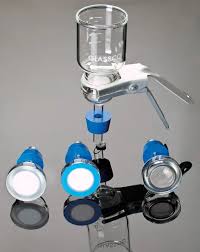
Sintered Glass
Exceptionally high chemical resistance to:
Strong acids (including HCl, HNO₃, H₂SO₄)
Oxidizers
Organic solvents
Water and steam
BUT highly vulnerable to strong bases:
Sodium hydroxide (NaOH)
Potassium hydroxide (KOH)
High-pH caustics
Alkaline attack results in surface leaching and weakening.
Conclusion
For acidic environments, sintered glass outperforms standard stainless steel.
For alkaline or chloride-rich environments, stainless steel is preferred (unless extreme chlorides require special alloy upgrades).
3.2 Chemical Inertness and Suitability for High-Purity Processes
Sintered Stainless Steel
Not fully inert-metal ions may leach in rare conditions.
Usually acceptable for:
Industrial processes
Catalyst systems
Fuel and oil filtration
Chemical processing (unless extreme purity required)
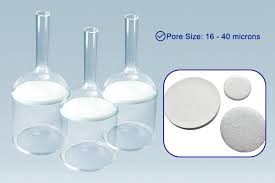
Sintered Glass
Chemically inert in most acidic and neutral settings.
Ideal for:
Analytical laboratory filtration
Pharmaceutical prep
Bio-chemical sample purification
High-purity aqueous processing
Conclusion
Sintered glass is the more "chemically clean" medium where ultra-high purity and inertness are essential.

3.3 Oxidation Resistance
Stainless Steel
Highly oxidation resistant in general.
At extremely high temperatures, oxidation can accelerate, especially with poorly selected alloys.
Glass
Does not oxidize since it is already fully oxidized silica.
Exceptional in oxidative gas processing and high-acid systems.
Conclusion
Sintered glass wins in oxidative environments, but stainless steel remains excellent for most industrial conditions.
4. Filtration Behavior and Performance Under Operating Conditions
4.1 Flow Rate and Permeability
Both materials can be engineered to similar pore sizes, but stainless steel typically offers better permeability-to-strength balance.
Stainless Steel
Designed for high permeability with strong structural integrity.
High flow rate even at fine pore sizes.
Suitable for:
Compressed air filtration
High-viscosity fluid filtration
Catalyst recovery
Glass
Provides highly uniform porosity.
Flow rate is consistent but lower due to brittle structure limiting thin-walled designs.
Conclusion
Stainless steel gives higher throughput under higher pressure.
4.2 Backwash and Regeneration Ability
Stainless Steel
Excellent for:
Backwashing
Ultrasonic cleaning
High-pressure air blowback
Steam sterilization
Does not degrade easily during cleaning.
Glass
Can be cleaned chemically but must avoid:
Abrasion
Mechanical brushing
Sudden temperature changes
High-pressure backwash
Repeated use of strong bases can degrade glass.
Conclusion
Stainless steel is far more robust and long-lasting under aggressive cleaning cycles.
4.3 Contaminant Retention and Pore Size Stability
Stainless Steel
Stable under:
Pressure
Flow turbulence
Cleaning cycles
Glass
Porosity is highly uniform and precise.
Can be damaged by thermal or mechanical shocks.
Conclusion
Choose glass for ultra-consistent lab-scale filtration; choose steel for durability and industrial reliability.
5. Comparative Performance Table
|
Performance Factor |
Sintered Stainless Steel |
Sintered Glass |
|
Mechanical Strength |
Excellent; ductile, tough |
Poor–Moderate; brittle |
|
Pressure Tolerance |
Very high (3–10 MPa) |
Low (0.5–1 MPa) |
|
Thermal Shock Resistance |
Excellent |
Very poor |
|
Max Temperature |
600–1000°C |
400–500°C |
|
Acid Resistance |
Moderate; alloy dependent |
Excellent |
|
Alkali Resistance |
Excellent |
Very poor |
|
Chemical Inertness |
Moderate |
Very high |
|
Cleaning Durability |
Excellent |
Limited |
|
Longevity |
Very long |
Moderate (fragile) |
|
Flow Rate |
High |
Medium |
|
Best Uses |
Industrial, high-pressure, high-temperature |
Labs, high-purity acids, controlled settings |
6. Final Evaluation
Sintered Stainless Steel Advantages
Best for industrial, high-pressure, high-temperature, and mechanically intensive environments.
Extremely durable and cost-effective long term.
Superior resistance to abrasion, pressure spikes, vibration, and thermal shock.
Sintered Glass Advantages
Best where chemical purity, acid resistance, and inertness are top priorities.
Ideal for laboratories, pharmaceutical sample prep, and analytical applications.
Choosing Between Them
Select sintered stainless steel when strength, durability, and harsh environment resistance are essential.
Select sintered glass when chemical purity and inertness matter more than mechanical strength.