





In modern process plants utilizing vertical and horizontal pressure leaf filters, overall vessel productivity is governed by the structural and fluidic performance of individual internal leaf panels. Operating inside closed pressure vessels, each filter leaf element acts as a self-contained filtration unit-supporting pre-coat beds, capturing suspended solid particles, and channeling clarified liquid into the clean outlet manifold header.
During continuous operating cycles, filter leaf elements are subjected to aggressive operating conditions, including differential pressure spikes ($\Delta P$), thermal cycling, chemical corrosion, and high-frequency pneumatic vibration during cake discharge. Poorly designed leaf panels often fail prematurely due to frame bowing, outer screen tearing, or spigot bypass leakage.
To maximize filtration throughput and eliminate unscheduled maintenance downtime, plant engineers depend on heavy-duty High-Efficiency Pressure Leaf Filter Leaf Element assemblies.
This technical article provides a detailed engineering breakdown of pressure filter leaf elements, examining mechanical frame dynamics, hydraulic flow kinetics through internal drainage cores, spigot sealing mechanisms, and field re-meshing protocols for plant workshop technicians.
To explore foundational metallurgy, weave structures, and primary filtration mechanics across our complete product family, visit our core [Stainless Steel Filter Leaf].
Mechanical Frame Dynamics and Structural Deformation Resistance
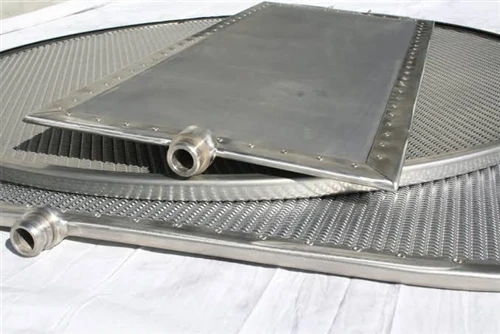
A high-performance filter leaf element consists of three primary structural layers: the outer C-channel perimeter frame, the internal heavy drainage grid core, and the multi-layer outer filtration screens.
Engineering Requirements for Frame Integrity
C-Channel Perimeter Compression: The outer frame profile must be cold-formed from heavy-gauge stainless steel (SS316L or Alloy 20). This C-channel holds the multi-layer mesh stack under continuous compression, preventing edge fraying and ensuring zero bypass around panel margins.
Resistance to Planar Bowing: Under high differential pressures ($\Delta P > 3.5\text{ bar}$), thin frames bow inward, disturbing the pre-coat bed and causing uneven cake deposition. Reinforced frame channels ensure the panel remains completely flat across its entire surface area.

Internal Fluid Dynamics and Spigot Sealing Integrity
Fluid exiting the outer filtration mesh enters the internal drainage core, where it flows downward or laterally toward the discharge spigot.
Fluidics and Outlet Sealing
High-Flow Internal Drainage Matrix: The central support grid must feature large open apertures to allow rapid, uninhibited liquid flow toward the discharge spigot. Restrictive internal cores create backpressure, reducing overall vessel flow velocity.
Precision CNC Spigot Sealing: The bottom or central outlet spigot bridges the leaf panel and the vessel outlet header. CNC-machined from solid bar stock with dual Viton O-ring grooves, it provides a leak-free seal that prevents raw, unfiltered slurry from entering the clean effluent stream.
Field Refurbishment & Re-Meshing Protocols
When the outer Dutch weave screens of a filter leaf element eventually suffer mechanical abrasion or blinding, the structural frame and internal core can be reused by installing a new replacement mesh pack in the plant workshop.
| Refurbishment Step | Key Technical Action | Workshop Equipment Used |
| 1. Strip & Inspect | Remove old C-channel, inspect inner core for flatness | Roll-seam wedge driver, straightening table |
| 2. Spigot Alignment | Lock spigot perpendicular to frame axis | Precision spigot alignment gauge block |
| 3. Layer Stacking | Lay cushion mesh and outer Dutch screen on core | Pre-cut multi-layer replacement mesh pack |
| 4. Planar Tensioning | Stretch mesh drum-tight across the panel face | Pneumatic planar tensioning clamp bars |
| 5. Frame Crimping | Crimp C-channel frame over tensioned mesh | Contoured C-channel crimping pliers |
Operational Best Practices for Extended Leaf Life
To achieve multi-year service life from your filter leaf elements, process plant teams should enforce the following operational guidelines:
Prevent Differential Pressure Surges: Monitor differential pressure closely; initiate cake discharge cycles before $\Delta P$ exceeds $3.5 - 4.0\text{ bar}$ to prevent permanent screen stretching or core compaction.
Routine Spigot O-Ring Replacement: Replace elastomeric spigot O-rings during every major turnaround to maintain a perfect seal inside the manifold header.
Proper Cake Discharge Vibration: Ensure pneumatic vibrators operate at the recommended air pressure ($4.0 - 6.0\text{ bar}$) for short, sharp bursts rather than prolonged low-frequency shaking, protecting frame welds from kinetic fatigue.
Conclusion
The High-Efficiency Pressure Leaf Filter Leaf Element serves as the vital core of heavy industrial pressure leaf filtration equipment. Combining rigid C-channel frames, high-flow drainage cores, CNC-machined outlet spigots, and pre-tensioned Dutch weave outer screens, engineered filter leaf elements deliver long service life, zero fluid bypass, and maximum hydraulic productivity.
To review general vertical pressure leaf designs and bottom spigot fluidics, read our technical article on [Vertical Leaf Filter Elements: Bottom-Discharge Fluidics, Vessel Manifold Sealing, and Array Alignment Stability] or contact our spare parts engineering department for OEM leaf replacement drawings and re-meshing consultations.