






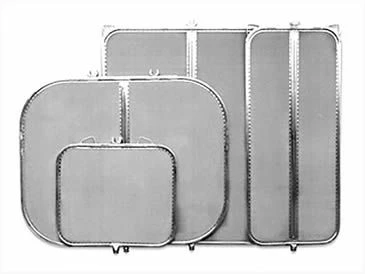
CHG Metal manufactures sintered mesh filter leaves for pressure leaf filtration systems. The leaves are made from multiple layers of stainless steel wire mesh that are diffusion-bonded under high temperature and pressure.
Standard constructions can be supplied with 3, 5, 6 or 7 layers, with a five-layer structure used as the common base for 1–100 µm filtration. Custom layer combinations, dimensions, frames, hubs and outlet connections are built to drawings or samples.


Sintered Structure and Layer Function
The filtration layer determines the nominal retention rating, while the protective, dispersion, support and drainage layers control flow distribution, mechanical support and cleanability. A typical five-layer sintered mesh filter leaf uses two protective/dispersion layers around one filtration control layer, plus two reinforcement layers on the clean side. This structure keeps the fine filtration layer supported and allows filtrate to flow through the internal drainage channels.
|
Layer |
Function |
Typical Mesh Reference |
|
Protective layer |
Protects the filtration layer and distributes inlet flow |
100 mesh |
|
Filtration control layer |
Sets the nominal filtration rating and particle retention |
400×2800, 325×2300, 200×1400, etc. |
|
Dispersion layer |
Creates an even flow field before the filtration layer |
100 mesh |
|
Reinforcement layer |
Supports the fine mesh and increases overall rigidity |
12×64 |
|
Heavy support/drainage layer |
Provides structural strength and filtrate channels |
64×12 |
Sintering Process and Bonding
Production starts with mesh structure design, material inspection, layer stacking and ultrasonic cleaning. The stacked mesh is then vacuum-sintered at high temperature so that wire contact points form diffusion bonds without losing the woven aperture geometry. After sintering, the panel is calendered, cut, edge-finished and assembled with the required frame or hub. The bonded structure resists layer movement, wire migration and aperture distortion under repeated pressure and backwash cycles.
Filtration Rating, Pore Size and Porosity
The filtration rating and permeability must be read together. A tighter filtration layer gives finer particle retention but lower air permeability and higher pressure drop. The reference table below shows common five-layer sintered mesh grades. Final performance should be selected using particle size distribution, viscosity, flow rate, differential pressure, backwash method and cleaning chemicals.
|
Nominal Rating |
Air Permeability Reference |
Bubble Point Reference |
Typical Structure Reference |
|
1 µm |
1.81 L/min/cm² |
360–600 mm H₂O |
100 + 400×2800 + 100 + 12×64 + 64×12 |
|
5 µm |
2.42 L/min/cm² |
260–550 mm H₂O |
100 + 200×1400 + 100 + 12×64 + 64×12 |
|
10 µm |
3.00 L/min/cm² |
220–500 mm H₂O |
100 + 165×1400 + 100 + 12×64 + 64×12 |
|
20 µm |
4.50 L/min/cm² |
170–450 mm H₂O |
100 + 165×800 + 100 + 12×64 + 64×12 |
|
50 µm |
8.41 L/min/cm² |
90–300 mm H₂O |
100 + 250 + 100 + 12×64 + 64×12 |
|
100 µm |
9.10 L/min/cm² |
70–190 mm H₂O |
100 + 150 + 100 + 12×64 + 64×12 |
Custom constructions are available
Materials, Pressure and Temperature
CHG Metal supplies sintered mesh filter leaves in SS304, SS304L, SS316, SS316L, SS904L, Hastelloy C276, Alloy 20 and Monel 400.
SS304 is used for general industrial filtration, SS316/316L for chemical, water and food-related duties, and higher-alloy grades for aggressive media, chlorides or elevated-temperature service.
Cleaning and Regeneration
Sintered mesh filter leaves are suitable for backwashing, ultrasonic cleaning, chemical cleaning and thermal cleaning when the construction and medium allow it. The bonded layers do not separate during normal reverse-flow cleaning, so the pore structure remains stable after repeated filtration cycles. Cleaning frequency and reusable life depend on solids loading, particle shape, viscosity, cleaning chemicals and the way the leaf is removed from the vessel.
Replacement Compatibility
CHG Metal can quote a complete sintered filter leaf, a replacement sintered mesh pack or an internal mesh replacement for an existing pressure leaf filter.
To match an existing installation, send the overall length, width or diameter, frame thickness, hub or nozzle position, outlet flange or spigot dimensions, mesh rating, layer construction, operating pressure, temperature, medium and cleaning method.
Drawings, 3D files, photos with dimensions and retired samples all help shorten the review.
Manufacturing and Quality Inspection
Every sintered mesh filter leaf goes through CHG's strict material verification, mesh inspection, layer alignment check, sintering review, dimensional inspection, edge and weld inspection, surface inspection, and packaging review.
For pressure leaf filter replacement projects, we also record frame diagonals, flatness, hole positions, and connection dimensions before shipment.
FAQ
What makes sintered mesh filter leaves superior for high-pressure backwashing?
+
-
Conventional wire mesh layers are held together by mechanical pressure and frame clamping; high reverse backwash pressure can cause outer mesh layers to bow away from inner support layers. In a sintered mesh leaf, all layers are atomistically fused together, allowing high reverse pressure pulses without delamination or deformation.
Can sintered mesh filter leaves be used without pre-coat filter aids?
+
-
Yes. Because sintered mesh offers highly uniform, non-deformable pore geometry down to 1–5 microns, many slurry clarification applications can achieve direct surface filtration without using diatomaceous earth or perlite pre-coat materials, reducing operating waste.
Are sintered filter leaves heavier than standard leaf assemblies?
+
-
Sintered mesh filter panels are structurally denser and more rigid than loose multi-layer mesh packs, but their overall weight remains fully compatible with standard vertical and horizontal pressure leaf vessel guides and vibration discharge mechanisms.
Can you manufacture a replacement leaf for existing equipment?
+
-
Yes. Send the old drawing, sample or measured dimensions. We review the frame, layer construction, hub, nozzle, connection, sealing and installation envelope before quotation.
What information is needed for a quotation?
+
-
Please provide filtration rating, layer construction, material, dimensions, frame type, hub or nozzle details, connection standard, working pressure, temperature, medium, flow rate, cleaning method, quantity and required inspection documents.
Request a Quote
Send your drawing, sample photos or existing leaf dimensions to CHG Metal.
Our engineering team will review the sintered mesh structure, material, frame, connection and installation requirements, then return a manufacturing drawing and quotation for your project.


