






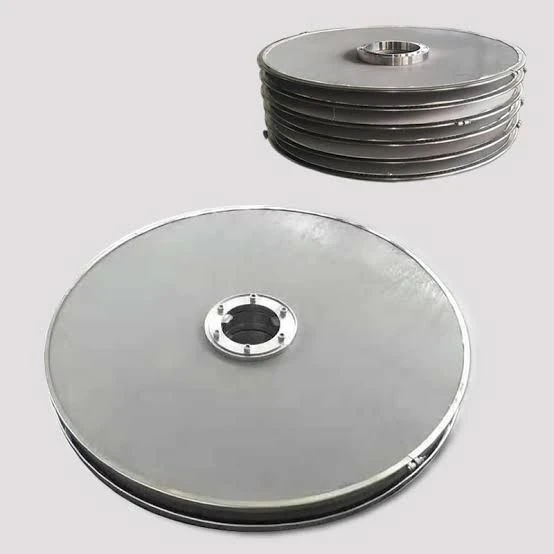
CHG Metal manufactures custom pressure leaf filter elements for projects where a standard catalogue leaf does not match the vessel, process fluid or maintenance method. Engineering starts with the application, equipment drawing, old-part sample or measured interface data. We then configure the material, mesh layers, drainage core, frame, hub or nozzle and sealing structure, and review the design before production.


Engineering Inputs
A custom pressure leaf filter engineering project starts with the process and the interface, not with a fixed model number. The input sheet should identify the medium, particle size, solids loading, viscosity, flow rate, allowable pressure drop, operating pressure, temperature, cleaning method and required filtrate quality. The equipment side should include the vessel type, leaf envelope, suspension or hub position, manifold or nozzle connection, sealing method, guide clearance and available maintenance space. A drawing, 3D model, retired sample or measured sketch shortens the review and reduces dimensional risk.
Application Matrix
|
Application |
Key Design Variables |
Material and Construction Direction |
|
Edible oil bleaching, dewaxing and hydrogenation |
Bleaching earth load, cake thickness, dry/wet discharge |
5-layer construction, PDW or RPDW, SS316L and reinforced frame |
|
Catalyst recovery |
Fine particles, valuable metal loss and cleaning method |
Finer filtration layer, stable apertures, corrosion-resistant alloy and edge sealing |
|
Chemicals and resins |
Viscosity, corrosion, temperature and solids |
316L, 904L, Alloy 20 or C276; U/C profile frame |
|
Brine and mineral filtration |
Particle abrasion, corrosion and flow variation |
Abrasion-resistant frame, reinforced drainage core, 316L or higher alloy |
|
Food and pharmaceutical liquids |
Cleaning, hygiene and material traceability |
Stainless steel, cleanable surface, material certificate and O-ring or gasket |
|
High-temperature or hot-oil loops |
Thermal expansion, seal stability and frame rigidity |
Thermally stable material, reinforced frame, metal seal or high-temperature O-ring |
Configuration Options
|
Configuration |
Available Range |
Selection Basis |
|
Layer count |
3-layer, 5-layer or 7-layer |
Particles, flow, pressure drop, backwashing and frame stiffness |
|
Filtration mesh |
24×110, 30×150, 80×700, RPDW, TDW and other grades |
Target micron and particle distribution |
|
Drainage core |
3×3, 4×4 or high-flow construction |
Viscosity, flow, pressure drop and cleaning method |
|
Frame |
U-channel, C-channel, reinforced edge bar, riveted/welded/bolted construction |
Vessel guide, vibration, pressure cycling and maintenance method |
|
Nozzle/hub |
O-ring groove, flat gasket, flange, manifold or bypass relief neck |
Vessel connection and sealing method |
|
Material |
SS304, SS316L, SS904L, Alloy 20, Hastelloy, Monel and Titanium |
Medium, temperature, chloride level and corrosion class |
|
Shape |
Circular, rectangular, disc and drawing-based profiles |
Vessel construction, mounting orientation and filtration area |
Manufacturing and Quality Inspection
CHG's manufacturing process includes material certification, mesh inspection, cutting, layer alignment, frame machining, drainage core assembly, welding or riveting, nozzle or hub machining, mesh tensioning, seal assembly, and final packaging. Inspection can cover material grade, mesh count, aperture, layer sequence, frame dimensions, diagonals, flatness, nozzle position, seal grooves, weld appearance, surface condition, and packaging photos.
Technical Reference
|
Item |
Reference Range |
|
Layer count |
3, 5 or 7 layers |
|
Filtration mesh |
24×110, 30×150, 80×700, RPDW and TDW |
|
Drainage core |
3×3, 4×4 or high-flow construction |
|
Frame |
U-channel, C-channel, riveted/welded/bolted |
|
Material |
SS304, SS316L, SS904L, Alloy 20, Hastelloy, Monel and Titanium |
|
Design reference pressure |
-1 to 6 bar(g) |
|
Design reference temperature |
0–150°C |
|
Dimensions |
Circular, rectangular and drawing-based |
FAQ
Q: Can your custom-engineered leaves replace original parts from brands like Amafilter, Sharplex, or LFC without modifying our vessel?
A: Absolutely. Every single custom element we manufacture is built as a 100% drop-in replacement. We collect the precise brand, model number, nozzle geometry, and vessel guide spacing from your facility, and apply our high-precision machining tolerances (±1.0mm outer width) to guarantee a flawless, frictionless fit inside your existing manifold.
Q: How does your customization process handle extreme high-temperature loops like molten sulfur?
A: Riverbanks, reservoirs, and coastal erosion control Slope stabilization and landslide protection Highway and railway embankment reinforcement Bridge abutment and culvert protection Garden retaining walls and landscape decoration Military and noise barrier walls (e.g., Hesco barriers)
Q: What makes a custom-engineered pressure leaf filter different from a standard leaf?
A: It is configured around the process fluid, vessel interface and maintenance method rather than selected from a fixed size list. The design may change the mesh, layer count, drainage core, frame, nozzle, material and sealing arrangement.
Q: Can you start from a sample or old part?
A: Yes. A retired leaf, measured dimensions, marked photos and the vessel connection drawing can be used as inputs for a drawing-based pressure leaf filter or replacement leaf.
Q: Which materials and meshes can be considered?
A: Common options include SS304, SS316L, SS904L, Alloy 20, Hastelloy, Monel and Titanium, with 24×110, 30×150, 80×700, RPDW and TDW mesh references.
Q: Which applications are suitable?
A: Edible oil, catalyst recovery, chemicals, resins, brine, minerals, food, pharmaceutical and high-temperature liquid filtration can be reviewed. The final design depends on the actual medium and equipment data.
Request a Quote
Send the application data, vessel drawing, old-part sample or measured dimensions to CHG Metal. Our engineering team will review the custom pressure leaf filter requirement, propose the material and construction, prepare a manufacturing drawing and confirm the inspection plan before quotation.
Select your process application, note your target operating viscosity and temperature, define your current vessel brand, and submit your clarification requirements to our engineering team. We will generate a detailed, serialized CAD model and metallurgical recommendation tailored to your plant's specific ROI goals.
Our address
Youyi North Street, Lianmeng Road, Xinhua District, Shijiazhuang City, Hebei Province, China 050061
Phone Number
+8615076820259
jesse@chgmetal.com



