



Metallurgy & Extreme-Environment Durability
In chemical process plants, pressure filter leaves often operate at elevated temperatures up to 420°C and in contact with highly reactive aggressive chemical media. Under these conditions, standard SS 304 or SS 316L mesh and frame components experience rapid pitting corrosion, intergranular carbide precipitation, and chloride-induced stress corrosion cracking (SCC), leading to sudden wire breakage and perimeter seal leakage.
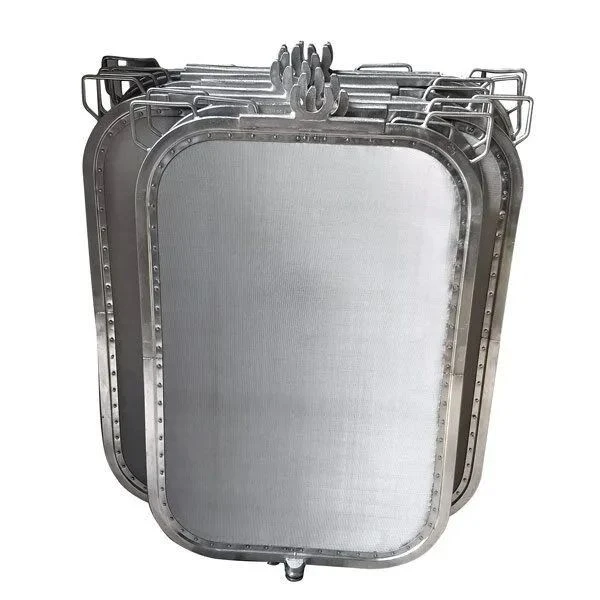
Our High-Temperature Alloys & Corrosion-Resistant Filter Leaves utilize specialized nickel-chromium-molybdenum and titanium metallurgy across every structural component-including the outer C-channel frame, inner drainage grid layers, and fine active filter cloth.
By matching the alloy chemistry of the entire leaf assembly, we eliminate galvanic corrosion at component contact points and preserve high tensile strength and fatigue resistance through thousands of thermal and chemical pressure cycles.
Details


Exotic Alloy Leaves vs. Standard SS 316L Leaves
Our specialized corrosion-resistant filter leaves provide critical reliability advantages in aggressive chemical environments:
| Operating Parameter | Standard SS 316L Filter Leaves | Specialty Alloy Filter Leaves (Hastelloy / Monel / 904L) |
| Max Operating Temperature | Continuous up to 250°C | Continuous up to 500°C (Alloy dependent) |
| Chloride Resistance (Pitting) | Moderate (Prone to pitting in high $Cl^-$) | Exceptional (High PREN rating for zero pitting) |
| Sulfuric/Phosphoric Acid Handling | Poor (Rapid chemical attack) | Superior (SS 904L / Hastelloy withstand acid concentration) |
| Stress Corrosion Cracking (SCC) | High vulnerability above 60°C | Immune (High Nickel/Molybdenum content blocks SCC) |
| Caustic & Hydrofluoric Acid | Rapid degradation | Monel 400 provides long-term chemical passivity |
| Service Life in Harsh Media | 3 to 6 months (Frequent replacement) | 24 to 60+ months (Drastically reduced downtime) |
Key Performance Advantages Rooted in Our Manufacturing Process
● Monometallic Component Integrity: Frame, internal core grids, intermediate buffer layers, outer wire mesh, and discharge necks are fabricated from the exact same alloy grade, preventing localized galvanic corrosion cells.
● Controlled Inert Gas TIG Welding: All structural seams and discharge necks are welded in continuous argon/purged shielding gas environments to prevent alloy oxidation, carbon burn-out, and weld seam embrittlement.
● Passivated Chemical Surface Treatment: Leaf assemblies undergo specialized chemical passivation and solvent cleaning to ensure immediate formation of a stable, corrosion-resistant passive oxide skin across all active surfaces.
Frequently Asked Questions (FAQ)
Q: 1. Why is SS 904L preferred over SS 316L for sulfuric acid and fertilizer processing?
A: SS 904L is a super-austenitic alloy containing 4.0% to 5.0% Molybdenum and added Copper (1.0–2.0%). This chemical combination creates high passivity against dilute and concentrated sulfuric, phosphoric, and organic acids, preventing the pitting and rapid dissolution that occurs with standard 316L.
Q: 2. How do you select between Hastelloy C276 and Monel 400 for liquid clarification?
A: Hastelloy C276 is the premier choice for highly oxidizing chemical environments, wet chlorine gas, ferric chlorides, and high-temperature organic acids. Monel 400 (a Nickel-Copper alloy) is specified for reducing chemical environments, hydrofluoric acid, strong alkaline/caustic solutions, and concentrated saltwater streams.
Q: 3. Can exotic alloy filter leaves be remeshed or refurbished?
A: Yes. Because Hastelloy, Monel, and SS 904L heavy frames retain their structural integrity long after the outer wire mesh reaches its service life, the rigid outer frames can be inspected, chemically cleaned, and re-fitted with new surface mesh, reducing overall lifecycle capital equipment costs.


