








316 stainless steel wire mesh is an austenitic woven mesh containing roughly 16–18% chromium, 10–14% nickel and 2–3% molybdenum. The molybdenum addition improves resistance to pitting in many chloride and chemical environments, which is why 316 is common in chemical processing, marine atmospheres, water treatment, food equipment and pharmaceutical filtration.
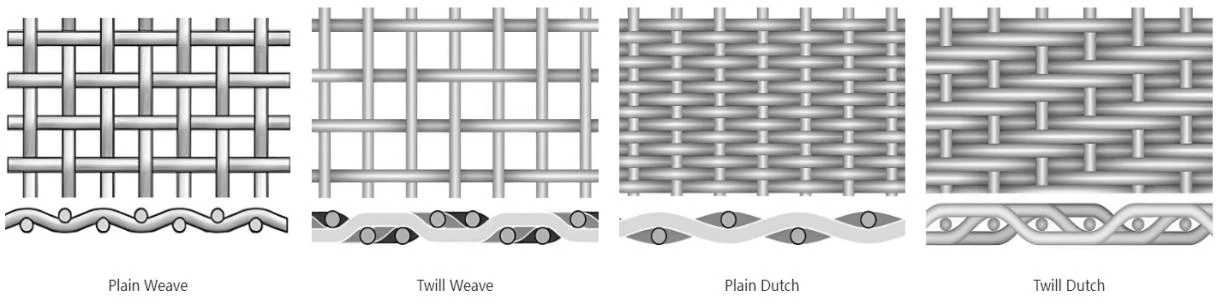
CHG Metal supplies plain, twill and Dutch weave in wire diameters from 0.01 to 2.03 mm and apertures from 0.02 to 23.37 mm. Rolls, sheets, discs, cylinders and framed parts are available. State the chloride level, temperature, cleaning chemicals and welded construction so that 316 can be checked against 316L or a higher alloy.
316 Selection Snapshot
- Material: 316 austenitic stainless steel with 2–3% molybdenum.
- Benefit: normally better chloride pitting resistance than 304.
- Limit: not a universal answer for strong acids, concentrated chlorides or hot seawater.
- Supply: rolls, sheets, discs, cylinders, baskets and drawing-based frames.
Product Technical Parameters
Material Composition:
The chemical composition of 316 stainless steel wire mesh includes:
Carbon (C): up to 0.08%
Manganese (Mn): up to 2.00%
Phosphorus (P): up to 0.045%
Sulfur (S): up to 0.03%
Silicon (Si): up to 1.00%
Chromium (Cr): 16.00% – 18.00%
Nickel (Ni): 10.00% – 14.00%
Molybdenum (Mo): 2.00% – 3.00%
Nitrogen (N): up to 0.10%
Physical Properties:
The physical properties of 316 stainless steel wire mesh include:
Density: 8.0 g/cm³ or 0.289 lb/in³
Melting Point: 1398 °C or 2555 °F
Coefficient of Thermal Expansion: 17.5 μm/m °C (20 – 100 °C) or 9.7 x 10^-6 in/in °F (70 – 212 °F)
Modulus of Elasticity: 187.5 kN/mm² or 27195 ksi
Mechanical Properties: The mechanical properties include tensile strength, yield strength, elongation, and reduction of area:
Tensile Strength σb: ≥480 MPa
Yield Strength σ0.2: ≥177 MPa
Elongation δ5: ≥40%
Reduction of Area ψ: ≥60%
Heat Treatment: 316 stainless steel wire mesh undergoes annealing or tempering treatment, typically at 250 °C or 480 °F for 1 hour, followed by air cooling.
Wire Diameter Range: The wire diameter can range from 0.025mm to 2.03mm (0.001 inches to 0.08 inches).
Mesh Size: The mesh size can range from 0.0254mm to 23.37mm (0.001 inches to 0.92 inches).
Width and Length: Standard width is less than 2000mm, with a length of 30 meters per roll or customized according to customer requirements.


316 Material and Finished-Part Checks
Incoming checks cover grade certification, wire diameter and surface. Weaving checks cover mesh count, aperture, weft density and visual defects. Finished parts add width, length, flatness, edge, weld and interface inspection.
For marine, chemical or food projects, specify certificates, corrosion or cleanliness tests, dimensional records and the acceptance standard at quotation stage.
FAQ
Q: Is 316 always better than 304?
A: No. 304 is more economical in mild service. 316 is normally preferred for chlorides and many chemical duties, but severe acids and high temperatures still require separate review.
Q: Should I choose 316 or 316L?
A: 316 is common for general woven mesh. 316L is preferred for welded cartridges, cylinders and baskets where post-weld corrosion resistance matters.
Q: Can you fabricate 316 filter baskets?
A: Yes. Provide basket dimensions, support layers, connections, weld details and surface requirements.
Request a Quote
Send the 316 mesh count or aperture, wire diameter, weave, roll or sheet size, medium, temperature, welded structure and quantity to CHG Metal for a manufacturing quotation.


