





Wire mesh (also referred to as wire cloth, wire screening, or metal mesh) is a versatile engineered material formed from metal wires that are woven, welded, expanded or otherwise joined to create a grid-like structure. This structure offers a unique combination of open area, structural strength, permeability, and durability, which makes wire mesh indispensable across many industries, including construction, filtration, agriculture, architecture, manufacturing, and more.
Below, we will explore this subject in depth through three principal sections:
1.Definition & Fundamental Composition of Wire Mesh
2.Major Types of Wire Mesh and Their Key Differences
3.Applications, Selection Criteria & Future Trends of Wire Mesh
Each of these sections provides detailed insight to ensure a thorough understanding of what wire mesh is, how it functions, and why it matters.

1. Definition & Fundamental Composition of Wire Mesh
In order to fully understand "What is wire mesh?", it is essential to break down the definition, the material and structural components, the key technical parameters, and the basic manufacturing process. This foundation enables you to assess what requirements you should consider when specifying or purchasing wire mesh.
1.1 Definition and Concept
Wire mesh is a sheet or roll product composed of metal wires arranged in a patterned formation of openings (also called apertures), formed either by weaving the wires (like fabric), welding the wires at intersections, or expanding a metal sheet into a mesh. The result is a structure that has both metal-wire elements and open spaces between them. The combination enables properties such as filtration, reinforcement, ventilation, partitioning, and design aesthetic.
This definition is aligned with how industry leader YKM Group describes the product: "Wire mesh is a material made from interwoven or welded wires arranged in a grid-like structure."

The key characteristics to highlight in this definition:
Metal wires: The primary structural elements are made of metal (steel, stainless steel, aluminium, copper, etc.).
Grid-like structure: The wires create repeated openings-either square, rectangular, diamond or other shapes.
Open area: The spaces between wires allow flow of air, light, fluids or visibility.
Structural integrity: The wires themselves provide strength, stability, and the ability to bear loads or provide protection.
Because of these combined features, wire mesh is not simply "metal netting" but a precision-engineered product where the wire diameter, opening size, material, pattern, surface treatment and manufacturing method each contribute to performance.
1.2 Fundamental Components: Materials, Wire Diameter, Aperture & Structure
To specify or evaluate a wire mesh, you must understand the essential components that determine its performance.
Materials
The choice of metal material dictates the mechanical, chemical and environmental performance of the mesh:
Stainless steel (e.g., grades 304, 316): Offers superior corrosion resistance, high strength and longevity. Common in chemical, marine, food and industrial applications.
Galvanised (carbon) steel: A cost-effective solution where moderate corrosion resistance is acceptable (e.g., outdoor fencing, concrete reinforcement).
Aluminium: Lightweight, non-magnetic, corrosion resistant (especially for marine/architectural use) but less strong than steel.
Copper, brass, nickel, other alloys: These may be chosen for speciality uses (conductivity, decorative finish, chemical resistance, etc.).
Low-carbon mild steel: Used in structural fencing, reinforcement where high corrosion resistance is not critical.
Material choice influences:
Strength and rigidity of the wires
Corrosion and weathering behaviour
Weldability (if applicable)
Cost and lifecycle.
Wire Diameter
Wire diameter (sometimes expressed in mm or gauge) determines how thick/wide each individual wire element is. A thicker wire:
- Increases load-bearing capacity and stiffness
- Reduces flexibility/bendability
- May reduce open area (% of the mesh that is "empty") if aperture is held constant.
Conversely, a thinner wire:
- Allows for finer openings and higher mesh counts
- Can be more flexible and easier to form
- But may have lower structural strength or may deform under load.
Aperture / Opening Size
The aperture (sometimes called the "opening size") is the free space between adjacent wires. Two common ways to specify:
Mesh count or number of openings per inch (or per cm). Higher counts mean finer openings, often used in filtration.
Opening size (in mm or inches): the clear distance between wires. Smaller openings restrict flow/particle size but may reduce visibility or increase cost.
The aperture size is vital for:
- Filtration/separation accuracy (the maximum size of particles that can pass)
- Ventilation, airflow or light transparency
- Structural performance – smaller apertures often require thinner wires and more wires, affecting cost/weight.
Structure / Manufacturing Method
Wire mesh can be made by different methods, and the structure affects its mechanical behaviour:
- Woven wire mesh: Wires interlace like fabric (warp and weft). Offers flexibility, can achieve very fine mesh counts.
- Welded wire mesh: Perpendicular wires are welded at intersections. More rigid, uniform openings, good for structural uses.
- Expanded metal mesh: A metal sheet is slit and stretched to form a continuous mesh without welding or weaving. High strength-to-weight and good visual aesthetics.
The manufacturing method influences flexibility, strength, shapeability, and cost.
Surface / Coating Treatment
Beyond the basic metal, surface treatment is crucial for performance in challenging environments:
- Galvanising (hot-dip or electro) – protects carbon steel against rust.
- PVC or plastic coating – adds colour, additional corrosion resistance, improved durability in outdoor/industrial settings.
- Anodising (for aluminium) – improves surface hardness and corrosion resistance, adds colour options.
- Polishing or passivation (for stainless steel) – enhances appearance, hygiene, and corrosion resistance.

1.3 Technical Parameters & Performance Metrics
When specifying or analysing wire mesh, several key parameters must be checked:
- Wire diameter – as discussed, the thickness of the individual wire.
- Mesh count or opening size – determines fineness of the mesh.
- Open area percentage – the proportion of the mesh surface that is void (open space) versus wire. Higher open area gives greater flow/transparency but may reduce structural strength.
- Tensile strength / yield strength of wire material – determines how much load the mesh can take.
- Surface finish thickness – e.g., thickness of zinc coating or PVC layer.
- Flatness, dimensional tolerance – important for installation, filtration, or architectural uses.
- Sheet/roll size – length, width, available in panels or rolls; affects installation logistics.
Together, these metrics define whether a given mesh is suitable for a specific application – for example, a fine stainless woven mesh for pharmaceutical filtration vs. a welded heavy gauge mesh for concrete reinforcement.
1.4 Manufacturing Process Overview
Although the detailed process will vary by type, the broad steps in wire mesh manufacturing are:
Wire drawing / raw material preparation – Starting from a larger diameter wire rod, the manufacturer draws it through dies to the required diameter. Quality checks of composition, elongation, surface finish are done.
Forming into mesh – Depending on the type:
Weaving: The wires are interlaced using loom-type machinery (warp wires held stationary, weft wires inserted). Variations include plain weave, twill, Dutch weave, etc.
Welding: Wires are placed in a perpendicular grid and welded at each intersection by automatic machines, ensuring uniform spacing and weld quality.
Expanding: A flat metal sheet is pierced/slit and simultaneously stretched into a mesh pattern; no welds or separate wires are joined.
Cutting and shaping – The mesh may be cut into rolls, sheets, or custom shapes/panels. Edge trimming, flattening, and checking for dimensional accuracy.
Surface treatment – Depending on requirements, the mesh may be galvanized, coated with PVC or other plastic, anodised (for aluminium), or polished/passivated.
Quality inspection – Verifying wire diameter tolerances, opening size accuracy, surface finish, mechanical strength (tensile, elongation), weld integrity (for welded types), and coating adhesion/corrosion resistance.
Packaging and shipping – The mesh is packed in rolls, sheets or pallets, labelled with specifications, and prepared for delivery.

1.5 Why the Definition and Composition Matter
Understanding these foundational concepts is not academic: they impact real-life outcomes such as:
- Performance reliability – selecting the wrong aperture or wire diameter can lead to failure (e.g., too coarse for filtration, or too thin to bear load).
- Cost efficiency – over-specifying (e.g., using high-grade stainless when galvanized would suffice) adds unnecessar
- Lifecycle and maintenance – correct material and coating reduce maintenance costs, downtime and replacement frequency.
- Safety and compliance – many applications have standards (e.g., concrete reinforcement mesh must meet ASTM or EN standards; filtration mesh may require specific alloys or certifications).
By thoroughly understanding what wire mesh is-its definition, constituent components, parameters and manufacturing-you are equipped to dive into how different types compare and which are appropriate for which applications.
2. Major Types of Wire Mesh and Their Key Differences
In this section, we explore in detail the major types of wire mesh, their structure and manufacturing method, their advantages and disadvantages, and their typical use cases. Understanding these types is essential for choosing the right mesh for a given application.
2.1 Woven Wire Mesh
Woven wire mesh is produced similarly to textile fabrics: longitudinal (warp) wires are held under tension and transverse (weft) wires are woven through them, alternating under and over in a regular pattern. This method allows high precision in opening size and consistent mesh count. It is particularly valuable for fine filtration, sieving, and separation.

Structural Variations
There are several common weave patterns:
- Plain Weave: The simplest, where each wire alternates under and over each adjacent wire. Balanced, cost-effective, with moderate openings.
- Twill Weave: Each wire passes over two wires and under two wires (or more), resulting in a diagonal pattern. The result is more wires per inch and greater strength, but slightly less open area.
- Dutch Weave: A combination of thicker warp wires and finer weft wires (or vice versa); this produces very fine openings and high wire counts-ideal for filtration of fine particles.
- Reverse Dutch Weave: Similar to Dutch but reversed roles of warp/weft wires; often used for high pressure and high temperature filtration.

Advantages
Ability to produce very fine mesh (e.g., hundreds of openings per inch) for filtration and separation of small particles.
Flexibility and ability to form or contour the mesh (to a degree) because it lacks welds at intersections.
Uniform opening and consistent material across the sheet/roll, making it reliable for precision applications.
Wide material options (stainless, brass, copper, aluminium, etc.).
Suitable for high-fidelity applications such as screen printing, vacuum belts, industrial belts and conveyor components.
Disadvantages
Less rigid than welded mesh; may deform if used for structural support.
For large openings and heavy gauge wires, weaving may be less cost-efficient.
Installation may require additional framing or supports since the mesh by itself may lack stiffness.

Typical Applications
Filtration of air, liquid or gas streams in chemical, pharmaceutical, food & beverage industries.
Sifting and classifying powders, granules, mineral ores.
Decorative panels, architectural accents where fine mesh or transparency is needed.
Screens for screen printing or separation process belts.
2.3Welded Wire Mesh
Welded wire mesh is created by arranging wires in a longitudinal and transverse grid, then using automatic welding machines to weld each intersection. The result is a strong, stiff panel or roll with uniform openings and good load-bearing capacity.
Structural Characteristics
Wires are fixed at intersections by welds, creating a rigid grid.
Common shapes: square openings, rectangular openings, sometimes triangular or diamond patterns depending on design.
Available in flat panels or rolls, and can be bent or formed into shapes for fencing, cage manufacture or reinforcement.

Advantages
High rigidity and strength make it suited to structural, safety or security applications.
Uniform spacing and strong welded joints ensure consistent performance.
Easy to install as panels, often requires minimal framing or support.
Suitable for heavier gauge wires and larger openings where stiffness matters.
Disadvantages
Less flexible – bending or shaping after welding may compromise structural integrity or welds.
Finer mesh counts are less economical in welded form compared to weaving.
For very large panel sizes, transport and handling must consider weight and rigidity.

2.2.4 Typical Applications

Concrete reinforcement mesh in slabs, walls, columns (also known as welded wire fabric).
Security fencing, barrier panels, cage structures.
Machine guards, partitions, fences for animals or material.
Architectural panels where a stronger mesh is needed but transparency is still desired.
2.3 Expanded Metal Mesh
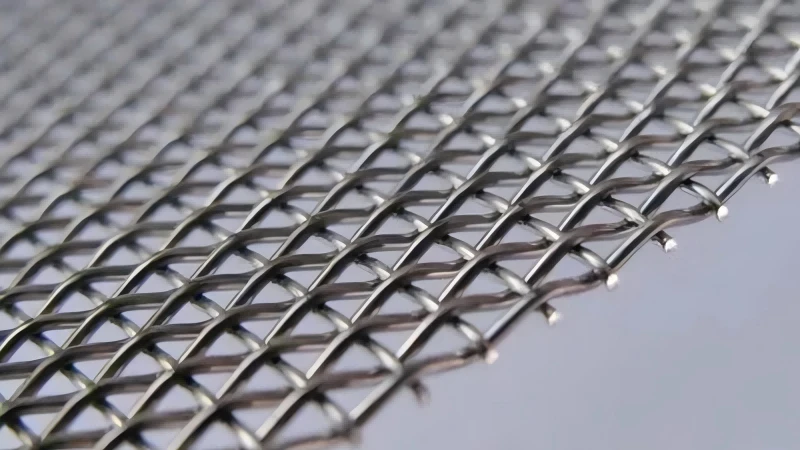
Expanded metal mesh is not made by weaving or welding discrete wires. Instead, a solid metal sheet is slit and simultaneously stretched in a press to form diamond- or hexagon-shaped openings. The resulting mesh is one continuous piece without welds or interlaced wires.
Structural Characteristics
The metal sheet itself becomes the mesh; the openings and strands are integral.
Because there are no joints, expanded metal has high structural integrity and strength-to-weight ratio.
The pattern often uses diamond openings which allow for good visibility, ventilation, and walking surface if used as tread.
01
Advantages
Excellent strength per unit weight due to continuous material and no weld points.
Better for decorative architectural applications, as the pattern can be visually interesting and the material can be bent or formed.
Suitable as flooring, anti-slip platforms, stair treads, screens, facades.
Good ventilation/visibility with high open-area percentages.
02
Disadvantages
The openings are typically larger than fine filtration mesh; thus, not suited for very fine separation tasks.
Material usage may be higher than welded mesh in some cases, increasing cost if heavy gauge is used.
Surface finish may need extra treatment if used outdoors or in corrosive environments.
03
Typical Applications
Architectural façade panels, sunscreens, decorative screens.
Flooring, stair treads, walkway grates, machine platforms (anti-slip surface).
Security screens, ventilation grilles in mechanical equipment.
Fences and partitions where aesthetics and ventilation are important.
04
2.4 Hexagonal Wire Mesh (Chicken Wire / Gabion Mesh) and Other Special Types
Apart from the main three, there are other special mesh types designed for specific use cases.
Hexagonal Wire Mesh
Created by twisting pairs or more of wires together to form a honeycomb-like hexagon opening pattern.
Often produced from galvanized or PVC-coated steel wire.
Commonly used for low-cost fencing, chicken pens, gabion systems (stone-filled cages for erosion control) and landscaping.

Chain-Link Mesh / Wire Fencing
A diamond-pattern mesh made by interwoven wire, often used for fence systems.
Less precision-oriented, more cost-effective, and designed for fencing applications rather than filtration or structural load.
Architectural / Decorative Wire Mesh
Aesthetic focus: materials, weave type, finish, pattern are chosen with design/visual impact in mind.
Applications include interior partitions, ceiling screens, exterior cladding, furniture accents.
Filter / Sieving Wire Mesh
Extremely fine woven or welded mesh used in filtration/separation industries.
Requirements include very consistent opening size, precise wire diameter, specific alloys to resist corrosion or high temperature.

2.5 Comparison and How to Choose Between Types
When deciding what type of mesh to use, consider the following comparison:
|
Mesh Type |
Manufacturing Method |
Rigidity |
Shapeability |
Typical Opening Size |
Best For |
|
Woven Wire Mesh |
Interlaced wires |
Medium |
High |
Very fine (e.g., 10-500 mesh) |
Filtration, sieving, separation |
|
Welded Wire Mesh |
Perpendicular wires welded |
High |
Low |
Medium to large |
Fencing, reinforcement, load-bearing |
|
Expanded Metal |
Slit & stretch sheet |
High |
Medium |
Medium to large diamond shapes |
Architecture, flooring, anti-slip use |
|
Hexagonal/Chain-Link |
Twisted or interwoven wires |
Low–Medium |
High |
Large to medium |
Low-cost fencing, landscaping, gabions |
Key decision factors:
- Opening size vs. particle size / flow requirements
- Wire diameter and strength vs. load or reinforcement needs
- Material and coating vs. corrosion / environment conditions
- Shapeability vs. installation complexity
- Cost vs. performance / lifecycle
2.6 Material & Coating Considerations Across Types
- Even if the mesh type is the same, material and surface finish make a large difference. For example:
- A stainless steel 316 woven mesh will far outperform a mild steel welded mesh in a marine environment.
- A PVC-coated welded mesh may be more suitable for outdoor fencing in a coastal region than a bare galvanised mesh.
- An aluminium expanded mesh used in façade design may be anodised and coloured for aesthetic effect, while a carbon steel expanded mesh used for a platform may only be hot-dip galvanised for corrosion protection.
- Thus, for each mesh type and each application you must consider:
- Material grade and alloy
- Coating or finish type and thickness
- Environmental exposure (salt-water, chemicals, temperature cycles, UV)
- Aesthetic and regulatory requirements (if used architecturally)

3. Applications, Selection Criteria & Future Trends of Wire Mesh
Having established what wire mesh is and what types are available, we now move to the practical side: where and how wire mesh is used, how to choose the right mesh for an application, and what future trends are emerging in the industry.
3.1 Application Areas
Wire mesh spans a wide range of applications across industry, agriculture, architecture and infrastructure. Below are major sectors and how mesh is used.
Construction & Civil Engineering
- Concrete reinforcement: In slabs, walls, foundations, welded wire mesh or welded wire fabric (WWF) is used to control cracking, distribute load and expedite construction.
- Fencing and barriers: Welded mesh panels, chain-link mesh, expanded metal or woven mesh fences are used for perimeter security, gates, guard rails.
- Architectural facades: Expanded metal mesh, decorative woven or welded mesh are used for building cladding, sunscreens, louvers, walkways, stair treads.
- Infrastructure: Walkways, bridges, platforms often employ expanded metal for anti-slip surfaces; mesh is used for screening and ventilation in mechanical plant rooms.

Filtration, Separation & Industrial Screens
Liquid/solid separation: Woven stainless steel mesh filters in chemical, petrochemical, food & beverage industries.
Gas filtration or air filtration: Fine mesh screens separate particles or provide airlines access to clean air.
Mining and quarrying: Sieving or grading of ores and aggregates using heavy-duty welded or woven mesh.
Oil & gas: Screen media in down-hole operations, separators, offshore filters – requiring specialised alloys and coatings because of harsh environment.
Agriculture, Landscaping & Animal Husbandry
- Fencing for livestock, poultry: Hexagonal wire mesh (chicken wire), welded mesh pens.
- Gabions and erosion control: Wire mesh cages filled with rock or soil to stabilise slopes and riverbanks.
- Greenhouses and plant support: Woven or welded mesh used for vine support, shade net frames, screening pests.
Architectural and Interior Design
Interior partitions, ceiling panels, balustrades: Decorative wire mesh adds texture, transparency and metal aesthetic.
Furniture and fixtures: Mesh panels in doors, shelving, lighting elements.
Exterior screening: Mesh used in building envelopes to control sunlight, provide ventilation while adding visual interest.

Security and Safety Applications
- Machine guards and safety enclosures: Welded mesh with fixed apertures and strong wires protects equipment and personnel.
- High-security fencing: Coated welded mesh or chain link with barbed/razor wire in sensitive sites.
- Window/door security screens: Stainless mesh panels that allow airflow/visibility but prevent intrusion.
3.2 Selection Criteria: How to Choose the Right Wire Mesh
Selecting the appropriate wire mesh involves a systematic understanding of requirement, environment, performance and cost. Key questions and criteria include:
Define the Requirement Clearly

What is the primary function? Filtration, reinforcement, protection, decoration?
What is the required opening size or maximum particle size to pass/retain?
Will the mesh be load-bearing, structural or simply decorative?
Will it be bent, formed, or stay flat?
How visible or transparent must it be?
What are the installation constraints (roll, panel, module)?
Consider Environmental Conditions
- Indoor or outdoor? Humid, marine, chemical exposure, high/low temperature?
- Will it be exposed to UV, salt spray, abrasion, impact?
- Is maintenance feasible or will it become inaccessible?
Material and Coating Choice
- For aggressive/corrosive environments, stainless steel (316) may be required.
- For cost-sensitive outdoor use, galvanised or PVC-coated carbon steel may suffice.
- For decorative/architectural use, aluminium (anodised and coloured) or stainless steel may be chosen.
- Check coating thickness, galvanising standard (e.g., ASTM hot-dip), and ensure compatibility with the surrounding structures.
Type and Structure of Mesh
- If fine filtration is needed → select woven mesh with fine wires and high mesh count.
- If structural strength is required → welded mesh or expanded metal.
- If the structure needs to be flexed or shaped on-site → woven or expanded may be better than welded.
- If aesthetics are important → consider decorative mesh types and finishes.
Wire Diameter, Opening and Open Area
- Ensure opening size is appropriate for retention/passage of particles or for visibility/ventilation.
- Ensure wire diameter provides sufficient strength for load, impact, or tension.
- Consider open area: too many wires (small opening) may restrict airflow/visibility and increase cost; too few wires (large opening) may lack strength or filtering capability.
Installation and Maintenance Considerations
- Accessibility for cleaning, repair or replacement.
- Edge finishing, supports/frames, method of attachment (welding, bolts, clips).
- Weight, handling, installation time/cost.
- Long-term maintenance: will coatings need to be renewed? Will debris clog the mesh?

Cost vs Life-Cycle Value
- Balance upfront cost (material, manufacturing) with life-cycle (maintenance, replacement, downtime).
- For critical applications (offshore oil, chemical plant) selecting premium materials pays off in long-term reliability.
- For decorative or non-critical uses, cost-effective mesh may be optimal.
3.3 Advantages of Wire Mesh
Wire mesh offers many distinct advantages that make it a preferred material in diverse applications:
1.Structural strength with open area – The combination of metal wires and openings gives strength without blocking light/air/flow.
2.Versatility in material and finish – Many metals, alloys and coatings allow adaptation to many environments.
3.Customisability – Wire diameter, mesh count/opening, panel size, finish, colour and shape can all be tailored.
4.Installation efficiency – Panels and rolls can be prefabricated, reducing on-site labour and installation time.
5.Transparency and ventilation – Useful in architectural design, security screens and mechanical installations.
6.Durability and maintenance – Properly chosen mesh with correct coating will yield long life with low maintenance.
7.Aesthetic and functional duality – In modern architecture mesh is used both for functional and decorative roles.
8.Sustainability – Many meshes are made from recyclable metals and long service life means lower replacement waste.

3.4 Maintenance, Service Life & Quality Assurance
To achieve the expected performance of a wire mesh product, maintenance and quality practices are key:
- Cleaning & debris removal: Over time dust, dirt, solids may accumulate, especially in filtration, ventilation or exterior panels. Regular cleaning prevents blockages, corrosion initiation or decreased performance.
- Inspection of coating / surface finish: Look for peeling, rust staining, or localised damage that could lead to corrosion propagation. If coatings are damaged, maintain repair or replacement.
- Structural inspection: For welded or expanded mesh used in load-bearing or safety applications, check for weld cracks, distortions, loose frames or fixings.
- Drainage and environment control: Avoid water stagnation, salt contact, chemical exposure which may accelerate corrosion.
- Quality assurance at manufacture: Check that the manufacturer uses certified raw materials, maintains dimensional tolerances (wire diameter, opening size), ensures weld integrity or weave consistency, and applies correct coating thickness. Many reputable manufacturers (like YKM Group) are ISO 9001, ISO 14001 certified and have rigorous inspection protocols.
- Expected service life: With proper material and coating selection, and correct installation/maintenance, a wire mesh installation can last decades. Conversely, wrong material or environment can drastically shorten life.
3.5 Emerging Trends & Future Directions
- Advanced Materials & Coatings: The demand for high-performance alloys (e.g., duplex stainless steel, nickel alloys) and novel coatings (nano-coatings, self-cleaning surfaces) continues to grow, especially in harsh industrial or offshore environments.
- Digital Fabrication and Customisation: Automated weaving machines, laser cutting of expanded metal, robotic welding allow more complex patterns, faster turnaround, and lower cost for custom meshes.
- Architectural Innovation: Wire mesh is increasingly used not just for function but for aesthetic façade systems, interior partitions, lighting diffusers, and furniture - blending function, art and architecture.
- Smart Mesh Systems: Integration of sensors into mesh structures (for air/flow monitoring, temperature/humidity sensing, security detection) is a growing field in smart building design.
- Sustainability & Circular Economy: Recycled content, lower-carbon production, long-life products, and recyclable end-of-life materials are becoming essential as clients demand more sustainable solutions.
- Multi-Functional Mesh: Combining filtration, reinforcement, seismic design, dynamic ventilation, and façade shading into one mesh system is being explored-reducing weight, complexity and cost.

3.6 Summary
Wire mesh, though deceptively simple in concept, is a sophisticated material system whose performance depends on design, material, structure and manufacturing quality. Its wide range of types and applications means it touches nearly every built environment-from the mining floor to the high-rise façade; from the filter in a water treatment plant to the curtains in a luxury hotel lobby.
By selecting the right type, right material, right structure and proper installation/maintenance, you harness the full benefits of wire mesh: durability, performance, transparency, strength, and aesthetic flexibility. The future of wire mesh appears bright, as the drive for higher performance, smarter buildings, sustainability and design innovation continues.
Conclusion
In summary, the question "What is wire mesh?" can be answered at multiple levels:
At the basic level, it's a metal grid made of wires with openings.
At the technical level, it is a highly configurable engineered product defined by material, wire diameter, opening size, pattern, manufacturing method and surface treatment.
At the application level, it is a critical component across industries for filtration, reinforcement, security, architecture and design.
At the strategic level, choosing and using the right wire mesh involves careful consideration of application, environment, material, type and lifecycle value.
As wire mesh continues to evolve-through new materials, manufacturing methods, integrated functionality and design applications-it remains a fundamental, versatile, cost-effective and high-value material. Whether you're an engineer specifying a filtration screen, an architect designing a building façade, or a purchaser sourcing fencing materials, understanding wire mesh means making the right choice and achieving the desired performance.