






Selecting the appropriate stainless steel alloy is perhaps the most consequential decision in the design and procurement of industrial wire mesh. While the market offers a myriad of specialty metals, the vast majority of high-performance applications revolve around two primary austenitic grades: Type 304 and Type 316. To the untrained eye, these alloys may appear identical in finish and weight, but their internal chemical blueprints dictate vastly different behaviors when subjected to mechanical stress, extreme temperatures, and aggressive chemical environments.
The distinction between these two "workhorse" materials lies in their elemental composition-specifically the strategic addition of molybdenum in Grade 316. This single change fundamentally alters the alloy's ability to resist localized corrosion, making it a critical factor in the lifecycle and safety of industrial projects. This guide provides a comprehensive technical analysis of 304 and 316 performance standards, offering engineers and procurement specialists the data necessary to balance cost-efficiency with uncompromising structural integrity. By understanding these metallurgical nuances, one can ensure that the chosen mesh will not only survive but thrive in its intended service environment.
Metallurgical Composition and Structural Foundations
The Role of Chromium and Nickel in 300-Series Steel
The "strength" and "stainless" nature of the 300-series alloys are primarily derived from the high concentration of Chromium and Nickel. Chromium (typically 18-20% in Grade 304) is the element responsible for "passivity." When exposed to oxygen, it forms an instantaneous, microscopic layer of chromium oxide on the surface of the wire. This layer is self-healing; if the mesh is scratched, the oxide reforms immediately, preventing rust from reaching the iron core. Nickel (typically 8-10.5% in Grade 304) is added to stabilize the "austenite" crystal structure. This structure is what gives the mesh its exceptional ductility and toughness, allowing it to be woven into incredibly fine counts without becoming brittle. The synergy between these two elements creates a material that is easy to fabricate yet remains structurally robust under significant tensile loads.

Molybdenum: The Critical Difference in Grade 316
What elevates Grade 316 above the standard 304 is the addition of approximately 2% to 3% Molybdenum. This element is specifically included to combat "pitting corrosion," a localized form of attack that creates small, deep holes in the metal. Pitting is particularly common in environments where chlorides (such as salt or industrial bleaches) are present. The molybdenum significantly increases the "Pitting Resistance Equivalent Number" (PREN) of the alloy. While 304 is perfectly suitable for indoor and mild outdoor use, it will eventually succumb to "tea staining" or pitting in coastal areas. Grade 316, often referred to as "marine-grade" stainless steel, maintains its surface integrity and mechanical strength even when constantly exposed to salt spray or de-icing chemicals, making it the non-negotiable choice for maritime and offshore infrastructure.
The "L" Grades: Low Carbon for Superior Welding
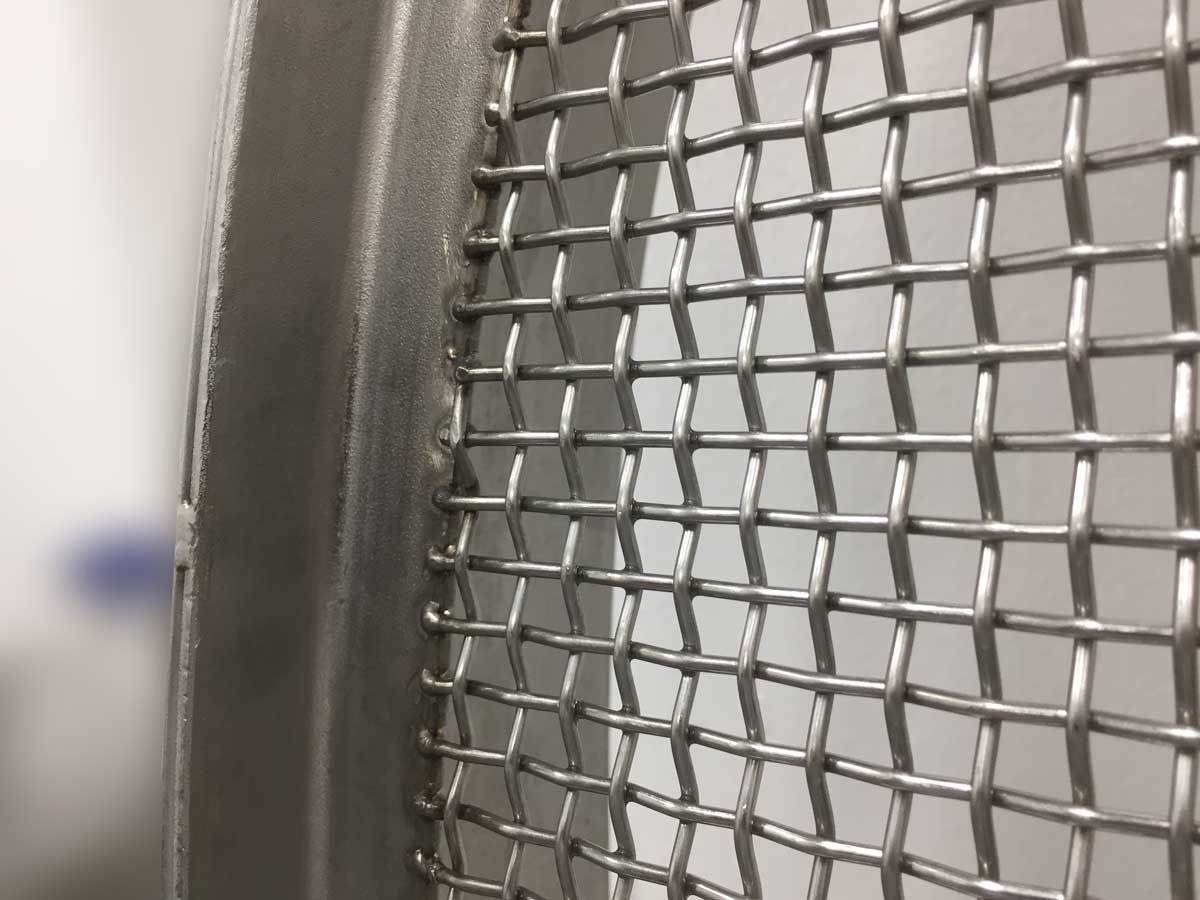
In many industrial mesh applications, the mesh must be welded to a frame or support structure. During standard welding, the high heat can cause "carbide precipitation," where carbon and chromium bond at the grain boundaries, leaving the surrounding areas vulnerable to corrosion. To solve this, manufacturers produce "L" grades, such as 304L and 316L. These variations have a maximum carbon content of 0.03% (compared to 0.08% in standard grades). By reducing the carbon, the risk of "sensitization" during welding is virtually eliminated. This ensures that the heat-affected zone (HAZ) around the weld maintains the same corrosion resistance and tensile strength as the rest of the mesh. For heavy-duty filtration baskets or structural security screens that require extensive welding, specifying the "L" grade is a standard best practice for long-term reliability.
Trace Elements and Grain Structure Stability
Beyond the primary elements, trace amounts of Manganese, Silicon, Phosphorus, and Sulfur are strictly controlled in high-quality stainless steel mesh. Manganese is used during the melting process to increase the solubility of nitrogen and improve the hot-working properties of the steel. Silicon acts as a deoxidizer, ensuring the molten metal is clean before it is drawn into wire. Professional manufacturing standards, such as ASTM A580, dictate the precise allowable ranges for these elements. A stable grain structure is essential for "weave consistency"; if the alloy composition varies slightly within a single coil of wire, the wire's "springback" will change, leading to uneven mesh openings. Adhering to these strict metallurgical standards ensures that the mesh remains dimensionally stable and structurally predictable under constant mechanical tension.
Chemical Composition Comparison (Typical %)
| Element | Grade 304 (%) | Grade 304L (%) | Grade 316 (%) | Grade 316L (%) |
| Chromium | 18.0 - 20.0 | 18.0 - 20.0 | 16.0 - 18.0 | 16.0 - 18.0 |
| Nickel | 8.0 - 10.5 | 8.0 - 12.0 | 10.0 - 14.0 | 10.0 - 14.0 |
| Molybdenum | N/A | N/A | 2.0 - 3.0 | 2.0 - 3.0 |
| Carbon (Max) | 0.08 | 0.03 | 0.08 | 0.03 |
| Manganese (Max) | 2.00 | 2.00 | 2.00 | 2.00 |
| Silicon (Max) | 0.75 | 0.75 | 0.75 | 0.75 |
Performance Metrics and Environmental Resistance
Pitting Resistance and the PREN Value
The most common failure mode for stainless steel mesh is pitting. To quantify an alloy's resistance to this, engineers use the Pitting Resistance Equivalent Number (PREN). The formula is $PREN = Cr + 3.3(Mo) + 16(N)$. Grade 304 typically has a PREN of around 19, whereas Grade 316 boasts a PREN of approximately 24 to 26. This higher value translates directly to a longer service life in harsh environments. For instance, in a high-chloride environment like a wastewater treatment plant or a coastal bridge, a 304 mesh may show signs of structural weakening within 5 years, while a 316 mesh can remain fully functional for over 25 years. Understanding this numerical value allows project managers to justify the higher upfront cost of 316 based on reduced replacement frequency.
Temperature Thresholds and Thermal Stability
Stainless steel mesh is frequently used in heat-intensive processes, such as food dehydration, chemical refining, and exhaust filtration. Grade 304 has good oxidation resistance in intermittent service up to 870°C and in continuous service to 925°C. However, its mechanical strength begins to drop rapidly at these temperatures. Grade 316 offers slightly better performance in the 425-860°C range due to its molybdenum content, which helps prevent "carbide precipitation" that can occur at high heats. For even higher temperatures (up to 1100°C), specialty grades like 310 or 314 are required, but for standard industrial heating, 304 and 316 are the primary contenders. Designers must calculate the "thermal expansion" of the mesh to ensure it doesn't buckle or sag as the processing equipment reaches its operating temperature.
Tensile Strength and Ductility Factors
While chemical resistance is often the focus, the mechanical strength of the alloy is equally important. Type 304 stainless steel generally has a higher tensile strength in the cold-worked state than Type 316. This makes it slightly "stiffer," which can be an advantage in creating rigid security screens or vibrating sieves. Grade 316, however, offers superior ductility, meaning it can undergo more deformation before it actually ruptures. This is why 316 is often preferred for complex architectural mesh that needs to be curved or tensioned around irregular structures. Both alloys exhibit "work-hardening," where the metal becomes stronger as it is physically stressed; this is a key reason why stainless steel mesh is so difficult to cut with manual tools compared to galvanized alternatives.
Resistance to Stress-Corrosion Cracking (SCC)
Stress-corrosion cracking is a catastrophic failure mode where a mesh panel suddenly snaps under tension in the presence of a corrosive medium. This is a major concern for architectural cable-mesh systems and high-pressure filter elements. Grade 316 is notably more resistant to SCC than Grade 304, particularly in the presence of halides. For structural safety applications where the mesh is under constant, heavy tension-such as bridge safety nets or fall protection in parking garages-316 is the standard material requirement. Choosing the wrong alloy in these high-tension scenarios can lead to a failure that occurs without warning, even if the wires appear healthy on the surface. Proper alloy selection is the first line of defense in structural engineering.
Selection Criteria for Industrial Projects
Cost vs. Lifecycle Value Analysis
The price of Grade 316 stainless steel is typically 30% to 50% higher than Grade 304, primarily due to the cost of molybdenum. For a large-scale project, this can represent a significant budget increase. However, a lifecycle value analysis often reveals that 316 is the more economical choice. If a 304 mesh in a coastal environment requires replacement every 7 years, but a 316 mesh lasts for 25 years, the 316 option pays for itself in avoided labor, downtime, and material costs by the second cycle. Procurement officers should focus on the "Total Cost of Ownership" rather than the initial purchase price, especially in sectors like mining, oil and gas, and municipal water treatment where maintenance access is difficult and expensive.
Application Environments: From Food to Marine
The environment is the final judge of alloy performance. In the food and beverage industry, Grade 304 is the most common choice for conveyor belts and sieves because it is resistant to organic acids and is easy to sanitize. However, in the dairy or meat processing sectors, where aggressive chloride-based cleaners are used to meet hygiene standards, Grade 316 is often required to prevent pitting. In the marine industry, anything within 5 miles of the coast should ideally be Grade 316 or higher. For indoor architectural partitions, 304 is usually more than sufficient. Understanding the "Micro-Climate" of the installation site-including humidity, chemical exposure, and temperature-is the most reliable way to select the correct alloy.
Manufacturing and Weave Feasibility
Not all alloys are equally easy to weave. Because 316 is slightly softer and more ductile, it is often preferred for weaving incredibly fine mesh counts (e.g., 400x400 mesh) used in precision filtration. Grade 304's higher stiffness can sometimes make it challenging to maintain uniform tension in ultra-fine wire diameters. Conversely, for heavy-duty welded mesh used in security cages, the "stiffness" of 304 can provide a more rigid and imposing barrier. Manufacturing standards also account for "Magnetic Permeability"; while both alloys are nominally non-magnetic, cold-working during the weaving process can introduce a slight magnetic pull in Grade 304. For sensitive medical imaging or electronic environments, 316 is often used because it remains more "paramagnetic" (non-magnetic) even after extensive processing.
Compliance with International Standards
Global projects require adherence to international standards like ASTM, ISO, and DIN to ensure material consistency. ASTM A240 and A666 are the primary standards for 304 and 316 stainless steel plate and strip used to produce wire. These standards ensure that regardless of the supplier, the chemical and mechanical properties of the steel are verified. When ordering mesh, always request a Mill Test Report (MTR). This document provides the specific "Heat Number" of the steel, confirming its elemental makeup and tensile test results. Compliance with these standards is not just a legal requirement in many industries; it is a critical safety measure that prevents the use of "counterfeit" or sub-standard alloys that could lead to structural failure in the field.
Alloy Selection Matrix based on Environment
| Environment | Recommended Grade | Reasoning |
| Indoor Commercial | Grade 304 | Cost-effective, sufficient resistance |
| Urban Outdoor | Grade 304 / 304L | Resistant to pollution and rain |
| Coastal / Marine | Grade 316 / 316L | Resists salt spray and pitting |
| Chemical Processing | Grade 316L | High resistance to acids/chlorides |
| Food (Mild) | Grade 304 | Resists food acids, easy to clean |
| Food (High Saline) | Grade 316 | Resists aggressive cleaning agents |
To understand how these chemical properties translate into the actual physical durability and impact resistance of a mesh panel, return to our master article:
[How Strong Is Stainless Steel Mesh?]