






Can sack gabions be used in foundation reinforcement? This is a question that often arises in the field of civil engineering and construction. As a supplier of Sack Gabions, I have witnessed firsthand the diverse applications of these versatile products. In this blog, I will delve into the feasibility and effectiveness of using sack gabions for foundation reinforcement, exploring their properties, advantages, and limitations.
Understanding Sack Gabions
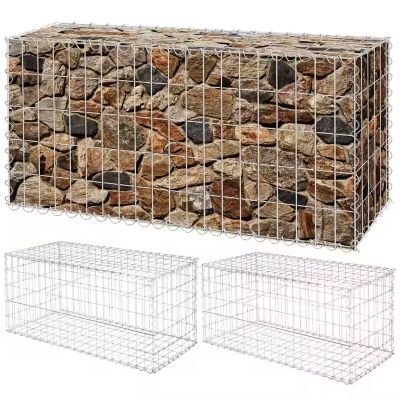
Sack gabions are essentially flexible containers filled with stones or other suitable materials. They are typically made from high - strength woven or welded wire mesh, which provides the necessary containment for the infill material. Unlike traditional rigid foundation reinforcement methods, sack gabions offer a more adaptable and cost - effective solution.
The Sack Gabion is easy to install. It can be transported in a flat, folded state to the construction site, which significantly reduces transportation costs. Once on - site, it can be quickly assembled and filled with locally available stones, saving both time and money. This ease of installation makes it an attractive option for projects with tight schedules and budget constraints.
The Mechanism of Foundation Reinforcement
Foundation reinforcement aims to improve the load - bearing capacity of the soil and prevent settlement or failure of the structure above. Sack gabions can contribute to this in several ways.
Firstly, the weight of the stones inside the sack gabions adds extra mass to the foundation area. This additional weight helps to compact the underlying soil, increasing its density and shear strength. As a result, the soil can better withstand the vertical loads exerted by the structure.
Secondly, the flexible nature of sack gabions allows them to conform to the irregularities of the soil surface. This means that they can distribute the load more evenly across the foundation, reducing stress concentrations that could lead to soil failure. For example, in areas with soft or variable soil conditions, sack gabions can adapt to the different settlement rates of the soil, providing a more stable base for the structure.
Advantages of Using Sack Gabions for Foundation Reinforcement
Cost - effectiveness
One of the most significant advantages of sack gabions is their cost - effectiveness. The materials used for sack gabions, such as wire mesh and stones, are relatively inexpensive compared to other foundation reinforcement materials like concrete piles or steel reinforcements. Additionally, the ease of installation reduces labor costs, making it a budget - friendly option for many construction projects.
Environmental friendliness
Sack gabions are an environmentally friendly choice. The use of locally sourced stones reduces the need for long - distance transportation of construction materials, which in turn reduces carbon emissions. Moreover, the porous nature of the sack gabions allows for natural water infiltration, promoting groundwater recharge and reducing the risk of surface water runoff and erosion.
Flexibility and Adaptability
As mentioned earlier, the flexibility of sack gabions makes them suitable for a wide range of soil conditions and construction sites. They can be used in areas with limited access or difficult terrain, where traditional foundation reinforcement methods may be impractical. For example, in mountainous regions or areas with uneven ground, sack gabions can be easily installed to provide a stable foundation.
Limitations and Considerations
While sack gabions offer many advantages for foundation reinforcement, there are also some limitations and considerations that need to be taken into account.
Durability
The durability of sack gabions depends on the quality of the wire mesh and the type of environment they are exposed to. In corrosive environments, such as areas with high humidity or near the coast, the wire mesh may be prone to corrosion. To address this issue, galvanized or PVC - coated wire mesh can be used to enhance the corrosion resistance of the sack gabions.
Load - bearing capacity
Although sack gabions can increase the load - bearing capacity of the soil, they may not be suitable for very heavy structures. In cases where the structure imposes extremely high vertical loads, additional foundation reinforcement methods may be required in conjunction with sack gabions. Engineers need to carefully calculate the load - bearing capacity of the sack gabions and the underlying soil to ensure the safety of the structure.
Long - term settlement
Over time, the soil beneath the sack gabions may continue to settle. This long - term settlement can affect the stability of the structure. To mitigate this risk, proper soil investigation and pre - loading techniques can be employed to minimize future settlement.
Comparison with Other Foundation Reinforcement Methods
It is also useful to compare sack gabions with other common foundation reinforcement methods, such as Welded Gabion and Hesco Barrier.
Welded gabions are similar to sack gabions in that they are also filled with stones. However, welded gabions are more rigid due to their welded wire mesh construction. They are often used in applications where a more rigid structure is required, such as retaining walls. In foundation reinforcement, welded gabions may provide higher initial stiffness but may be less adaptable to soil settlement compared to sack gabions.
Hesco barriers are primarily used for flood control and erosion protection. They are made of a collapsible wire mesh container filled with soil or sand. While they can also be used for foundation reinforcement in some cases, their design is more focused on rapid deployment and temporary structures. Sack gabions, on the other hand, are more suitable for long - term foundation reinforcement due to their ability to provide stable support over time.
Case Studies
To illustrate the effectiveness of sack gabions in foundation reinforcement, let's look at some real - world case studies.
In a small residential construction project in a rural area, the soil conditions were found to be soft and unstable. Instead of using expensive concrete piles, the contractor decided to use sack gabions for foundation reinforcement. The sack gabions were installed around the perimeter of the foundation and filled with locally sourced stones. After the construction was completed, the settlement of the structure was monitored over a period of time. The results showed that the sack gabions effectively reduced the settlement and provided a stable foundation for the house.
In another case, a bridge abutment was being constructed on a riverbank with loose soil. Sack gabions were used to reinforce the foundation of the abutment. The flexible nature of the sack gabions allowed them to adapt to the dynamic soil conditions caused by the flowing water. The bridge has been in service for several years without any signs of foundation failure, demonstrating the reliability of sack gabions in challenging environments.
Conclusion
In conclusion, sack gabions can be a viable option for foundation reinforcement in many construction projects. Their cost - effectiveness, environmental friendliness, flexibility, and adaptability make them an attractive choice, especially for projects with limited budgets and complex soil conditions. However, it is important to consider their limitations, such as durability and load - bearing capacity, and to ensure proper design and installation.

If you are considering using sack gabions for your next construction project, I encourage you to reach out for more information and to discuss your specific requirements. As a Sack Gabion supplier, I am committed to providing high - quality products and professional advice to help you achieve a successful foundation reinforcement solution. Whether you are an engineer, contractor, or developer, let's start a conversation about how sack gabions can meet your needs.
References
- Bowles, J. E. (1996). Foundation analysis and design. McGraw - Hill.
- Das, B. M. (2010). Principles of geotechnical engineering. Cengage Learning.
- Terzaghi, K., Peck, R. B., & Mesri, G. (1996). Soil mechanics in engineering practice. John Wiley & Sons.