





Product Details
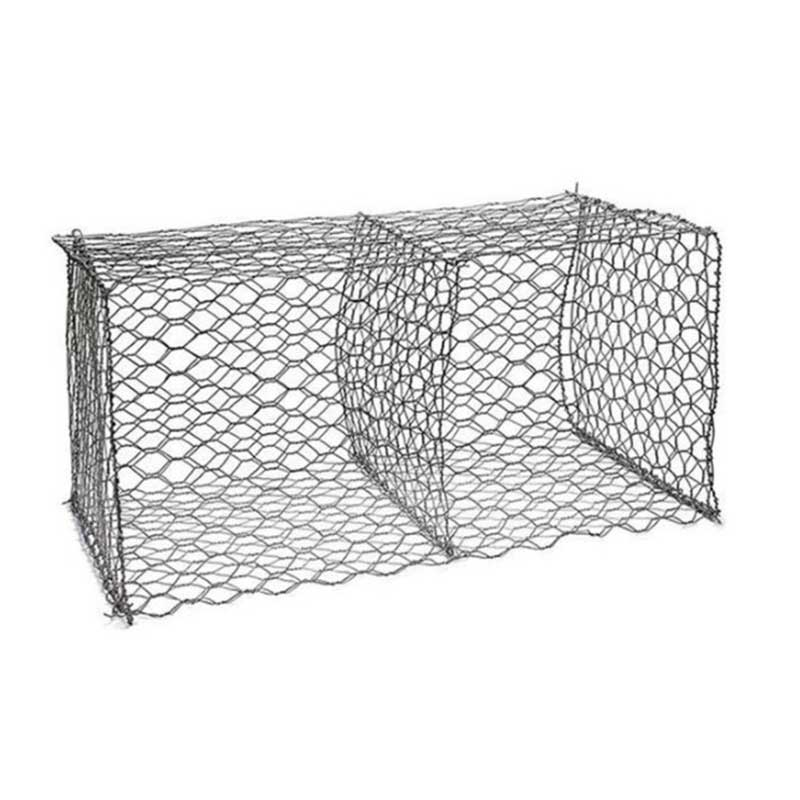
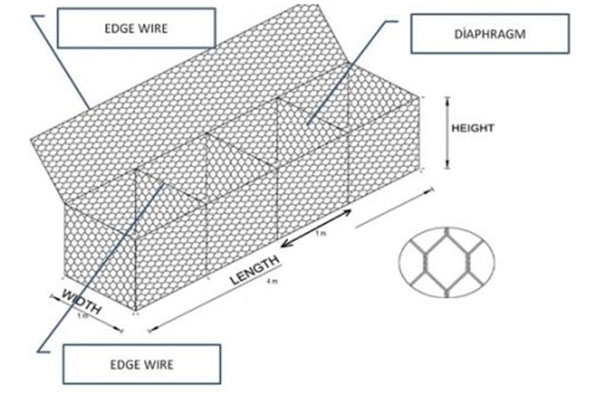
Gabion cages are rectangular containers made from double-twisted hexagonal wire mesh, designed to be filled with stones or similar materials. They are widely used for retaining walls, erosion control, slope stabilization, and riverbank protection. Thanks to their flexible and permeable structure, gabion cages can withstand ground movement and water pressure without losing stability.
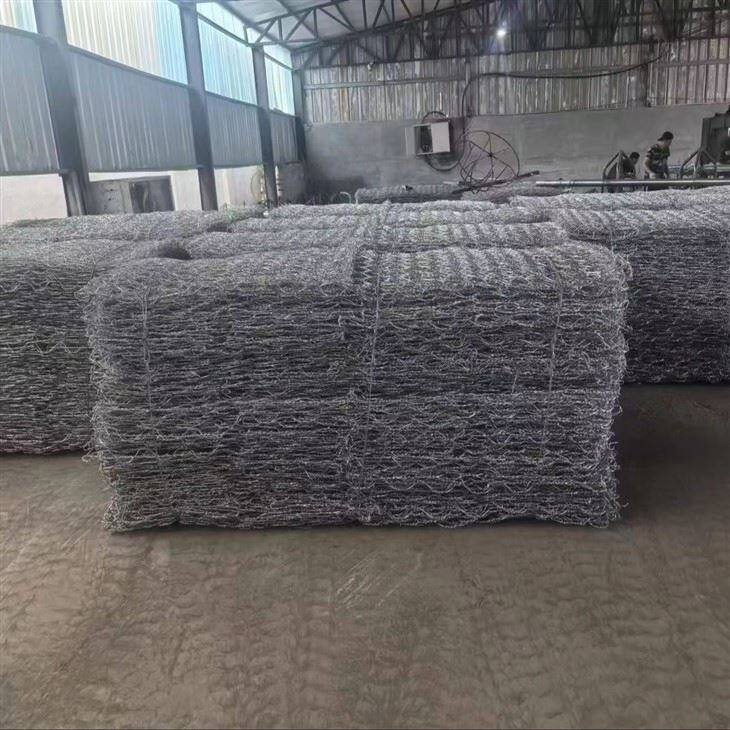
Manufactured with galvanized or PVC-coated wire, they offer excellent corrosion resistance and long-term durability. Delivered in flat-packed form, gabion cages are easy to transport and assemble on-site without mortar, making them a cost-effective and environmentally friendly solution for both infrastructure and landscaping projects.
| Model | Length(m) | Width(m) | Height(m) | Spacer(u) | Size |
|---|---|---|---|---|---|
| 2*1*1, 2.7 | 2 | 1 | 1 | 1 | 11 ㎡/set |
| 2*1*1, 2.95 | 2 | 1 | 1 | 1 | 11 ㎡/set |
| 2*1*1, 3.05 | 2 | 1 | 1 | 1 | 11 ㎡/set |
| 3*1*1, 3.05 | 3 | 1 | 1 | 2 | 16㎡/set |
| 4*1*1, 3.05 | 4 | 1 | 1 | 3 | 21㎡/set |
| 6x2x0.3, 2.2 | 6 | 2 | 0.3 | 5 | 31.8㎡/set |
| 6x2x0.3, 2.7 | 6 | 2 | 0.3 | 5 | 31.8㎡/set |
| PVC 2x1x1, 3.05 | 2 | 1 | 1 | 1 | 11 ㎡/set |
| PVC 2x1x1, 3.7 | 2 | 1 | 1 | 1 | 11㎡/set |
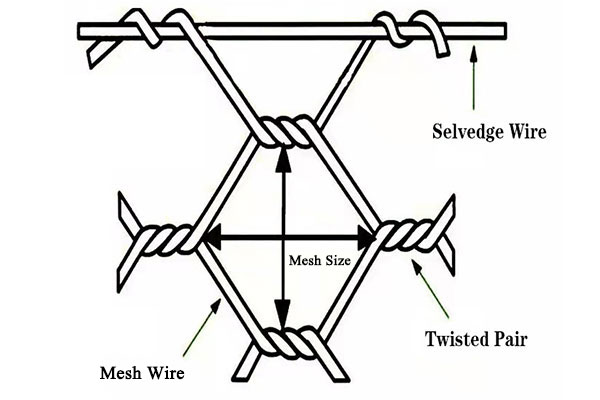
| Material | Mesh Wire Diameter | Selvedge Wire | Binding Wire | Mesh Size |
|---|---|---|---|---|
| Hot dipped galvanized wire(40-260g/m2) | 2.0-3.05mm(±0.05mm) | 3.0-4.0mm | 2.0-2.2mm | 60*80mm |
| Hot dipped galvanized wire(40-260g/m2) | 2.0-3.05mm(±0.05mm) | 3.0-4.0mm | 2.0-2.2mm | 60*100mm |
| Hot dipped galvanized wire(40-260g/m2) | 2.0-3.05mm(±0.05mm) | 3.0-4.0mm | 2.0-2.2mm | 80*100mm |
| Hot dipped galvanized wire(40-260g/m2) | 2.0-3.05mm(±0.05mm) | 3.0-4.0mm | 2.0-2.2mm | 90*120mm |
| Hot dipped galvanized wire(40-260g/m2) | 2.0-3.05mm(±0.05mm) | 3.0-4.0mm | 2.0-2.2mm | 100*120mm |
| Hot dipped galvanized wire(40-260g/m2) | 2.0-3.05mm(±0.05mm) | 3.0-4.0mm | 2.0-2.2mm | 120*150mm |
Note: We offer full customization of gabion cage, including all sizes and materials, to meet your specific requirements.
Production Process


Gabion Cages Installation Method
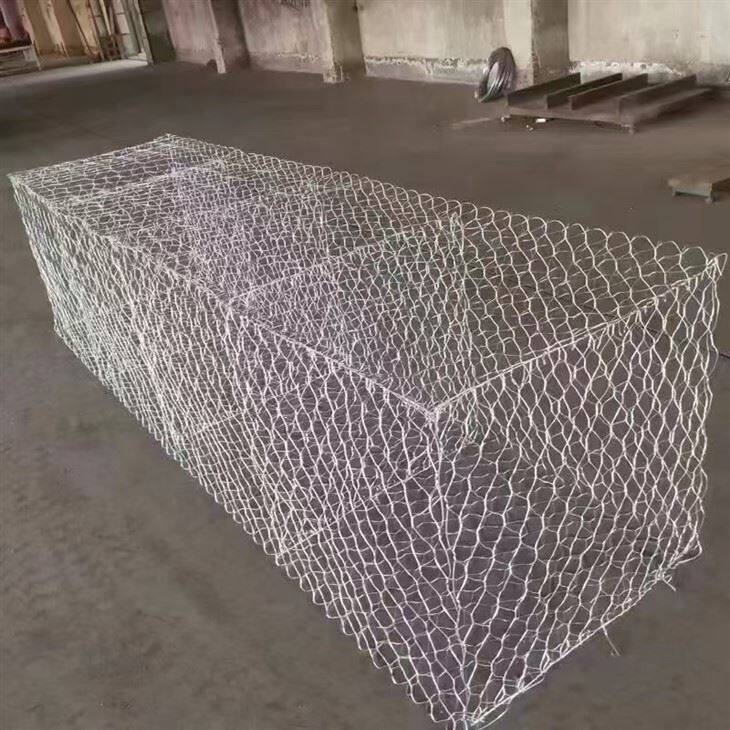
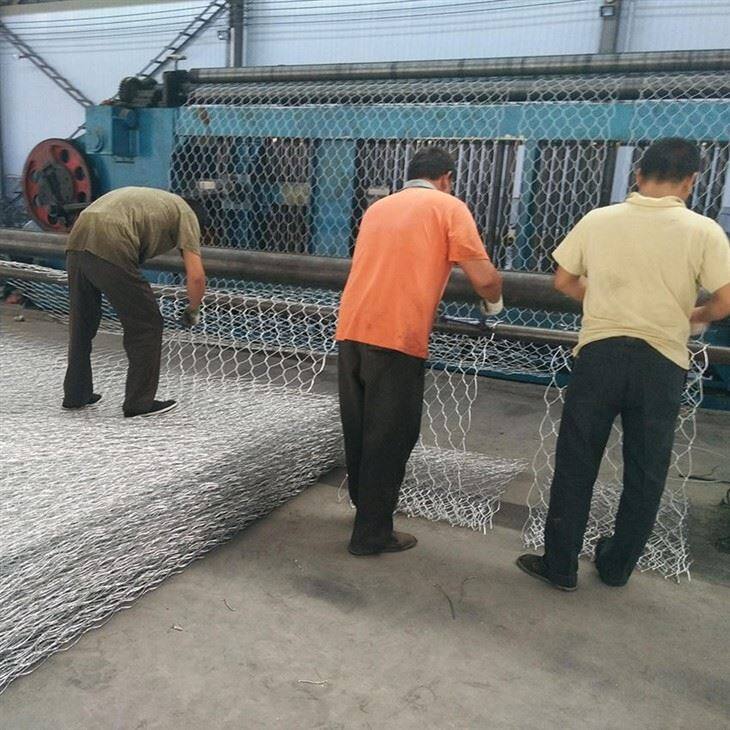
Gabion products are manufactured using galvanized or plastic-coated wire. The mesh is machine-woven, then manually cut, edged, and assembled with supporting panels. After folding and compressing the completed structure, the products are packaged and shipped according to specified requirements.
Applications of Gabion Cages
Gabion cages are widely used in civil engineering, hydraulic structures, transportation projects, and landscaping.
Their typical applications include:
Retaining walls for slope and earth stabilization
Erosion control along riverbanks, coastlines, and embankments
Channel lining and flood prevention in drainage systems
Sound barriers and privacy fences in urban environments
Landscaping features, such as garden walls, seating, and decorative elements
Bridge abutment protection and culvert support
Reinforcement of roads and railways in areas prone to landslides or subsidence
Construction Picture


Installation
Installation of Gabion Cage
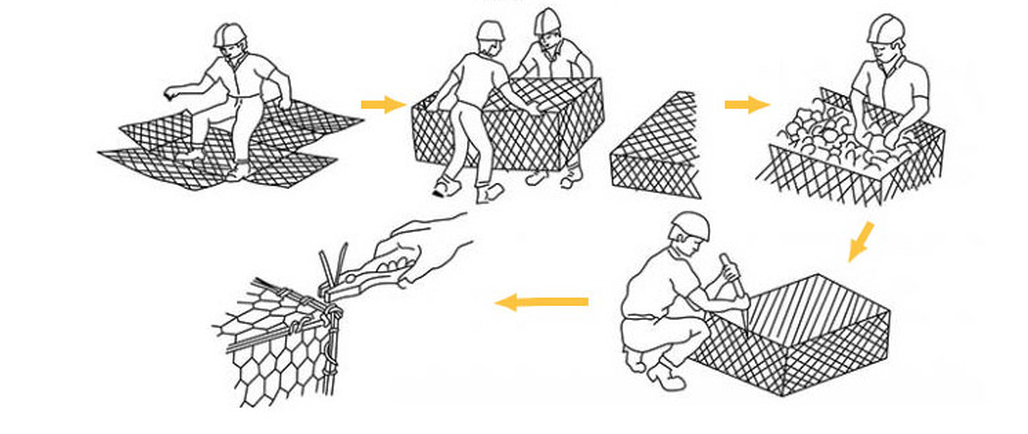
Gabion cage units are easy and efficient to install. CHG METAL offers complete installation services, including the construction of full retaining wall systems. During assembly, gabion wire cages are connected using high-tensile lacing wire. When stacking multiple layers, internal connecting wires-also made of lacing wire-secure the exposed face of one cell to the opposite side, ensuring structural integrity across all levels.
Gabion Cage Assembly Guide:
Step 1: Packing
Gabion mesh units are pre-collapsed and palletized for easy handling, transportation, and storage.
Step 2: Unfolding
Remove the packaging and fully unfold each gabion basket panel.
Step 3: Assembling
Erect each panel into a rectangular cage and align the corners. Secure adjacent panels by tying the edges with binding wire.
Lacing Procedure:
Cut a lacing wire approximately 1.5 times the length to be joined (maximum length: 1.65 meters).
Anchor one end by looping and twisting it securely at a corner.
Lace the joint using single or double loops spaced at approximately 100 mm intervals.
Firmly secure the opposite terminal end to complete the connection.
Step 4: Stone Selection
Select rigid, breakage-resistant stones ranging in size from 75 mm to 250 mm.
Place larger stones along the outer edges and especially on the exposed front face, where they will absorb the most impact. Smaller stones can be used at the base or to fill internal gaps. All stones should be clean, angular, and suitable for structural filling.
Step 5: Filling the Cage
Carefully fill the gabion cage with the selected stones.
Position larger stones around the sides and front to bear external forces.
Use smaller stones in the center and at the bottom to ensure compact filling.
Install internal bracing wires in both directions every 12 inches (approx. 30 cm) to maintain the shape and structural integrity of the cage.
Use double-twisted lacing wire to tie opposite sides of the gabion cage at 1/3 and 2/3 of the height, ensuring added stability during and after filling.
Slightly overfill the cage by about 50 mm to account for natural settling over time.
Step 6: Lid Closure
Stretch the lid tightly across the top of the filled gabion cage.
Ensure all four edge wires of the lid fully overlap with the top edges of the side panels.
Secure the lid using lacing wire, applying the same looping and twisting method used during assembly.
Once properly closed and fastened, the gabion cage is complete and ready for installation in retaining walls, erosion control structures, or other civil applications.


FAQ
Q: 1. What is Gabion Mesh?
A: Gabion mesh is a structure made of hexagonal woven wire mesh, usually filled with stones or gravel. It is widely used in civil and environmental engineering for erosion control, slope stabilization, and retaining structures. Its flexibility, permeability, and durability make it ideal for rivers, roads, and landscaping.
Q: 2. Types of Gabion Mesh
A: Hexagonal Woven Gabion: The most common type, flexible and suitable for uneven terrain. Welded Gabion Box: Flat surface and rigid structure, often used in architectural and landscaping applications. Gabion Mattress (Reno Mattress): Thinner height, used for riverbed and bank toe protection. Surface Coatings: Available in galvanized, PVC-coated, or Galfan-coated (zinc-aluminum alloy) wire for corrosion resistance.
Q: 3. Applications of Gabion Mesh
A: Riverbanks, reservoirs, and coastal erosion control Slope stabilization and landslide protection Highway and railway embankment reinforcement Bridge abutment and culvert protection Garden retaining walls and landscape decoration Military and noise barrier walls (e.g., Hesco barriers)
Q: 4. Gabion Mesh Production Process
A: Wire Preparation: Drawing, galvanizing, or PVC coating of low-carbon steel wire Mesh Weaving: Hexagonal mesh is woven by specialized machines Cutting & Forming: Cut to size and folded into panels for box formation Edge Binding & Reinforcement: Manual or machine twisted edges for added strength Quality Inspection: Tests for mesh size, tensile strength, coating thickness, and anti-corrosion Packing & Shipping: Folded and bundled, typically shipped with pallets or wooden crates
Q: 5. Which is better for gabion boxes: hand-twisted edges or machine-twisted edges?
A: Hand-twisted edges have tighter knots and provide a stronger structure, making them ideal for projects with high durability and load requirements, especially in harsh environments. However, they come with higher costs and longer production times. Machine-twisted edges offer higher production efficiency and lower costs, suitable for large-volume projects with moderate strength needs, though their strength and durability are slightly lower than hand-twisted edges. If your project demands high strength and durability, hand-twisted edges are recommended. If cost and production speed are more important and the environmental conditions are less severe, machine-twisted edges are a more economical choice.


